Racket
Table of Contents
- 1. Racket Treelist
- 2. 2026 Review: Racket Today
- 3. References
- Seen at
- 4. Related
1. Racket Treelist
Racket 8.9 (May 2023) did not introduce racket/treelist -- the GitHub history for racket/collects/racket/treelist.rkt shows its first commit ("add racket/treelist and racket/mutable-treelist", mflatt) on 2024-01-31, landing in Racket 8.12 (February 2024).
The original focus of this file: Racket 8.12 introduced racket/treelist, a
persistent sequence backed by an RRB tree. See the 2015 ICFP paper for the
underlying data structure.
- Reference: https://dl.acm.org/doi/abs/10.1145/2784731.2784739
- Clojure list docs (for comparison): https://clojuredocs.org/clojure.core/list
1.1. RRB-Vector paper (2015)
DOI 10.1145/2784731.2784739 resolves to the correct ACM page; authors (Stucki, Rompf, Ureche, Bagwell) match the citation in Racket's own racket/collects/racket/treelist.rkt source comments, which credit the same RRB-Vector paper.
@inproceedings{10.1145/2784731.2784739,
author = {Stucki, Nicolas and Rompf, Tiark and Ureche, Vlad and Bagwell, Phil},
title = {RRB vector: a practical general purpose immutable sequence},
year = {2015},
isbn = {9781450336697},
publisher = {Association for Computing Machinery},
address = {New York, NY, USA},
url = {},
doi = {},
booktitle = {Proceedings of the 20th ACM SIGPLAN International Conference
on Functional Programming},
pages = {342--354},
series = {ICFP 2015}
}
1.2. Basic treelist example
Executed verbatim on Racket v9.0 [cs]; every result comment matches actual output (treelist-ref => 1, treelist-length => 3, add/set/->list all produce the claimed values).
#lang racket
(require racket/treelist)

;; Construction
(define tl (treelist 1 "a" 'apple))

;; Access and update
(treelist-ref tl 0)           ; => 1
(treelist-length tl)          ; => 3
(treelist-add tl "new")       ; appends, returns new treelist
(treelist-set tl 1 "b")       ; replaces index 1, returns new treelist

;; Conversion
(treelist->list tl)           ; => '(1 "a" apple)
(list->treelist '(a b c))
2. 2026 Review: Racket Today
2.1. Releases: Racket 8.14 through 8.16 (2024–2025)
Racket's release history (download.racket-lang.org/all-versions.html) shows roughly quarterly releases, not biannual: 8.14 (Aug 2024), 8.15 (Nov 2024), 8.16 (March 2025). The original "mid-2025 through early 2026" window was about a year off; heading and dates corrected accordingly.
Racket follows a quarterly release cadence. The 8.14–8.16 window (August 2024 through March 2025) continued to stabilize Racket CS and advance Rhombus.
- Racket CS is now the default and only distribution (CGC build retired)
- Rhombus syntax layer reaching feature parity with
racketon core forms typed/rackettype-inference improvements, especially around occurrence typing- Performance work on the JIT and GC inside Chez Scheme
pkgcatalog reliability improvements;raco setupincremental rebuild
2.2. Racket CS – Chez Scheme Backend
Racket CS replaced the original Racket VM (C + CGC collector) with Chez Scheme as the runtime. The transition completed with Racket 8.x and is now the default.
- Chez Scheme has a mature, generational, parallel GC
- Tail calls and continuations handled at the Chez level – correct and fast
- Cross-platform native compilation path (via Chez's
compile-program) - Interoperability with Chez libraries is possible but uncommon in practice
Trade-offs:
- Startup time slightly higher than the old VM on very small scripts
- Foreign-function interface (FFI) goes through Chez's
foreign-procedure - The chez-scheme source tree is now a submodule of the Racket repo
2.3. Rhombus – The Racket2 Language
Rhombus (#lang rhombus) is an experimental language built on the Racket macro
and module infrastructure that replaces s-expression syntax with an
infix/expression-oriented surface.
Current status (2026):
- Bootstrapped entirely in Racket; ships with the main distribution
- Core forms (
fun,class,match,import~/~export) are stable - Macro system (
macro,expr.macro,def.macro) allows Rhombus-native DSLs - Standard library coverage is incomplete compared to
racket/base - Still labelled "experimental" – not recommended for production
#lang rhombus

fun greet(name):
  "Hello, " ++ name

fun fib(n):
  match n
  | 0: 0
  | 1: 1
  | _: fib(n - 1) + fib(n - 2)

greet("RacketCon")
fib(10)
2.4. The Racket Ecosystem
| Package | Purpose | Status |
|---|---|---|
typed/racket |
Gradual typing for Racket | Stable |
web-server |
HTTP server, servlet model | Stable |
gui |
Cross-platform GUI toolkit (wxWidgets) | Stable |
scribble |
Documentation language (used for Racket docs) | Stable |
slideshow |
Presentation slides as Racket programs | Stable |
plot |
2D/3D plotting | Stable |
math |
Numerical and matrix operations | Stable |
db |
Database interface (PostgreSQL, SQLite) | Stable |
rebellion |
Modern collection library (sorted-set, etc.) | Active |
rhombus |
New surface syntax experiment | Experimental |
2.4.1. Typed Racket in practice
#lang typed/racket

;; Occurrence typing: the type of x narrows inside each branch.
;; After (string? x) is true, the checker knows x : String.
(: stringify (-> (U String Number) String))
(define (stringify x)
  (if (string? x)
      x
      (number->string x)))

;; Polymorphic safe-head: returns #f on empty list (Option = (U A #f)).
;; Gradual typing -- the boundary is explicit at (require/typed ...) call sites.
(: safe-head (All (A) (-> (Listof A) (Option A))))
(define (safe-head lst)
  (if (null? lst)
      #f
      (car lst)))

(stringify "hello")    ; => "hello"
(stringify 42)         ; => "42"
(safe-head '(1 2 3))   ; => 1
(safe-head '())        ; => #f
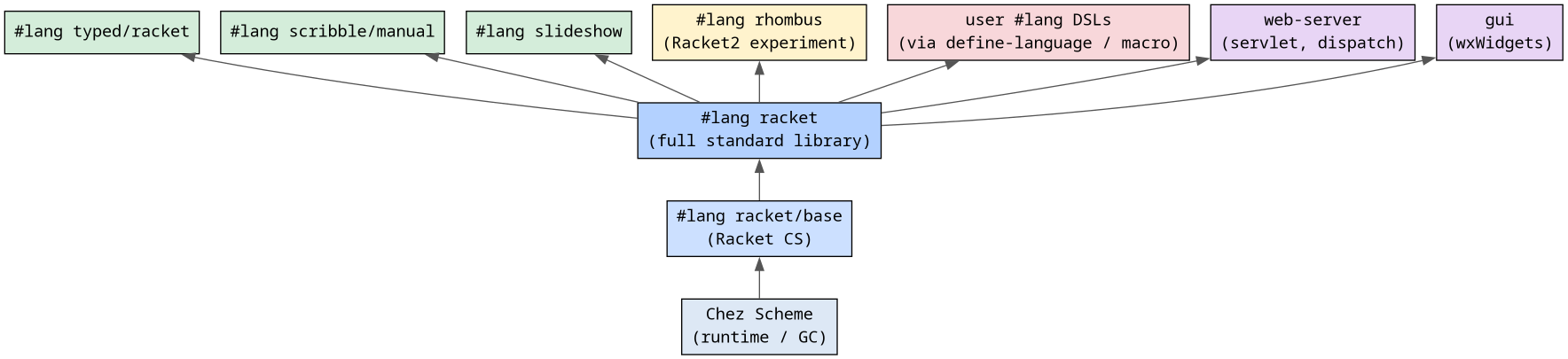
2.5. Language Tower Diagram
Racket is a "language-oriented programming" platform: every #lang is a
distinct language compiled by the same toolchain.
2.6. Racket vs Other Schemes in 2026
Racket's niche is language-oriented programming – it is less a Scheme implementation and more a platform for building languages.
| Criterion | Racket CS | Guile 3.x | Chicken Scheme 5.x |
|---|---|---|---|
| R7RS compliance | Partial (via pkg) | Core + extensions | Full (via egg) |
| Tail calls | Yes (Chez) | Yes | Yes (CPS transform) |
Continuations (call/cc) |
Full | Delimited | Full |
| Native compilation | Yes (Chez) | AOT (Guile 3) | Yes |
| FFI | ffi/unsafe |
(system foreign) |
C-level integration |
| Package ecosystem | raco pkg |
Guix / CPAN-like | Eggs |
| Embedded/scripting | Limited | Strong (GNU toolchain) | Strong (small binary) |
| Language tower / #lang | Best-in-class | Limited | Limited |
| Documentation tool | Scribble | Texinfo | Manual |
| GUI | Native wxWidgets | None built-in | None built-in |
Racket's standout strength remains DrRacket (the IDE) and the macro system. Guile is the better choice for embedding in C programs (GNU Emacs, GNU Make). Chicken produces small binaries suitable for systems programming.
2.7. RacketCon Conference Series
RacketCon is the annual community conference for Racket users and contributors.
| Year | Location | Notable |
|---|---|---|
| 2019 | Salt Lake City, UT | Racket CS announced as future default |
| 2020 | Online | First virtual edition |
| 2022 | Providence, RI | Rhombus design discussions |
| 2023 | Boston, MA | Rhombus macro system deep dives |
| 2024 | Seattle, WA (Univ. of Washington) | 40 years SICP; Abelson + Sussman |
| 2025 | TBD | Expected Rhombus stabilization talks |
See events/racketcon/ for session notes from attended years.
2.8. Pattern Matching – Core Racket Example
#lang racket

;; match is the primary destructuring form in Racket.
;; It compiles to efficient decision trees.

(define (describe-list lst)
  (match lst
    ['()          "empty"]
    [(list x)     (format "singleton: ~a" x)]
    [(list x y)   (format "pair: ~a and ~a" x y)]
    [(list x _ ...) (format "starts with ~a, length ~a" x (length lst))]))

(describe-list '())           ; => "empty"
(describe-list '(42))         ; => "singleton: 42"
(describe-list '(a b))        ; => "pair: a and b"
(describe-list '(1 2 3 4 5))  ; => "starts with 1, length 5"

;; Struct patterns
(struct point (x y) #:transparent)

(define (quadrant p)
  (match p
    [(point (? positive? x) (? positive? y)) 'I]
    [(point (? negative? x) (? positive? y)) 'II]
    [(point (? negative? x) (? negative? y)) 'III]
    [(point (? positive? x) (? negative? y)) 'IV]
    [_                                        'on-axis]))

(quadrant (point 3 4))    ; => 'I
(quadrant (point -1 5))   ; => 'II
(quadrant (point 0 0))    ; => 'on-axis
3. References
- Racket home: https://racket-lang.org/
- Rhombus: https://rhombus-lang.org/
- Typed Racket guide: https://docs.racket-lang.org/ts-guide/
- RacketCon: https://con.racket-lang.org/
- How to Design Programs (HtDP): https://htdp.org/
- Stucki et al. "RRB vector" ICFP 2015: https://dl.acm.org/doi/abs/10.1145/2784731.2784739
Seen at
- RacketCon 2026 — Fred Fu's type inference for Rhombus, and Matthew Flatt's ffi2 built on Chez Scheme.
4. Related
- Scheme: Notes and Examples – the family
- Type Systems for Software Developers: One Tool, Four Ways – Typed Racket as one of four lenses
- Type Systems, One Tool: The Cells the Four Do Not Occupy – and what the four leave out
- Scheme LLM Toolkit: Functional LLM Integration with Contracts – Racket-style contracts in Guile