Category Theory in Computing
Table of Contents
1. Introduction
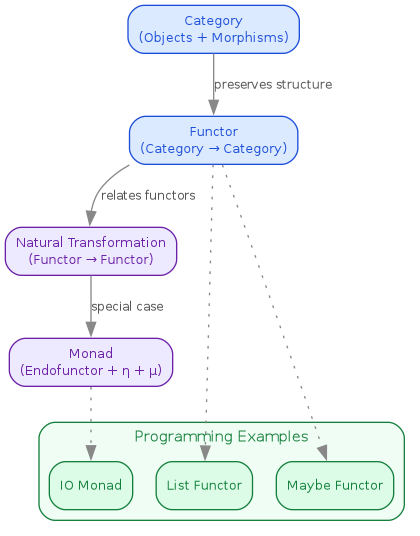
Category theory provides a unifying mathematical framework for understanding computation, types, and program structure through objects, morphisms, and their compositions (Lane 1971).
6. Implementation in Scheme
6.1. Category as Record
(define-record-type <category>
  (make-category objects morphisms compose identity)
  category?
  (objects category-objects)
  (morphisms category-morphisms)
  (compose category-compose)
  (identity category-identity))

(define-record-type <functor>
  (make-functor source target fmap)
  functor?
  (source functor-source)
  (target functor-target)
  (fmap functor-fmap))

(define (functor-map F f)
  "Apply functor F to morphism f"
  ((functor-fmap F) f))
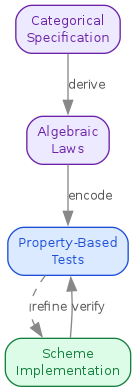
6.2. Verification Pattern
7. Applications
- Type systems (Hindley-Milner as adjunction) (Lambek and Scott 1986)
- Functional reactive programming
- Database query optimization
- Concurrent and distributed systems
- Effect systems and algebraic effects (Plotkin and Power 2003)