Deployment Systems: The Distributed Content Surface
Table of Contents
- 1. The distributed deployment surface
- 2. Deployment primitives (who is allowed to ship to the surface)
- 2.1. The auth wall: why an agent cannot reach a held-credential target
- 2.2. Claimable deployments as the inverted-authority primitive
- 2.3. wrangler as the agent-facing deploy verb
- 2.4. The two-target split is the design space, not a migration
- 2.5. Cost/observability as a primitive-selection criterion
- 3. Deployment verification (keeping the surface's agreements true)
- 4. The gaps every company has (a checklist)
- 5. Related
- 6. Reading list (to cite when fleshed out)
"Deployment" sounds like one build shipping to one host. It almost never is. At any company past its first month, the live experience is assembled from content that originates in many separately-owned systems — a CMS, a product catalog, an image library, a marketing tool, a pricing service — and is fanned out to many targets — the storefront, a CDN, a product feed for ads, an email platform, a status page. The central problem is not "can the build ship," it is keeping that distributed surface consistent, current, and verifiable.
1. The distributed deployment surface
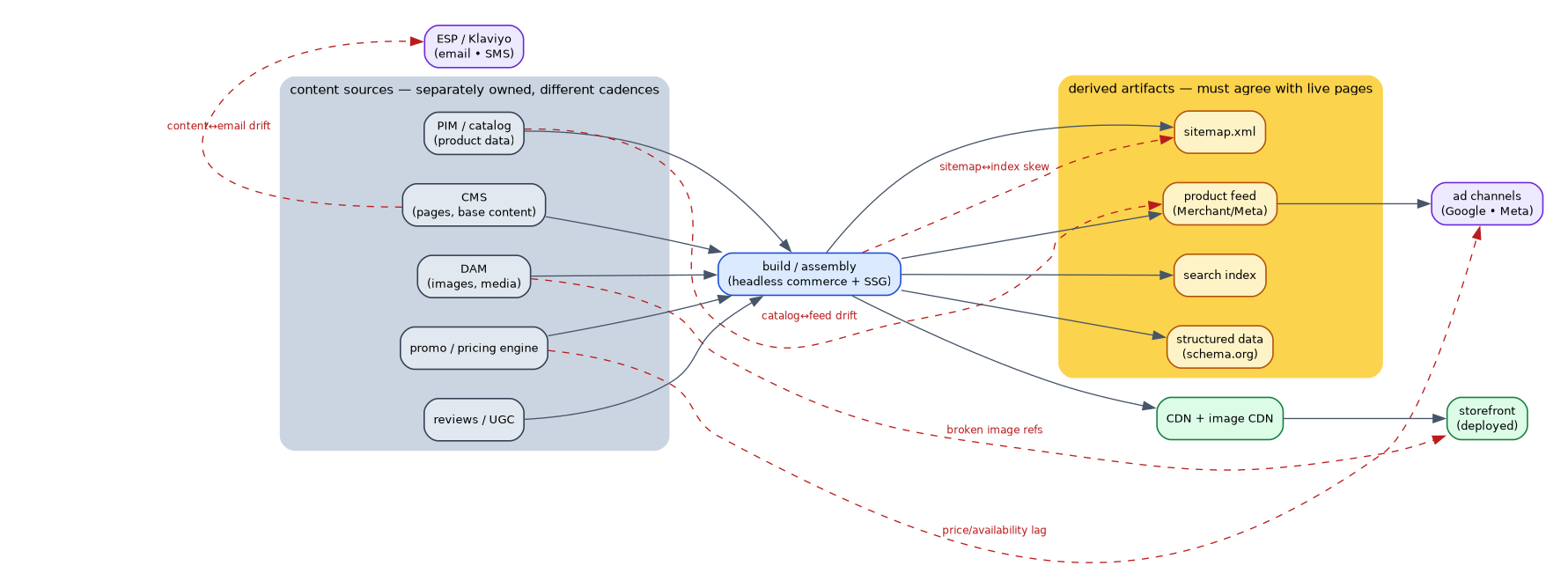
The recurring shape: N content sources to an assembly step to M derived artifacts to an edge to many consumers. Each source is owned by a different team or vendor, on a different release cadence. The derived artifacts (sitemap, product feed, search index, structured data, RSS) are the ones that must agree with the live pages — and the ones that quietly drift, because nothing owns the agreement.
1.1. A mid-size ecommerce company
Catalog lives in a PIM, pages in a CMS, media in a DAM, email/SMS in an ESP (Klaviyo), price in a promo engine. The build assembles them; the derived product feed drives Google/Meta ads; the storefront serves shoppers. The dashed red edges are the drifts every ecommerce team fights.
digraph ecomm_deploy_surface {
  rankdir=LR; bgcolor="white";
  graph [fontname="Helvetica", fontsize=11, nodesep=0.35, ranksep=0.9, pad=0.3];
  node  [fontname="Helvetica", fontsize=10, style="filled,rounded", shape=box, penwidth=1.2];
  edge  [fontname="Helvetica", fontsize=9, color="#475569"];

  subgraph cluster_src {
    label="content sources — separately owned, different cadences";
    color="#cbd5e1"; style="rounded,filled"; bgcolor="#f1f5f9"; fontsize=11;
    pim   [label="PIM / catalog\n(product data)",      fillcolor="#e2e8f0", color="#334155"];
    cms   [label="CMS\n(pages, base content)",         fillcolor="#e2e8f0", color="#334155"];
    dam   [label="DAM\n(images, media)",               fillcolor="#e2e8f0", color="#334155"];
    promo [label="promo / pricing engine",             fillcolor="#e2e8f0", color="#334155"];
    ugc   [label="reviews / UGC",                       fillcolor="#e2e8f0", color="#334155"];
  }

  build [label="build / assembly\n(headless commerce + SSG)", fillcolor="#dbeafe", color="#1d4ed8"];

  subgraph cluster_derived {
    label="derived artifacts — must agree with live pages";
    color="#fcd34d"; style="rounded,filled"; bgcolor="#fffbeb"; fontsize=11;
    sitemap [label="sitemap.xml",                fillcolor="#fef3c7", color="#b45309"];
    pfeed   [label="product feed\n(Merchant/Meta)", fillcolor="#fef3c7", color="#b45309"];
    search  [label="search index",               fillcolor="#fef3c7", color="#b45309"];
    sd      [label="structured data\n(schema.org)", fillcolor="#fef3c7", color="#b45309"];
  }

  cdn   [label="CDN + image CDN", fillcolor="#dcfce7", color="#15803d"];
  store [label="storefront\n(deployed)", fillcolor="#dcfce7", color="#15803d"];
  esp   [label="ESP / Klaviyo\n(email • SMS)", fillcolor="#ede9fe", color="#6d28d9"];
  ads   [label="ad channels\n(Google • Meta)", fillcolor="#ede9fe", color="#6d28d9"];

  pim -> build; cms -> build; dam -> build; promo -> build; ugc -> build;
  build -> sitemap; build -> pfeed; build -> search; build -> sd;
  build -> cdn -> store;
  pfeed -> ads;

  pim   -> pfeed [style=dashed, color="#b91c1c", fontcolor="#b91c1c", constraint=false, label="catalog↔feed drift"];
  dam   -> store [style=dashed, color="#b91c1c", fontcolor="#b91c1c", constraint=false, label="broken image refs"];
  build -> sitemap [style=dashed, color="#b91c1c", fontcolor="#b91c1c", label="sitemap↔index skew"];
  promo -> ads   [style=dashed, color="#b91c1c", fontcolor="#b91c1c", constraint=false, label="price/availability lag"];
  cms   -> esp   [style=dashed, color="#b91c1c", fontcolor="#b91c1c", constraint=false, label="content↔email drift"];
}
1.2. A mid-size fintech company
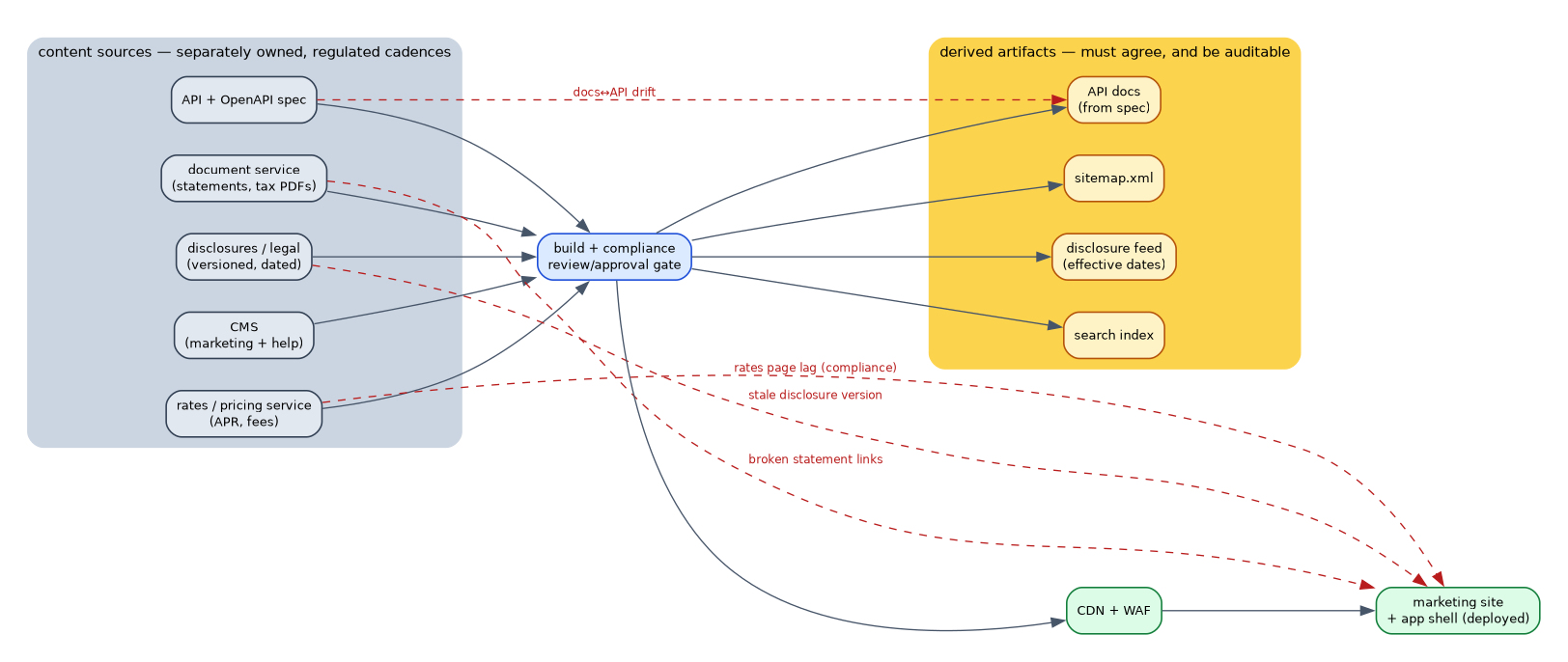
Same shape, higher stakes: a rates/pricing service feeds the public rates pages, disclosures and legal content carry version and effective-date obligations, statements/tax PDFs come from a document service, the public API has docs that must match the API. Here the drifts are not just bad UX — a rates page that lags the pricing service, or a stale disclosure, is a compliance event. The build gains a review/approval gate, and verification gains an audit trail.
digraph fintech_deploy_surface {
  rankdir=LR; bgcolor="white";
  graph [fontname="Helvetica", fontsize=11, nodesep=0.35, ranksep=0.9, pad=0.3];
  node  [fontname="Helvetica", fontsize=10, style="filled,rounded", shape=box, penwidth=1.2];
  edge  [fontname="Helvetica", fontsize=9, color="#475569"];

  subgraph cluster_src {
    label="content sources — separately owned, regulated cadences";
    color="#cbd5e1"; style="rounded,filled"; bgcolor="#f1f5f9"; fontsize=11;
    cms   [label="CMS\n(marketing + help)",         fillcolor="#e2e8f0", color="#334155"];
    rates [label="rates / pricing service\n(APR, fees)", fillcolor="#e2e8f0", color="#334155"];
    disc  [label="disclosures / legal\n(versioned, dated)", fillcolor="#e2e8f0", color="#334155"];
    docs  [label="document service\n(statements, tax PDFs)", fillcolor="#e2e8f0", color="#334155"];
    api   [label="API + OpenAPI spec",             fillcolor="#e2e8f0", color="#334155"];
  }

  gate  [label="build + compliance\nreview/approval gate", fillcolor="#dbeafe", color="#1d4ed8"];

  subgraph cluster_derived {
    label="derived artifacts — must agree, and be auditable";
    color="#fcd34d"; style="rounded,filled"; bgcolor="#fffbeb"; fontsize=11;
    sitemap [label="sitemap.xml",            fillcolor="#fef3c7", color="#b45309"];
    discfeed[label="disclosure feed\n(effective dates)", fillcolor="#fef3c7", color="#b45309"];
    search  [label="search index",           fillcolor="#fef3c7", color="#b45309"];
    apidocs [label="API docs\n(from spec)",  fillcolor="#fef3c7", color="#b45309"];
  }

  cdn   [label="CDN + WAF", fillcolor="#dcfce7", color="#15803d"];
  site  [label="marketing site\n+ app shell (deployed)", fillcolor="#dcfce7", color="#15803d"];

  cms -> gate; rates -> gate; disc -> gate; docs -> gate; api -> gate;
  gate -> sitemap; gate -> discfeed; gate -> search; gate -> apidocs;
  gate -> cdn -> site;

  rates -> site    [style=dashed, color="#b91c1c", fontcolor="#b91c1c", constraint=false, label="rates page lag (compliance)"];
  disc  -> site    [style=dashed, color="#b91c1c", fontcolor="#b91c1c", constraint=false, label="stale disclosure version"];
  docs  -> site    [style=dashed, color="#b91c1c", fontcolor="#b91c1c", constraint=false, label="broken statement links"];
  api   -> apidocs [style=dashed, color="#b91c1c", fontcolor="#b91c1c", label="docs↔API drift"];
}
1.3. Why the gaps are universal
Across both diagrams the same failure modes recur, and none of them is anyone's explicit job because each lives between two systems:
- Source and derived drift — the catalog says one price, the product feed (and the ad built from it) says another; the API changes, the docs do not.
- Sitemap and live skew — URLs in the sitemap that 404, or live pages absent from it; the same applies to the search index.
- Asset reachability — image/PDF references that resolve in the source but break on the edge (DAM path change, never-deleted orphan).
- Partial / out-of-band deploy — one channel updates (a single page, a feed) while a version stamp says everything is current; the stamp certifies a broken state.
- Marketing-tool divergence — the ESP (Klaviyo) or ad channel keeps consuming a feed snapshot that no longer matches the live catalog or price.
The distributed nature is the cause: each artifact is produced by a different step, on a different clock, and the agreement between them is what nobody owns.
2. Deployment primitives (who is allowed to ship to the surface)
2.1. The auth wall: why an agent cannot reach a held-credential target
The conventional path — publishing over a held SSH session to a single host — is structurally agent-hostile: deploy authority is a long-lived, broadly-scoped credential, so an autonomous agent either cannot deploy at all or must be handed standing access far broader than the task needs. Across a distributed surface this multiplies: each source/target (CMS, feed endpoint, CDN purge, ESP API) is its own credential, and "let the agent deploy" quietly means "hand the agent every key."
Refutation: false if an SSH/API deploy can be scoped to a single per-run, write-only, short-TTL credential the agent never persists — i.e. if the held-credential property is removable without changing the transport.
Open questions:
- Can each target issue a per-deploy, forced-command, single-path key with a blast-radius profile as bounded as proxy injection?
- Is the wall the credential, or the interactive/stateful session model of the transport?
- How much of the publish gate exists precisely because no one trusts the agent with the key?
2.2. Claimable deployments as the inverted-authority primitive
Direct fetch of Cloudflare's primary docs (developers.cloudflare.com/workers/platform/claim-deployments/ and the 2026-06-19 changelog post) confirms the model as described: an unauthenticated =wrangler deploy --temporary= run provisions a throwaway account with an ephemeral token and returns a live Worker URL plus a claim URL; "the intended user must complete the claim within 60 minutes" (exact match for this note's "TTL (60 min observed)"); claiming is done entirely by a human who opens the claim URL and signs in or creates an account -- the agent holds no token scoped to the durable account at any point, so the refutation condition (claiming requiring agent-held durable credentials) does not hold.
The Cloudflare temporary-account + claim-deployments model inverts deploy authority: the agent deploys into a throwaway namespace with an ephemeral token and a human later claims the result into a durable account, so the agent never holds the production credential — the same credential-provenance shape the cloudflare-agents note identifies for egress-proxy injection.
Refutation: false if claiming still requires the agent to hold a token scoped to the durable account, or if the temporary account can mutate already-claimed production state — then it is held authority with extra steps, not inversion.
Confirmed (2026-10-08, same primary-source fetch as the drawer above): claim-deployments
is workers.dev-only — Cloudflare's docs name no custom-domain path, apex or
subdomain, for a temporary account.
Open questions:
- Does an unclaimed deployment's TTL (60 min observed) survive the human-in-loop review a publish gate implies?
- Can the claim primitive wrap static site output, or does it presuppose a Worker/Pages build?
2.3. wrangler as the agent-facing deploy verb
Direct fetch of Cloudflare's Wrangler system-environment-variables docs confirms the env-token claim: =CLOUDFLARE_API_TOKEN= is documented "for situations like CI/CD, and other automation," and when =CLOUDFLARE_ACCESS_CLIENT_ID=/=CLOUDFLARE_ACCESS_CLIENT_SECRET= are both set, "Wrangler authenticates using the service token instead of launching =cloudflared access login=" -- i.e. the browser-OAuth path is documented as avoidable in headless/CI contexts, so this note's refutation condition does not hold.
wrangler is a better agent deploy verb than a held-SSH push: headless,
idempotent, returns a structured deployment URL the agent can hand straight to a
validation gate, and takes its token via env rather than an interactive session —
closing the observe-after-deploy loop a separate liveness check otherwise leaves
open.
Refutation: false if wrangler's browser-OAuth auth cannot be fully replaced by
a non-interactive scoped token (the failure mode to avoid is an interactive
"Select an account" prompt in a headless run), or if its output yields no
deterministic post-deploy verification URL.
Open questions:
- Does an API-token-based deploy work with no browser-OAuth fallback in a sandboxed agent?
- Can an external validation gate consume the emitted preview URL directly, or does it still assume the apex?
- Is there a
deploy --dry-rundiff for intent self-check before spending the deploy?
2.4. The two-target split is the design space, not a migration
The right 2026 primitive is not one-target-replaces-the-other but a deliberate split: agents own credential-less ephemeral targets (preview/claimable, blast-radius-bounded); the durable apex stays human-gated; promotion across the boundary is the only privileged step. On a distributed surface the "target" is not one site but a set — storefront, feed endpoint, CDN, ESP — and the split is per artifact: an agent may regenerate a preview product feed freely; promoting it to the one ad channel consumes is the gated step.
Refutation: false if two targets cost more in drift (content/sitemap/canonical skew) than the security gain, or if a single target can be made human-gated cleanly enough to retire the other without losing the inversion property.
Open questions:
- What is the promotion artifact — a claimed deployment, a source ref, or a content hash — and who signs it?
- Does preview-on-one-target + prod-on-another reintroduce the canonical / duplicate-URL problem?
- Is egress-proxy credential injection a third option that makes even the durable target agent-reachable without a held credential?
2.5. Cost/observability as a primitive-selection criterion
Direct fetch of Cloudflare's Containers pricing docs confirms the billing mechanic behind "active-CPU billing": "CPU usage is based on active usage only," and "charges stop after the container instance goes to sleep." Cloudflare's own docs don't use the exact phrase "active-CPU" (that term appears in the sibling [[file:../2026-q2-cloudflare-agents/index.org][cloudflare-agents]] note's own paraphrase of Sandbox GA), but the mechanic this note attributes to it -- a deploy as a discrete, attributable billing event rather than flat-rate always-on spend -- matches the docs.
Deploy-primitive choice is coupled to telemetry: a credential-less ephemeral target makes per-deploy cost and per-agent attribution natural (active-CPU billing; a deploy is a discrete claimable event), where a flat-rate always-on host makes agent-driven deploy spend invisible — so the telemetry posture should extend to deploy actions, not just inference.
Refutation: false if deploy cost is negligible beside inference cost, or if the platform's billing granularity does not expose per-deployment cost.
3. Deployment verification (keeping the surface's agreements true)
3.1. Version-stamp reconciliation as the liveness oracle
A single live-vs-source comparison — the deployed version-stamp against the source HEAD — is the cheapest sufficient signal a deploy propagated, and generalizes across targets. On a distributed surface there is rarely one stamp; each artifact (storefront, feed, search index) needs its own, and the real check is that they agree — one stamp current and another stale is exactly the source and derived drift.
Refutation: false if a deploy can serve stale/partial content while the version-stamp already reports HEAD — if the stamp is uploaded out-of-band, its freshness does not entail page freshness; a matching stamp would then certify a broken deploy. (Seen: a single-file publish ships a page without bumping the stamp.)
Open questions:
- Should the version-stamp be content-addressed over the deployed tree so a match implies page freshness?
- Does each artifact (feed, sitemap, search) need its own version marker?
- What stamp should a partial single-channel publish report?
3.2. Pre-deploy alignment check
A static pre-deploy validation pass over the about-to-publish tree can pre-empt the recurring failures before they ship — a link or index entry with no target ("404-in-index"), a page whose slug collides with a same-named directory ("403 directory-collision"), a product/feed row referencing an image the DAM no longer serves, a sitemap URL with no page — by checking statically that every internal reference resolves and every derived artifact agrees with its source.
Refutation: false if the failures are server-emergent, not tree-derivable — the 403 arises from the web server's directory-vs-file resolution and the 404 from publish's upload-only (never-delete) semantics leaving orphans the local tree cannot see.
Open questions:
- Can the source parse map resolve link/asset/heading targets, or does include-relative resolution need its own pass?
- Model the server's rewrite rules, or just flag any loose file sharing a basename with a sibling directory?
- Is upload-only orphan drift detectable pre-deploy, or only via a post-deploy server-side listing diff?
3.3. An external black-box gate
An external HTTP + browser grind is the only check that exercises the deployed artifact the way a reader (or a feed consumer) does, and must stay authoritative over any internal check because it needs no privileged access and sees server-state failures the tree cannot — a 404 on a live URL, an image that 200s but is the wrong asset, a feed that parses but lists a discontinued SKU.
Refutation: false if the grind is too slow/flaky to gate every deploy (a browser leg may not be CI-stable), forcing un-gated deploys — a routinely skipped gate provides no assurance.
Open questions:
- What is the runtime budget for a full URL-inventory grind at catalog scale?
- Should it cross-reference the deployed stamp so a stale edge is a content-currency failure?
- Promote the cheap HTTP harness to a hard gate while the browser leg stays advisory?
3.4. Rollback as a first-class verified operation
Because deploy is often forward-only (publish overwrites; no rollback path), a verified rollback is re-publishing a prior source ref and re-running the same version-stamp + black-box gate — so rollback is best modeled as a normal deploy of an older ref, not a distinct mechanism. On a distributed surface, rollback is multi-artifact: rolling the storefront back without rolling the product feed and the ESP snapshot leaves a worse hybrid than the bug did.
Refutation: false if forward re-publishing cannot restore prior state — upload-only semantics leave deleted files un-removed, and an ephemeral target versions independently of the source, so deploying an older ref leaves a hybrid state the gate might still pass.
Open questions:
- Does rollback need an explicit server-side orphan-cleanup step to be sound?
- How are multiple artifacts rolled back atomically across different clocks (a source ref vs a feed snapshot vs a deployment id)?
- Should the verification trail record rollbacks as their own entry?
3.5. Cost-aware gating: keep the deploy gate deterministic and LLM-free
Deployment verification must stay deterministic and LLM-free — HTTP checks, JSON/XML/feed validation, a static tree check — so gating every deploy costs no per-run LLM spend, consistent with the llm-cost-monitoring concerns.
Refutation: false if some necessary check (semantic content-currency, "does this disclosure say what legal approved") genuinely needs an LLM judgement no deterministic check approximates — then a free gate is unsound and the cost is a required line item.
4. The gaps every company has (a checklist)
Independent of stack, these are the agreements a deployment system should be proving — and the ones most pipelines leave to chance:
- No centralized validation orchestrator. Checks scatter across separate tools (link check, feed validator, image audit, sitemap diff); no single entrypoint that fails closed before promote.
- Sitemap and search-index and live drift. Three views of "what pages exist" that are generated separately and rarely reconciled.
- Source and derived feed drift. The catalog/CMS/rates service and the product feed / disclosure feed / API docs generated from it, diverging silently.
- Asset reachability. Image/PDF references never audited for resolution or for orphans after a DAM/path change.
- Out-of-band / partial deploy. A single channel updated while a version stamp claims the whole surface is current.
- Marketing/channel divergence. ESP (Klaviyo) and ad channels consuming a feed snapshot that no longer matches the live catalog, price, or availability.
- No deployment telemetry record. Verification expects deployed metadata (per-artifact stamp, content hash) that nothing emits or validates.
5. Related
- Agent Telemetry Systems — observing deploy actions, not just inference
- Cloudflare Agents Week 2026
- Agent Sandbox Systems — the credential-boundary kin
- Team Topologies for the Agentic Platform — who owns the surface
- LLM Cost / LLM Cost Monitoring
- Harness Flagship 2026 — feature-flag/release framing
6. Reading list (to cite when fleshed out)
- Cloudflare Docs — "Claim a deployment / temporary accounts" (developers.cloudflare.com, 2026)
- Cloudflare Docs — "Sandbox SDK egress proxy + credential injection" (2026)
- sitemaps.org protocol; schema.org structured-data vocabulary
- Google Merchant Center / Meta Commerce product-feed specifications
- OpenGuard — "The webpage has instructions, the agent has your credentials" (2025)
- Humble & Farley — Continuous Delivery (pipeline, automated gates, rollback)
- Beyer et al. — Site Reliability Engineering (release engineering, canarying)