The Evolution of Large Language Models and AI Agent Frameworks
Table of Contents
- 1. LLM, Agent, and Flow Control Frameworks
- 2. Year-by-Year Overview of LLM and Agent Technologies
- 2.1. 2020: Foundations of Generative AI
- 2.2. 2021: Educational Resources and Beginner-Friendly Content
- 2.3. 2022: Data Frameworks and Retrieval-Augmented Generation
- 2.4. 2023: Agent Frameworks, Workflows, and LLM Integration
- 2.5. 2024 (Early): Efficiency, Specialized Applications, and Open-Source Models
- 3. Evolution of LLM and Agent Technologies (2009-2024)
- 3.1. 2009-2010: Foundations of Natural Language Processing
- 3.2. 2011-2012: Advancements in Machine Learning
- 3.3. 2013-2014: Rise of Deep Learning in NLP
- 3.4. 2015-2016: Attention Mechanisms and Neural Machine Translation
- 3.5. 2017-2018: Transformer Architecture and BERT
- 3.6. 2019-2020: GPT Models and Few-Shot Learning
- 3.7. 2021: Scaling Language Models and Ethical Considerations
- 3.8. 2022: Emergence of Specialized LLM Frameworks
- 3.9. 2023: Agent Frameworks and LLM Integration
- 3.10. 2024 (Early): Efficiency and Specialized Applications
1. LLM, Agent, and Flow Control Frameworks
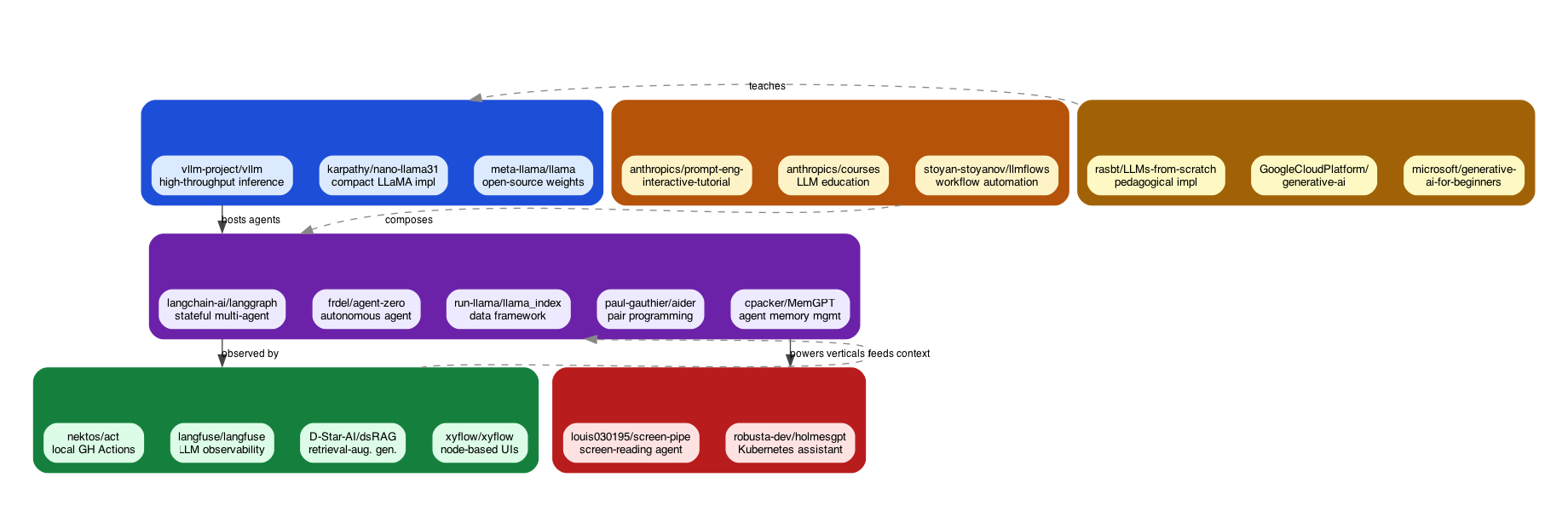
Figure 1: Six-category taxonomy of the LLM and AI agent framework landscape, with dependency arrows showing how substrate models, agents, flow control, integration tooling, research repos, and specialized assistants relate.
1.1. Large Language Models
1.1.1. vllm-project/vllm
- High-throughput and memory-efficient inference for LLMs
- Last updated: 5 minutes ago
1.1.2. karpathy/nano-llama31
- Compact implementation of LLaMA-like language model
- Last updated: 1 minutes ago
1.1.3. meta-llama/llama
- Open source LLM from Meta
- Last updated: 14 minutes ago
1.2. Agent Development
1.2.1. langchain-ai/langgraph
- Framework for building stateful, multi-agent workflows
- Last updated: 3 minutes ago
1.2.2. frdel/agent-zero
- Autonomous AI agent framework
- Last updated: 13 minutes ago
1.2.3. run-llama/llama_index
- Data framework for LLM applications
- Last updated: 42 minutes ago
1.2.4. paul-gauthier/aider
- AI pair programming in your terminal
- Last updated: 2 minutes ago
1.2.5. cpacker/MemGPT
- Memory management for AI agents
- Last updated: 31 minutes ago
1.3. Flow Control and Orchestration
1.3.1. nektos/act
- Run GitHub Actions locally
- Last updated: 38 minutes ago
1.3.2. langfuse/langfuse
- Open source observability and analytics for LLM applications
- Last updated: 26 minutes ago
1.3.3. D-Star-AI/dsRAG
- Retrieval-augmented generation framework
- Last updated: 6 hours ago
1.3.4. xyflow/xyflow
- Library for building node-based UIs
- Last updated: 42 minutes ago
1.4. LLM Integration and Tooling
1.4.1. anthropics/prompt-eng-interactive-tutorial
- Interactive tutorial for prompt engineering
- Last updated: 56 minutes ago
1.4.2. anthropics/courses
- Educational content for working with LLMs
- Last updated: 2 hours ago
1.4.3. stoyan-stoyanov/llmflows
- Workflow automation with LLMs
- Last updated: 11 hours ago
1.5. Research and Tutorials
1.5.1. rasbt/LLMs-from-scratch
- Implementations of LLMs from scratch
- Last updated: 6 minutes ago
1.5.2. GoogleCloudPlatform/generative-ai
- Generative AI examples and resources
- Last updated: 3 minutes ago
1.5.3. microsoft/generative-ai-for-beginners
- Beginner's course on generative AI
- Last updated: 37 minutes ago
1.6. Miscellaneous Tools
1.6.1. louis030195/screen-pipe
- AI assistant that reads your screen
- Last updated: 7 minutes ago
1.6.2. robusta-dev/holmesgpt
- AI-powered Kubernetes assistant
- Last updated: 8 hours ago
2. Year-by-Year Overview of LLM and Agent Technologies
2.1. 2020: Foundations of Generative AI
2.1.1. Key Developments:
- Introduction of generative AI concepts and applications
- Beginning of educational content for working with LLMs
2.1.2. Active Repositories:
- GoogleCloudPlatform/generative-ai
2.2. 2021: Educational Resources and Beginner-Friendly Content
2.2.1. Key Developments:
- Creation of courses and tutorials for LLM usage
- Focus on making generative AI accessible to beginners
2.2.2. Active Repositories:
- anthropics/courses
- microsoft/generative-ai-for-beginners
2.3. 2022: Data Frameworks and Retrieval-Augmented Generation
2.3.1. Key Developments:
- Development of frameworks for LLM-powered applications
- Emergence of retrieval-augmented generation (RAG) techniques
2.3.2. Active Repositories:
- run-llama/llama_index
- D-Star-AI/dsRAG
2.4. 2023: Agent Frameworks, Workflows, and LLM Integration
2.4.1. Key Developments:
- Creation of frameworks for building AI agents and workflows
- Tools for LLM observability and analytics
- Integration of LLMs into development workflows
2.4.2. Active Repositories:
- langchain-ai/langgraph
- frdel/agent-zero
- langfuse/langfuse
- xyflow/xyflow
- paul-gauthier/aider
2.5. 2024 (Early): Efficiency, Specialized Applications, and Open-Source Models
2.5.1. Key Developments:
- Focus on efficient LLM inference and deployment
- Development of specialized AI assistants
- Release of open-source large language models
- Exploration of memory management for AI agents
2.5.2. Active Repositories:
- vllm-project/vllm
- karpathy/nano-llama31
- meta-llama/llama
- cpacker/MemGPT
- louis030195/screen-pipe
- robusta-dev/holmesgpt
3. Evolution of LLM and Agent Technologies (2009-2024)
3.1. 2009-2010: Foundations of Natural Language Processing
- Early work on language models and processing
- Limited focus on "large" models by today's standards
3.1.1. Notable Repositories:
- None from the given list (predates most LLM work)
3.2. 2011-2012: Advancements in Machine Learning
- Growing interest in neural networks for NLP
- Emergence of deep learning techniques
3.2.1. Notable Repositories:
- None from the given list (predates most LLM work)
3.3. 2013-2014: Rise of Deep Learning in NLP
- Word embeddings become popular (e.g., word2vec)
- Sequence-to-sequence models gain traction
3.3.1. Notable Repositories:
- None from the given list (predates most LLM work)
3.4. 2015-2016: Attention Mechanisms and Neural Machine Translation
- Introduction of attention mechanisms
- Improvements in machine translation using neural networks
3.4.1. Notable Repositories:
- None from the given list (predates most LLM work)
3.5. 2017-2018: Transformer Architecture and BERT
- Introduction of the Transformer architecture
- BERT and other pre-trained language models emerge
3.5.1. Notable Repositories:
- None from the given list (major breakthroughs, but specific repos not listed)
3.6. 2019-2020: GPT Models and Few-Shot Learning
- GPT-2 and GPT-3 demonstrate impressive language generation
- Increased focus on few-shot and zero-shot learning
3.6.1. Notable Repositories:
- GoogleCloudPlatform/generative-ai: Early examples of generative AI applications
3.7. 2021: Scaling Language Models and Ethical Considerations
- Larger models like GPT-3 become more accessible
- Increased discussion on AI ethics and bias in language models
3.7.1. Notable Repositories:
- anthropics/courses: Educational content for working with LLMs
- microsoft/generative-ai-for-beginners: Beginner's course on generative AI
3.8. 2022: Emergence of Specialized LLM Frameworks
- Development of tools for efficient LLM deployment and use
- Focus on retrieval-augmented generation (RAG) techniques
3.8.1. Notable Repositories:
- run-llama/llama_index: Data framework for LLM applications
- D-Star-AI/dsRAG: Retrieval-augmented generation framework
3.9. 2023: Agent Frameworks and LLM Integration
- Growing interest in autonomous AI agents
- Development of tools for LLM observability and flow control
3.9.1. Notable Repositories:
- langchain-ai/langgraph: Framework for building stateful, multi-agent workflows
- frdel/agent-zero: Autonomous AI agent framework
- langfuse/langfuse: Observability and analytics for LLM applications
- xyflow/xyflow: Library for building node-based UIs
- paul-gauthier/aider: AI pair programming in your terminal
3.10. 2024 (Early): Efficiency and Specialized Applications
- Focus on efficient LLM inference and deployment
- Exploration of LLMs in specialized domains
3.10.1. Notable Repositories:
- vllm-project/vllm: High-throughput and memory-efficient inference for LLMs
- karpathy/nano-llama31: Compact implementation of LLaMA-like language model
- meta-llama/llama: Open source LLM from Meta
- cpacker/MemGPT: Memory management for AI agents
- louis030195/screen-pipe: AI assistant that reads your screen
- robusta-dev/holmesgpt: AI-powered Kubernetes assistant