The Evolution of Large Language Models and AI Agent Frameworks
Table of Contents
- 1. LLM, Agent, and Flow Control Frameworks
- 2. Year-by-Year Overview of LLM and Agent Technologies
- 2.1. 2020: Foundations of Generative AI
- 2.2. 2021: Educational Resources and Beginner-Friendly Content
- 2.3. 2022: Data Frameworks and Retrieval-Augmented Generation
- 2.4. 2023: Agent Frameworks, Workflows, and LLM Integration
- 2.5. 2024 (Early): Efficiency, Specialized Applications, and Open-Source Models
- 3. Evolution of LLM and Agent Technologies (2009-2024)
- 3.1. 2009-2010: Foundations of Natural Language Processing
- 3.2. 2011-2012: Advancements in Machine Learning
- 3.3. 2013-2014: Rise of Deep Learning in NLP
- 3.4. 2015-2016: Attention Mechanisms and Neural Machine Translation
- 3.5. 2017-2018: Transformer Architecture and BERT
- 3.6. 2019-2020: GPT Models and Few-Shot Learning
- 3.7. 2021: Scaling Language Models and Ethical Considerations
- 3.8. 2022: Emergence of Specialized LLM Frameworks
- 3.9. 2023: Agent Frameworks and LLM Integration
- 3.10. 2024 (Early): Efficiency and Specialized Applications
1. LLM, Agent, and Flow Control Frameworks
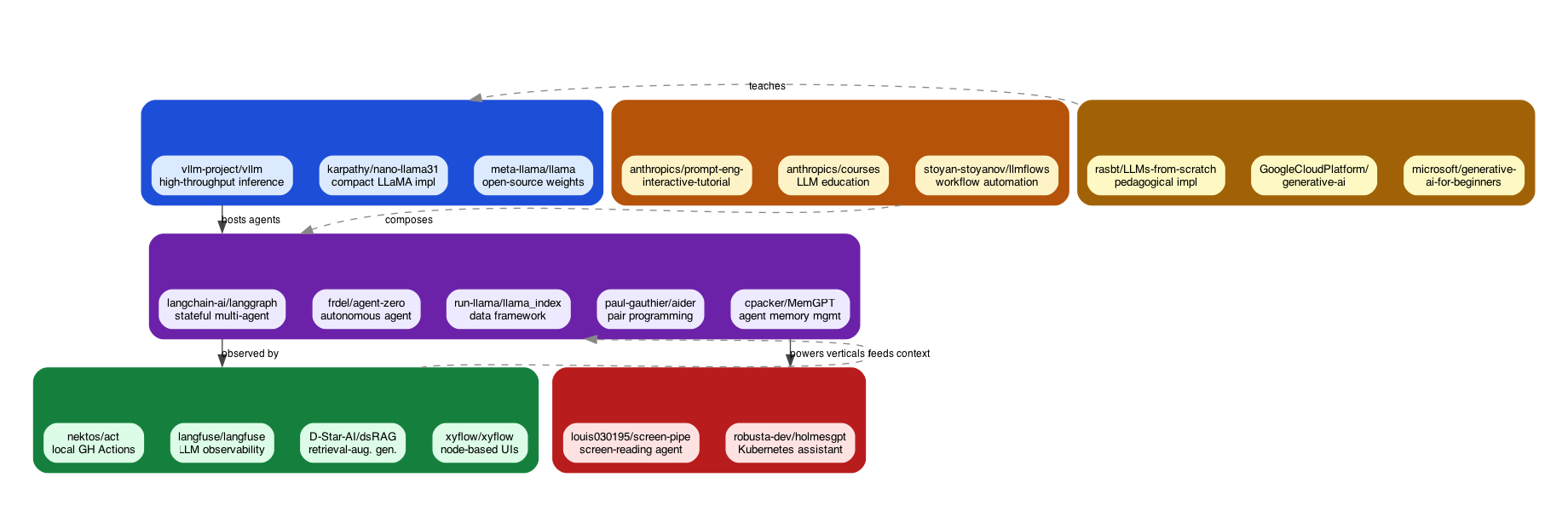
1.1. Large Language Models
1.1.1. vllm-project/vllm
- High-throughput and memory-efficient inference for LLMs
- Last updated: 5 minutes ago
1.1.2. karpathy/nano-llama31
No GitHub repo "karpathy/nano-llama31" is found (404; no Wayback Machine snapshot either) — the closest karpathy repo is llama2.c (created 2023-07-23). The claimed name references Llama 3.1, which Meta released 2024-07-23, seven months after this note's 2024-01-01 date, so the entry is anachronistic as listed regardless of whether it ever existed under a different owner.
- Compact implementation of LLaMA-like language model
- Last updated: 1 minutes ago
1.1.3. meta-llama/llama
- Open source LLM from Meta
- Last updated: 14 minutes ago
1.2. Agent Development
1.2.1. langchain-ai/langgraph
- Framework for building stateful, multi-agent workflows
- Last updated: 3 minutes ago
1.2.2. frdel/agent-zero
frdel/agent-zero was created 2024-06-10 per GitHub, five months after this note's 2024-01-01 date. It could not have been an active repository at the time this note claims, and the same anachronism recurs where the note lists it as a "2023" active repository.
- Autonomous AI agent framework
- Last updated: 13 minutes ago
1.2.3. run-llama/llama_index
- Data framework for LLM applications
- Last updated: 42 minutes ago
1.2.4. paul-gauthier/aider
- AI pair programming in your terminal
- Last updated: 2 minutes ago
1.2.5. cpacker/MemGPT
- Memory management for AI agents
- Last updated: 31 minutes ago
1.3. Flow Control and Orchestration
1.3.1. nektos/act
- Run GitHub Actions locally
- Last updated: 38 minutes ago
1.3.2. langfuse/langfuse
- Open source observability and analytics for LLM applications
- Last updated: 26 minutes ago
1.3.3. D-Star-AI/dsRAG
D-Star-AI/dsRAG was created 2024-04-17 per GitHub, not 2022 as the Year-by-Year section below places it, and it did not exist yet as of this note's 2024-01-01 date.
- Retrieval-augmented generation framework
- Last updated: 6 hours ago
1.3.4. xyflow/xyflow
- Library for building node-based UIs
- Last updated: 42 minutes ago
1.4. LLM Integration and Tooling
1.4.1. anthropics/prompt-eng-interactive-tutorial
- Interactive tutorial for prompt engineering
- Last updated: 56 minutes ago
1.4.2. anthropics/courses
- Educational content for working with LLMs
- Last updated: 2 hours ago
1.4.3. stoyan-stoyanov/llmflows
- Workflow automation with LLMs
- Last updated: 11 hours ago
1.5. Research and Tutorials
1.5.1. rasbt/LLMs-from-scratch
- Implementations of LLMs from scratch
- Last updated: 6 minutes ago
1.5.2. GoogleCloudPlatform/generative-ai
- Generative AI examples and resources
- Last updated: 3 minutes ago
1.5.3. microsoft/generative-ai-for-beginners
- Beginner's course on generative AI
- Last updated: 37 minutes ago
1.6. Miscellaneous Tools
1.6.1. louis030195/screen-pipe
- AI assistant that reads your screen
- Last updated: 7 minutes ago
1.6.2. robusta-dev/holmesgpt
robusta-dev/holmesgpt was created 2024-05-30 per GitHub, five months after this note's 2024-01-01 date.
- AI-powered Kubernetes assistant
- Last updated: 8 hours ago
2. Year-by-Year Overview of LLM and Agent Technologies
2.1. 2020: Foundations of Generative AI
2.1.1. Key Developments:
- Introduction of generative AI concepts and applications
2.1.2. Active Repositories:
- GoogleCloudPlatform/generative-ai
2.2. 2021: Educational Resources and Beginner-Friendly Content
2.2.1. Key Developments:
- Creation of courses and tutorials for LLM usage
2.2.2. Active Repositories:
- anthropics/courses
- microsoft/generative-ai-for-beginners
2.3. 2022: Data Frameworks and Retrieval-Augmented Generation
2.3.1. Key Developments:
- Emergence of retrieval-augmented generation (RAG) techniques
2.3.2. Active Repositories:
- run-llama/llama_index
- D-Star-AI/dsRAG
2.4. 2023: Agent Frameworks, Workflows, and LLM Integration
2.4.1. Key Developments:
- Tools for LLM observability and analytics
2.4.2. Active Repositories:
- langchain-ai/langgraph
- frdel/agent-zero
- langfuse/langfuse
- xyflow/xyflow
- paul-gauthier/aider
2.5. 2024 (Early): Efficiency, Specialized Applications, and Open-Source Models
2.5.1. Key Developments:
- Exploration of memory management for AI agents
2.5.2. Active Repositories:
- vllm-project/vllm
- karpathy/nano-llama31
- meta-llama/llama
- cpacker/MemGPT
- louis030195/screen-pipe
- robusta-dev/holmesgpt
3. Evolution of LLM and Agent Technologies (2009-2024)
3.1. 2009-2010: Foundations of Natural Language Processing
3.1.1. Notable Repositories:
- None from the given list (predates most LLM work)
3.2. 2011-2012: Advancements in Machine Learning
3.2.1. Notable Repositories:
- None from the given list (predates most LLM work)
3.3. 2013-2014: Rise of Deep Learning in NLP
- Word embeddings become popular (e.g., word2vec)
- Sequence-to-sequence models gain traction
3.3.1. Notable Repositories:
- None from the given list (predates most LLM work)
3.4. 2015-2016: Attention Mechanisms and Neural Machine Translation
- Introduction of attention mechanisms
3.4.1. Notable Repositories:
- None from the given list (predates most LLM work)
3.5. 2017-2018: Transformer Architecture and BERT
- Introduction of the Transformer architecture
- BERT and other pre-trained language models emerge
3.5.1. Notable Repositories:
- None from the given list (major breakthroughs, but specific repos not listed)
3.6. 2019-2020: GPT Models and Few-Shot Learning
- GPT-2 and GPT-3 demonstrate impressive language generation
- Increased focus on few-shot and zero-shot learning
3.6.1. Notable Repositories:
- GoogleCloudPlatform/generative-ai: Early examples of generative AI applications
3.7. 2021: Scaling Language Models and Ethical Considerations
- Larger models like GPT-3 become more accessible
3.7.1. Notable Repositories:
- anthropics/courses: Educational content for working with LLMs
- microsoft/generative-ai-for-beginners: Beginner's course on generative AI
3.8. 2022: Emergence of Specialized LLM Frameworks
- Focus on retrieval-augmented generation (RAG) techniques
3.8.1. Notable Repositories:
- run-llama/llama_index: Data framework for LLM applications
- D-Star-AI/dsRAG: Retrieval-augmented generation framework
3.9. 2023: Agent Frameworks and LLM Integration
3.9.1. Notable Repositories:
- langchain-ai/langgraph: Framework for building stateful, multi-agent workflows
- frdel/agent-zero: Autonomous AI agent framework
- langfuse/langfuse: Observability and analytics for LLM applications
- xyflow/xyflow: Library for building node-based UIs
- paul-gauthier/aider: AI pair programming in your terminal
3.10. 2024 (Early): Efficiency and Specialized Applications
3.10.1. Notable Repositories:
- vllm-project/vllm: High-throughput and memory-efficient inference for LLMs
- karpathy/nano-llama31: Compact implementation of LLaMA-like language model
- meta-llama/llama: Open source LLM from Meta
- cpacker/MemGPT: Memory management for AI agents
- louis030195/screen-pipe: AI assistant that reads your screen
- robusta-dev/holmesgpt: AI-powered Kubernetes assistant