Event-Driven Architectures and the Actor Model
Table of Contents
- 1. Summary: Event-Driven Architectures & Actor Model
- 2. Acronyms
- 2.1. Architectural Styles
- 2.2. Related Concepts
- 2.2.1. ESP : Event Stream Processing en.wikipedia.org
- 2.2.2. OLEP : Online Event Processing en.wikipedia.org
- 2.2.3. CVE : Causal Vector Engine en.wikipedia.org
- 2.2.4. API : Application Programming Interface en.wikipedia.org
- 2.2.5. JMS : Java Message Service en.wikipedia.org
- 2.2.6. ESB : Enterprise Service Bus en.wikipedia.org
- 3. Impact
- 4. Code
- 5. Questions
- 6. 2026 Landscape
- 7. Related
- 8. References
1. Summary: Event-Driven Architectures & Actor Model
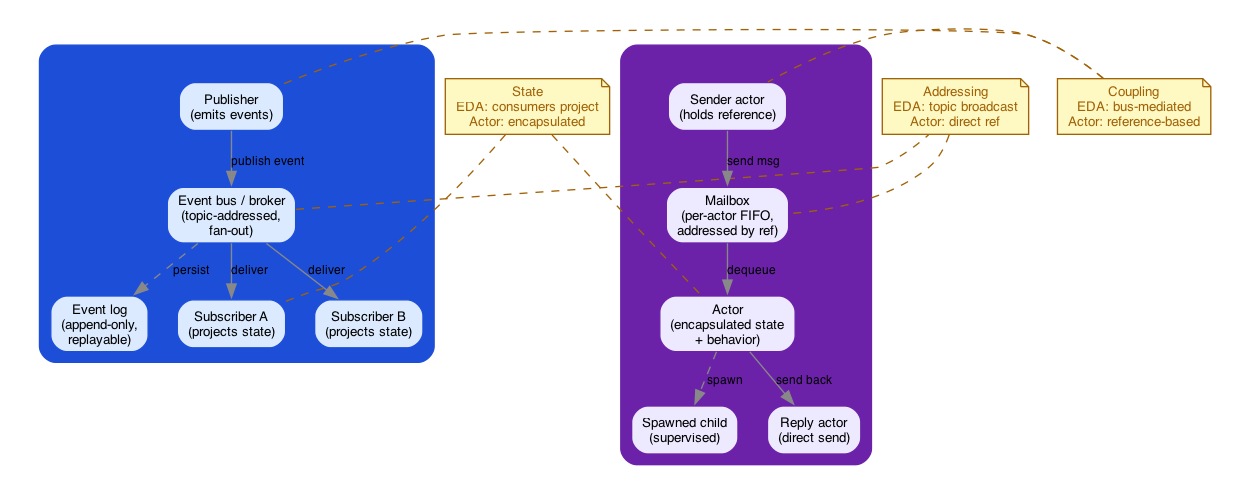
Event-Driven Architectures (EDA) and the Actor Model both provide patterns for asynchronous, distributed computing. The EDA communicates through events, pieces of data that signify a state change, propagating them as messages to interested consumers. The Actor Model utilizes individual acting entities, or actors, each with its mailbox and behavior, processing incoming messages asynchronously.
In EDA, several styles exist, including event sourcing, Commands Query Responsibility Segregation (CQRS), and event-carried state transfer. Event sourcing concerns capturing all changes as events, offering strong audit trails and temporal queries. CQRS divides an application into command and query models, reducing contention and complexity. Event-carried state transfer involves sharing state updates via events reducing service dependency.
The Actor Model is an architectural model for concurrent computation in distributed systems, with actors being the universal primitives. Actors encapsulate state and behavior, communicate through asynchronous messaging, and dynamically create other actors. They provide high-level abstractions for distributed and concurrent computation.
3. Impact
They don't naturally provide the ACID guarantees common to traditional relational database operations.
4. Code
EDA in Clojure can be implemented using libraries like core.async for asynchronous communication. The Actor Model can be created with pulsar.
(ns eda-example
  (:require [clojure.core.async :as async]))

(def updates (async/chan))

;; Producer
(async/go-loop []
  (async/>! updates (generate-update))
  (async/<! (async/timeout 1000))
  (recur))

;; Consumer
(async/go-loop []
  (let [update (async/<! updates)]
    (process-update update))
  (recur))
5. Questions
- What are the primary trade-offs in selecting an event-driven architecture versus a more traditional, request-response model?
- Given a system with a mix of fast and slow consumers, how might an event-driven architecture be designed to prevent slow consumers from becoming a bottleneck?
- How does the Actor Model handle failures and ensure message delivery in a distributed environment?
6. 2026 Landscape
6.1. Actor Model Implementations
6.1.1. JVM: Akka to Pekko
Apache Pekko entered the Apache Incubator on 2022-10-24, the same year as Lightbend's September 2022 BSL license change for Akka -- not 2023 as originally stated. Pekko graduated to a top-level Apache project on 2024-03-20. Source: https://incubator.apache.org/projects/pekko.html.
Lightbend's 2022 license change for Akka (moving away from Apache 2.0 for newer
versions) prompted the Apache Software Foundation to accept the pekko fork in 2022.
By 2026 Apache Pekko has become the canonical JVM actor framework for open-source
projects. The API surface is deliberately compatible: typed actors, cluster sharding,
persistence, and streams all carry over. Teams migrating from Akka 2.6.x can rename
the akka namespace to org.apache.pekko and rebuild with minimal friction.
Microsoft Orleans, originally a research project, matured to a fully open-source virtual actor (grains) framework targeting .NET. The key abstraction is grain activation: the Orleans runtime finds or creates a grain instance wherever it is needed, making location transparency a first-class runtime concern rather than a library pattern.
6.1.2. BEAM: Elixir, OTP, and LiveView
The Erlang/OTP actor model remains the gold standard for fault-tolerant,
high-concurrency systems. Every Elixir GenServer is an OTP actor with a supervised
mailbox; the supervision tree is the system's fault-isolation boundary.
Phoenix LiveView takes this further: each connected browser session runs as an Elixir process on the server. The process holds UI state, receives user events via WebSocket, and sends diffs back. This is an actor-like UI paradigm where the traditional client-side framework collapses into per-session server processes – a concrete demonstration that the actor model scales to interactive UIs.
6.1.3. Cloud and Edge: Durable Objects and Wasm Actors
Cloudflare Durable Objects are the closest thing to the actor model available in a serverless edge environment. A Durable Object instance is:
- single-threaded (no concurrency conflicts within an object),
- location-transparent (the platform routes requests to the correct shard),
- persistent (attached storage survives cold starts),
- addressable by a stable ID (analogous to an actor reference or mailbox address).
The wake/get model – wake the object if dormant, route the request, let it sleep again – maps cleanly onto the virtual actor pattern from Orleans.
Fermyon Spin (WebAssembly components) extends this model to heterogeneous runtimes. A Wasm component implementing a message handler interface can function as an actor regardless of its source language, with the Spin host providing the mailbox and scheduling abstraction.
6.2. Event-Driven Patterns That Matured
6.2.1. Event Sourcing and CQRS Mainstream
Event sourcing and CQRS moved from architectural experiment to default recommendation in high-throughput domains. Mature tooling includes:
Axon Framework(Java/Kotlin): opinionated framework enforcing command, event, and query models with built-in sagas and deadlines.EventStoreDB: purpose-built append-only event log with built-in projections, persistent subscriptions, and a stream-per-aggregate model.Marten(.NET): PostgreSQL as an event store using JSONB, enabling teams to adopt event sourcing without a dedicated infrastructure dependency.
6.2.2. Change Data Capture as Event Source
Debezium established change data capture (CDC) as a first-class integration pattern. A Debezium connector tails a database's write-ahead log and emits row-level change events to Kafka. This makes any existing relational database a source of truth for downstream event streams without application-level instrumentation – a pragmatic bridge between legacy persistence and event-driven consumers.
6.2.3. CloudEvents as Standard Envelope
The CNCF CloudEvents specification (v1.0, widely adopted by 2026) provides a
vendor-neutral event envelope: a small set of required attributes (id, source,
type, specversion) plus optional extensions. CloudEvents decouples event producers
from consumers at the schema level – a Kafka message, an HTTP webhook, and a
gRPC call can all carry the same CloudEvents envelope, enabling routing and filtering
infrastructure that is transport-agnostic.
Debezium CDC events, Eventarc (GCP), EventBridge (AWS), and Azure Event Grid all emit or accept CloudEvents, making it the HTTP/1.1 of event transport: not exciting, but now the assumed baseline.
6.2.4. Async Rust and Go Channels
tokio in Rust provides mpsc and broadcast channels that function as lightweight
actor mailboxes. The actix and xtra crates build formal actor runtimes on top of
tokio. The combination of Rust's ownership model and tokio's cooperative scheduler
produces actor systems with predictable memory behavior and no GC pauses.
Go's goroutines and channels remain the textbook example of communicating sequential processes (CSP) – an actor-adjacent model where channels are first-class values rather than bound to a particular goroutine identity.
6.3. Agentic Systems as Actor Systems
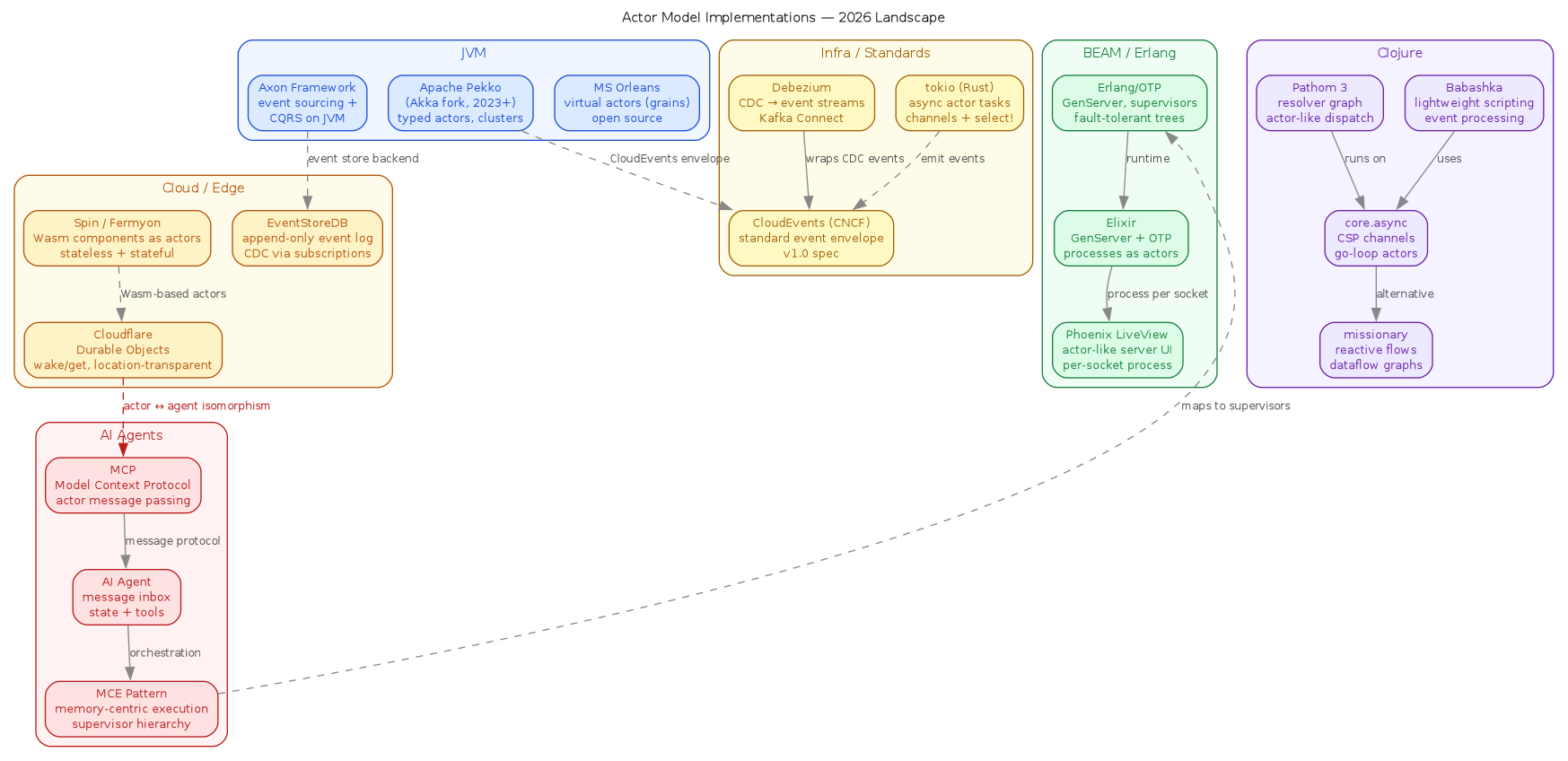
The structural parallel between the actor model and AI agent architectures is not coincidental. An AI agent exhibits all the defining properties of an actor:
| Actor property | AI agent equivalent |
|---|---|
| Receives messages | Accepts tool call results, user turns, MCP events |
| Maintains private state | Context window, memory store, task queue |
| Sends messages | Issues tool calls, spawns sub-agents, emits logs |
| Spawns children | Delegates sub-tasks to specialized agents |
| Supervised | Orchestrator detects failure, retries or escalates |
Model Context Protocol (MCP) is the message-passing layer. MCP tool calls are asynchronous message sends; MCP servers are actor-like processes with their own state and capabilities. The protocol enforces the same decoupling that Akka actor references enforce: callers hold a capability reference, not a direct object.
The Memory-Centric Execution (MCE) pattern from our Q4 2024 agentic systems research maps directly onto supervisor hierarchies. A memory actor holds durable state across agent invocations; task actors are spawned for each unit of work; a supervisor actor monitors liveness and handles failure modes. The theoretical foundations of the actor model from the 1970s apply without modification to multi-agent AI orchestration in
See Agentic Systems Q4 2024 for the MCE pattern detail and orchestration diagrams.
6.4. Clojure-Specific Updates
core.async remains the standard channel-based concurrency library. Its CSP model
(go-blocks communicating over channels) is well understood, well documented, and
stable. For most Clojure event-processing workloads it remains the correct choice.
missionary is gaining adoption for dataflow-style reactive programming. Where
core.async models concurrency as explicit channel operations, missionary models it
as composable flows using monadic abstractions. The tradeoffs are real: missionary
offers better composition for complex derived state, while core.async is more
approachable for team code reviews and operational debugging.
Pathom 3 implements a resolver graph where each resolver is a function from input
attributes to output attributes. The runtime dispatches over the graph to satisfy a
query, backtracking and parallelizing resolver invocations as needed. This is
semantically actor-like: each resolver is stateless but the graph's execution engine
maintains scheduling state, and resolvers can themselves invoke async channels or
missionary flows.
Babashka enables lightweight event processing scripts that run on the JVM with
fast startup. Its GraalVM-compiled binary can consume events from files, HTTP
endpoints, or stdin and route them to downstream handlers. For edge preprocessing
before ingestion into a Kafka topic, Babashka scripts offer a practical alternative
to full JVM startup overhead. See the 2026 REPL-Driven Flight Tracking research for
a worked example of Babashka processing ADS-B event streams.
7. Related
- Agentic Systems Q4 2024 – MCE pattern, orchestration topologies, supervisor hierarchies
- 2026 Agent Memory Systems – durable state in actor-like agent architectures
- 2026 Q2 Cloudflare Agents – Durable Objects as virtual actors on the edge
- 2026 REPL-Driven Flight Tracking – Babashka and core.async for real-time event streams
- Software Design and Architecture Patterns (2021) – saga, CQRS and event sourcing as 2021 patterns
- State Projection over an ADS-B Stream – event sourcing's fold, named seven ways
- Domain-Driven Design – the bounded contexts events cross
8. References
- Event-Driven Architectures, Microsoft Azure
- Event-Driven Architectures, Google Cloud
- Google Cloud Solutions - Event-Driven Architecture with Pub/Sub
- Distributed Publish-Subscribe in Akka
- Actor Model, Wikipedia
- Apache Pekko
- CloudEvents – CNCF
- Debezium – Change Data Capture
- Cloudflare Durable Objects
- Fermyon Spin – WebAssembly Components
- Microsoft Orleans
- missionary – Clojure/ClojureScript reactive flows
- Pathom 3
- tokio – Rust async runtime
- Axon Framework
- EventStoreDB
- Marten – .NET event sourcing on PostgreSQL