CI/CD Pipelines
Table of Contents
1. Overview
2. Background
2.1. The Evolution of CI/CD
Prior to 2020, Jenkins dominated the CI/CD space, but its plugin-based architecture and maintenance overhead led teams to seek alternatives.
2.2. Key Market Trends
- Shift from VM-based to container-based build environments
- Adoption of YAML-based declarative pipeline definitions
- Integration of security scanning (DevSecOps) into pipelines
- Rise of GitOps as a deployment paradigm
- Increased focus on developer experience and self-service platforms
3. Key Concepts
3.1. Continuous Integration (CI)
Continuous Integration focuses on automatically building and testing code changes as they are committed. Key practices include:
- Automated builds triggered on every commit
- Comprehensive test suites (unit, integration, end-to-end)
- Static code analysis and linting
- Security vulnerability scanning
- Artifact generation and storage
3.2. Continuous Delivery/Deployment (CD)
Continuous Delivery ensures code is always in a deployable state, while Continuous Deployment automates the release to production:
- Immutable artifacts (container images)
- Environment promotion workflows (dev -> staging -> production)
- Feature flags for gradual rollouts
- Automated rollback capabilities
- Blue-green and canary deployment strategies
3.3. GitOps
GitOps treats Git as the single source of truth for infrastructure and application deployments:
- Declarative configuration stored in Git
- Automated synchronization between Git state and cluster state
- Pull-based deployments (cluster pulls changes from Git)
- Audit trail through Git history
- Self-healing infrastructure
4. Implementation
4.1. GitHub Actions
Released in 2019 and mature by 2020, GitHub Actions provides CI/CD directly integrated with GitHub repositories.
name: CI Pipeline
on:
  push:
    branches: [main]
  pull_request:
    branches: [main]

jobs:
  build:
    runs-on: ubuntu-latest
    steps:
      - uses: actions/checkout@v2
      - name: Build Docker image
        run: docker build -t myapp:${{ github.sha }} .
      - name: Run tests
        run: docker run myapp:${{ github.sha }} npm test
      - name: Push to registry
        run: |
          echo ${{ secrets.DOCKER_PASSWORD }} | docker login -u ${{ secrets.DOCKER_USERNAME }} --password-stdin
          docker push myapp:${{ github.sha }}
Strengths:
- Native GitHub integration
- Extensive marketplace of reusable actions
- Matrix builds for multi-platform testing
- Self-hosted runners for custom environments
4.2. GitLab CI
GitLab CI offers a comprehensive DevOps platform with built-in CI/CD.
stages:
  - build
  - test
  - deploy

variables:
  DOCKER_IMAGE: $CI_REGISTRY_IMAGE:$CI_COMMIT_SHA

build:
  stage: build
  image: docker:19.03
  services:
    - docker:19.03-dind
  script:
    - docker build -t $DOCKER_IMAGE .
    - docker push $DOCKER_IMAGE

test:
  stage: test
  image: $DOCKER_IMAGE
  script:
    - npm test
    - npm run lint

deploy-staging:
  stage: deploy
  script:
    - kubectl set image deployment/myapp myapp=$DOCKER_IMAGE
  environment:
    name: staging
  only:
    - main
Strengths:
- Single platform for code, CI/CD, and container registry
- Built-in security scanning (SAST, DAST, container scanning)
- Review apps for merge request previews
- Multi-project pipelines
4.3. CircleCI
Both the build and test jobs used `cimg/node:14.0`, but Node.js 14.0.0 released 2020-04-22 (nodejs.org release notes), nearly two months after this note's 2020-03-01 date. The active LTS at the time was Node 12 (12.16.1 released 2020-02-18, per nodejs.org). Changed both image tags to `cimg/node:12.16`.
CircleCI provides cloud-native CI/CD with strong parallelism support.
version: 2.1

orbs:
  docker: circleci/docker@1.0.0

workflows:
  build-and-deploy:
    jobs:
      - build
      - test:
          requires:
            - build
      - deploy:
          requires:
            - test
          filters:
            branches:
              only: main

jobs:
  build:
    docker:
      - image: cimg/node:12.16
    steps:
      - checkout
      - setup_remote_docker
      - run: docker build -t myapp .
      - docker/push:
          image: myapp

  test:
    docker:
      - image: cimg/node:12.16
    parallelism: 4
    steps:
      - checkout
      - run: npm ci
      - run: npm test -- --shard=$(echo $CIRCLE_NODE_INDEX)/$(echo $CIRCLE_NODE_TOTAL)
Strengths:
- Excellent parallelism and test splitting
- Orbs for reusable configuration
- Insights and analytics
- Resource classes for compute optimization
4.4. Jenkins
Jenkins remains relevant for organizations with complex, custom requirements.
pipeline {
    agent {
        kubernetes {
            yaml '''
                apiVersion: v1
                kind: Pod
                spec:
                  containers:
                  - name: docker
                    image: docker:19.03
                    command: ['cat']
                    tty: true
                    volumeMounts:
                    - name: docker-sock
                      mountPath: /var/run/docker.sock
                  volumes:
                  - name: docker-sock
                    hostPath:
                      path: /var/run/docker.sock
            '''
        }
    }
    stages {
        stage('Build') {
            steps {
                container('docker') {
                    sh 'docker build -t myapp:${BUILD_NUMBER} .'
                }
            }
        }
        stage('Test') {
            steps {
                sh 'npm test'
            }
        }
        stage('Deploy') {
            when { branch 'main' }
            steps {
                sh 'kubectl apply -f k8s/'
            }
        }
    }
}
Strengths:
- Extensive plugin ecosystem
- Highly customizable
- On-premise deployment for security requirements
- Jenkinsfile for pipeline-as-code
4.5. ArgoCD and GitOps
ArgoCD implements GitOps for Kubernetes deployments.
apiVersion: argoproj.io/v1alpha1
kind: Application
metadata:
  name: myapp
  namespace: argocd
spec:
  project: default
  source:
    repoURL: https://github.com/org/myapp-manifests
    targetRevision: HEAD
    path: overlays/production
  destination:
    server: https://kubernetes.default.svc
    namespace: production
  syncPolicy:
    automated:
      prune: true
      selfHeal: true
    syncOptions:
      - CreateNamespace=true
ArgoCD workflow:
- CI pipeline builds container image and pushes to registry
- CI updates Kubernetes manifests in Git with new image tag
- ArgoCD detects Git changes and syncs to cluster
- ArgoCD monitors for drift and self-heals
4.6. Container-Based Workflows
The Dockerfile used `node:14` / `node:14-alpine`, but Node.js 14.0.0 released 2020-04-22 (nodejs.org release notes), after this note's 2020-03-01 date (same issue as the CircleCI example above). Changed both stages to `node:12.16` / `node:12.16-alpine`, the active LTS at the time.
# Multi-stage Dockerfile for CI/CD
FROM node:12.16 AS builder
WORKDIR /app
COPY package*.json ./
RUN npm ci
COPY . .
RUN npm run build
RUN npm test

FROM node:12.16-alpine AS production
WORKDIR /app
COPY --from=builder /app/dist ./dist
COPY --from=builder /app/node_modules ./node_modules
USER node
CMD ["node", "dist/server.js"]
Benefits:
- Reproducible builds across environments
- Isolated dependencies
- Smaller production images
- Security through minimal base images
5. Best Practices
5.1. Pipeline Design
- Keep pipelines fast: Target under 10 minutes for feedback
- Fail fast: Run quick checks (lint, unit tests) before slow ones
- Parallelize: Run independent jobs concurrently
- Cache dependencies: Avoid re-downloading on every build
- Use immutable artifacts: Build once, deploy everywhere
5.2. Security
- Scan dependencies: Use tools like Snyk, Dependabot, or Trivy
- Scan containers: Check for vulnerabilities in base images
- Manage secrets: Use vault solutions, never commit secrets
- Sign artifacts: Implement image signing for supply chain security
- Least privilege: CI/CD service accounts should have minimal permissions
5.3. Reliability
- Idempotent deployments: Running twice should produce same result
- Health checks: Verify deployments are healthy before proceeding
- Rollback automation: Automate rollback on failure detection
- Environment parity: Keep staging as close to production as possible
- Observability: Integrate logging, metrics, and tracing
6. References
- GitHub Actions Documentation
- GitLab CI/CD Documentation
- CircleCI Documentation
- Jenkins Pipeline Documentation
- ArgoCD Documentation
- GitOps Principles
- The Twelve-Factor App
- Humble, J., & Farley, D. (2010). Continuous Delivery. Addison-Wesley.
7. Notes
7.1. Tool Selection Considerations
| Criterion | GitHub Actions | GitLab CI | CircleCI | Jenkins |
|---|---|---|---|---|
| Setup Complexity | Low | Low | Low | High |
| Customization | Medium | Medium | Medium | High |
| Self-Hosting | Yes | Yes | No | Yes |
| Enterprise Features | Yes | Yes | Yes | Limited |
| Learning Curve | Low | Low | Low | Medium |
7.2. Migration Path from Jenkins
Organizations moving from Jenkins typically:
- Start with new projects on modern platforms
- Gradually migrate existing pipelines
- Maintain Jenkins for legacy systems with custom plugins
- Use Jenkins as an orchestrator calling modern CI tools
7.3. Emerging Trends (Late 2020)
- Tekton for Kubernetes-native pipelines
- GitHub Actions gaining market share rapidly
- Increased focus on supply chain security
- Platform engineering and internal developer platforms
- Ephemeral, on-demand build environments
8. Canonical pipeline shape
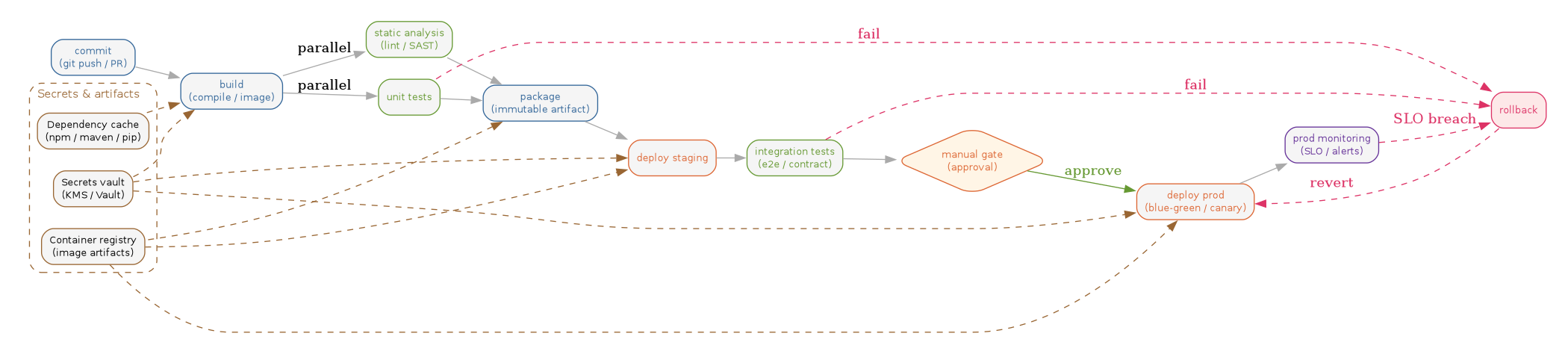
The 2020 CI/CD reference architecture: a left-to-right pipeline with parallel quality gates after build, a manual approval before production, and feedback edges from monitoring back into rollback.
// CI/CD 2020 -- canonical pipeline shape with parallel checks and rollback feedback
digraph ci_cd_pipeline {
    rankdir=LR;
    graph [bgcolor="white", fontname="Helvetica", fontsize=11,
           pad="0.3", nodesep="0.3", ranksep="0.4"];
    node  [shape=box, style="rounded,filled", fontname="Helvetica",
           fontsize=10, fillcolor="#dbeafe", color="#888"];
    edge  [color="#aaa"];

    // Inputs cluster -- secrets and artifact stores feed the pipeline
    subgraph cluster_inputs {
        label="Secrets & artifacts"; labeljust="l"; color="#a16207";
        fontcolor="#a16207"; style="rounded,dashed";
        secrets   [label="Secrets vault\n(KMS / Vault)",
                   fillcolor="#fef9c3", color="#a16207", fontcolor="#a16207"];
        registry  [label="Container registry\n(image artifacts)",
                   fillcolor="#fef9c3", color="#a16207", fontcolor="#a16207"];
        depcache  [label="Dependency cache\n(npm / maven / pip)",
                   fillcolor="#fef9c3", color="#a16207", fontcolor="#a16207"];
    }

    // Pipeline stages
    commit   [label="commit\n(git push / PR)",
              fillcolor="#dbeafe", color="#1d4ed8", fontcolor="#1d4ed8"];
    build    [label="build\n(compile / image)",
              fillcolor="#dbeafe", color="#1d4ed8", fontcolor="#1d4ed8"];
    lint     [label="static analysis\n(lint / SAST)",
              fillcolor="#dcfce7", color="#15803d", fontcolor="#15803d"];
    unit     [label="unit tests",
              fillcolor="#dcfce7", color="#15803d", fontcolor="#15803d"];
    pkg      [label="package\n(immutable artifact)",
              fillcolor="#dbeafe", color="#1d4ed8", fontcolor="#1d4ed8"];
    stg      [label="deploy staging",
              fillcolor="#fef3c7", color="#b45309", fontcolor="#b45309"];
    integ    [label="integration tests\n(e2e / contract)",
              fillcolor="#dcfce7", color="#15803d", fontcolor="#15803d"];
    gate     [label="manual gate\n(approval)",     shape=diamond,
              fillcolor="#fef3c7", color="#b45309", fontcolor="#b45309"];
    prod     [label="deploy prod\n(blue-green / canary)",
              fillcolor="#fef3c7", color="#b45309", fontcolor="#b45309"];
    monitor  [label="prod monitoring\n(SLO / alerts)",
              fillcolor="#ede9fe", color="#6b21a8", fontcolor="#6b21a8"];
    rollback [label="rollback",
              fillcolor="#fee2e2", color="#b91c1c", fontcolor="#b91c1c"];

    // Main flow
    commit -> build;
    build  -> lint   [label="parallel"];
    build  -> unit   [label="parallel"];
    lint   -> pkg;
    unit   -> pkg;
    pkg    -> stg;
    stg    -> integ;
    integ  -> gate;
    gate   -> prod   [label="approve", color="#15803d", fontcolor="#15803d"];
    prod   -> monitor;

    // Feedback edges
    unit    -> rollback [label="fail",   style=dashed, color="#b91c1c", fontcolor="#b91c1c"];
    integ   -> rollback [label="fail",   style=dashed, color="#b91c1c", fontcolor="#b91c1c"];
    monitor -> rollback [label="SLO breach", style=dashed, color="#b91c1c", fontcolor="#b91c1c"];
    rollback -> prod    [label="revert", style=dashed, color="#b91c1c", fontcolor="#b91c1c"];

    // Inputs feed pipeline (loose, dashed)
    secrets  -> build [style=dashed, color="#a16207"];
    secrets  -> stg   [style=dashed, color="#a16207"];
    secrets  -> prod  [style=dashed, color="#a16207"];
    depcache -> build [style=dashed, color="#a16207"];
    registry -> stg   [style=dashed, color="#a16207"];
    registry -> prod  [style=dashed, color="#a16207"];
    pkg      -> registry [style=dashed, color="#a16207", dir=back];
}
9. Related notes
- Terraform AWS resource patterns – the IaC artifacts that CD pipelines apply against staging and production
- Grunt + git-flow + Puppet – the 2014-era predecessor: branch-driven asset builds and Puppet-mediated promotion
- 2019 software development radar – Git Flow, CD4ML, and the cultural backdrop these pipelines emerged from
- Kubeflow ML pipelines – applies the same DAG-of-stages model to model training, registry, and serving
10. Postscript (2026)
Six years in, GitHub Actions has consolidated the market: matrix builds, reusable workflows, and the Actions Importer have absorbed migrations from CircleCI, Jenkins, and even much of GitLab CI outside the GitLab-hosted base. The CD half of the picture is now overwhelmingly GitOps – Argo CD and Flux are CNCF graduated, and "image updater + manifest repo" is the default Kubernetes deploy shape. Supply-chain hardening went from aspirational to table-stakes: SLSA v1.0 provenance, CISA-driven SBOM mandates, and Sigstore/cosign keyless signing are now wired into the package and deploy stages of the diagram above. Test selection has caught up to compute cost – impact-aware runners (Bazel-style affected-target detection, Launchable, Datadog Test Optimization) routinely cut the unit/integration phases by 60-80%. The newest addition to the pipeline is an AI layer: PR-time review bots (Claude Code, Cursor reviewers, GitHub Copilot Code Review) and post-deploy heuristics that auto-trigger the rollback edge when error budgets burn faster than baseline – collapsing what used to be a human pager response into a sub-minute control loop.