Blockchain Border Bank Concept
Table of Contents
1. Overview
This research examines the potential for blockchain technology to transform cross-border payments and international remittances. Traditional correspondent banking through SWIFT has dominated international transfers for decades, but faces challenges including high fees (averaging 6-7% for remittances), slow settlement times (2-5 business days), limited transparency, and exclusion of unbanked populations. Blockchain-based alternatives promise near-instant settlement, reduced costs, and greater financial inclusion.
2. Background
2.1. Traditional Cross-Border Payment Infrastructure
The Society for Worldwide Interbank Financial Telecommunication (SWIFT) has served as the backbone of international payments since 1973. The network connects over 11,000 financial institutions across 200+ countries. However, SWIFT itself does not move money—it transmits payment instructions between correspondent banks, each of which adds fees and processing time.
Key limitations of traditional systems:
- Settlement delays: 2-5 business days typical
- High costs: Wire fees plus FX spreads
- Opacity: Senders cannot track payment progress
- Exclusion: Requires traditional banking relationships
- Geopolitical risk: Subject to sanctions and deplatforming
2.2. Blockchain as Settlement Layer
Bitcoin (2009) demonstrated that cryptographically secured distributed ledgers could enable peer-to-peer value transfer without intermediaries. Ripple (2012) specifically targeted cross-border payments with its XRP Ledger. Ethereum (2015) introduced programmable smart contracts enabling more complex financial instruments.
3. Key Concepts
3.1. Stablecoins for Cross-Border Settlement
Stablecoins—cryptocurrencies pegged to fiat currencies—address the volatility problem that makes Bitcoin unsuitable for commercial payments.
Major stablecoins for cross-border use:
- USDC (Circle): Regulated, fully reserved, multi-chain
- USDT (Tether): Largest by market cap, controversial reserves
- DAI (MakerDAO): Decentralized, crypto-collateralized
- PYUSD (PayPal): Traditional fintech entry into stablecoins
3.2. Ripple and XRP
Ripple Labs developed RippleNet specifically for financial institution cross-border payments. The XRP cryptocurrency serves as a bridge currency, enabling conversion between any currency pair without requiring direct liquidity pools.
RippleNet components:
- xCurrent: Messaging and settlement between banks
- On-Demand Liquidity (ODL): Uses XRP for instant settlement
- xVia: API for corporates to send payments
3.3. Central Bank Digital Currencies (CBDCs)
Many central banks are exploring or piloting CBDCs for cross-border payments:
- mBridge: BIS Innovation Hub project with China, UAE, Thailand, Hong Kong
- Project Dunbar: Singapore, Australia, Malaysia, South Africa
- Digital Euro: ECB investigating cross-border retail payments
3.4. SWIFT gpi and Blockchain Integration
SWIFT responded to blockchain competition with SWIFT gpi (global payments innovation), reducing average cross-border payment time from 3-5 days to under 30 minutes for many corridors. SWIFT has also explored blockchain integration through experiments with R3 Corda and Hyperledger.
4. Implementation
4.1. Architecture Considerations
Cross-border blockchain payment systems require:
- Fiat on/off ramps: Converting local currency to/from crypto
- Liquidity management: Ensuring sufficient funds in destination currency
- Compliance infrastructure: KYC/AML for all parties
- FX conversion: Real-time or near-real-time currency exchange
- Settlement finality: Legal certainty that payment is complete
4.2. Technical Stack Example
+------------------+     +-------------------+     +------------------+
| Sender Bank      |     | Blockchain Layer  |     | Receiver Bank    |
| - KYC/AML check  |---->| - Smart contracts |---->| - KYC/AML check  |
| - Fiat to stable |     | - Atomic swaps    |     | - Stable to fiat |
| - Compliance     |     | - Settlement      |     | - Local payout   |
+------------------+     +-------------------+     +------------------+
4.3. Settlement-rail comparison diagram
The same Bank-A-to-Bank-B payment can clear through three substantively different rails. The diagram below contrasts the legacy correspondent chain (SWIFT + nostro/vostro accounts), blockchain-native rails (Ripple/XRP, Stellar, USDC), and central-bank rails (mBridge, eNaira, Sand Dollar, e-CNY). KYC/AML and travel-rule overlays apply to all three.
// Cross-border payment settlement — Bank A (origin) to Bank B
// (destination) via three competing rails: traditional SWIFT/Nostro,
// blockchain (Ripple/Stellar/USDC), and CBDC (mBridge, Sand Dollar,
// eNaira, e-CNY). KYC/AML overlay applies to all rails.
digraph cross_border_settlement {
    rankdir=LR;
    graph [bgcolor="white", fontname="Helvetica", fontsize=11,
           pad="0.3", nodesep="0.3", ranksep="0.5"];
    node  [shape=box, style="rounded,filled", fontname="Helvetica",
           fontsize=10, fillcolor="#dbeafe", color="#888"];
    edge  [color="#aaa"];
    // Tailwind 100/700 pastel palette

    // Origin
    bankA [label="Bank A\n(origin)\nfiat: USD",
           fillcolor="#dbeafe", color="#1d4ed8", fontcolor="#1d4ed8"];

    // Traditional rail: SWIFT messaging + correspondent/nostro chain
    subgraph cluster_swift {
        label="Traditional rail (SWIFT GPI + nostro/vostro)";
        labeljust="l"; color="#a16207"; fontcolor="#a16207"; style="rounded";
        swift_msg [label="SWIFT GPI\nMT103 / pacs.008\n(ISO 20022)",
                   fillcolor="#fef9c3", color="#a16207", fontcolor="#a16207"];
        corr1 [label="Correspondent\nbank 1",
               fillcolor="#fef9c3", color="#a16207", fontcolor="#a16207"];
        corr2 [label="Correspondent\nbank 2\n(optional)",
               fillcolor="#fef9c3", color="#a16207", fontcolor="#a16207"];
        nostro [label="Nostro / vostro\naccounts",
                fillcolor="#fef9c3", color="#a16207", fontcolor="#a16207"];
        swift_msg -> corr1 -> corr2 -> nostro [color="#a16207"];
    }

    // Blockchain rail: Ripple, Stellar, USDC bridges
    subgraph cluster_chain {
        label="Blockchain rails"; labeljust="l";
        color="#15803d"; fontcolor="#15803d"; style="rounded";
        xrp [label="Ripple ODL\n(XRP bridge)",
             fillcolor="#dcfce7", color="#15803d", fontcolor="#15803d"];
        xlm [label="Stellar\n(XLM / anchors)",
             fillcolor="#dcfce7", color="#15803d", fontcolor="#15803d"];
        usdc [label="USDC\n(Circle CCTP)",
              fillcolor="#dcfce7", color="#15803d", fontcolor="#15803d"];
    }

    // CBDC rail: wholesale + retail pilots
    subgraph cluster_cbdc {
        label="CBDC rails (wholesale + retail pilots)";
        labeljust="l"; color="#6b21a8"; fontcolor="#6b21a8"; style="rounded";
        mbridge [label="mBridge\n(BIS / CN, HK,\nTH, AE, SA)",
                 fillcolor="#ede9fe", color="#6b21a8", fontcolor="#6b21a8"];
        sand [label="Sand Dollar\n(Bahamas, 2020)",
              fillcolor="#ede9fe", color="#6b21a8", fontcolor="#6b21a8"];
        enaira [label="eNaira\n(Nigeria, 2021)",
                fillcolor="#ede9fe", color="#6b21a8", fontcolor="#6b21a8"];
        ecny [label="e-CNY\n(China retail pilot)",
              fillcolor="#ede9fe", color="#6b21a8", fontcolor="#6b21a8"];
        deuro [label="Digital euro\n(ECB legislative)",
               fillcolor="#ede9fe", color="#6b21a8", fontcolor="#6b21a8"];
    }

    // KYC/AML overlay applies to all rails
    subgraph cluster_compliance {
        label="Compliance overlay"; labeljust="l";
        color="#b91c1c"; fontcolor="#b91c1c"; style="rounded";
        kyc [label="KYC / AML\nOFAC, EU, UN\nsanctions screen",
             fillcolor="#fee2e2", color="#b91c1c", fontcolor="#b91c1c"];
        travel [label="FATF travel rule\n(Recommendation 16)",
                fillcolor="#fee2e2", color="#b91c1c", fontcolor="#b91c1c"];
        kyc -> travel [style=dashed, color="#b91c1c"];
    }

    // Destination
    bankB [label="Bank B\n(destination)\nfiat: local",
           fillcolor="#dbeafe", color="#1d4ed8", fontcolor="#1d4ed8"];

    // Bank A fans out to each rail
    bankA -> swift_msg [label="instruction", fontsize=9, color="#a16207"];
    bankA -> xrp  [label="on-ramp", fontsize=9, color="#15803d"];
    bankA -> xlm  [label="on-ramp", fontsize=9, color="#15803d"];
    bankA -> usdc [label="on-ramp", fontsize=9, color="#15803d"];
    bankA -> mbridge [label="wholesale", fontsize=9, color="#6b21a8"];
    bankA -> sand    [label="retail",    fontsize=9, color="#6b21a8"];

    // Each rail converges on Bank B
    nostro  -> bankB [label="credit",     fontsize=9, color="#a16207"];
    xrp     -> bankB [label="off-ramp",   fontsize=9, color="#15803d"];
    xlm     -> bankB [label="off-ramp",   fontsize=9, color="#15803d"];
    usdc    -> bankB [label="off-ramp",   fontsize=9, color="#15803d"];
    mbridge -> bankB [label="atomic PvP", fontsize=9, color="#6b21a8"];
    sand    -> bankB [label="payout",     fontsize=9, color="#6b21a8"];
    enaira  -> bankB [style=dotted, color="#6b21a8"];
    ecny    -> bankB [style=dotted, color="#6b21a8"];
    deuro   -> bankB [style=dotted, color="#6b21a8"];

    // Compliance overlay touches every rail (dashed, grey)
    kyc -> swift_msg [style=dashed, color="#b91c1c", arrowhead=none];
    kyc -> xrp       [style=dashed, color="#b91c1c", arrowhead=none];
    kyc -> usdc      [style=dashed, color="#b91c1c", arrowhead=none];
    kyc -> mbridge   [style=dashed, color="#b91c1c", arrowhead=none];
    travel -> bankB  [style=dashed, color="#b91c1c", arrowhead=none];
}
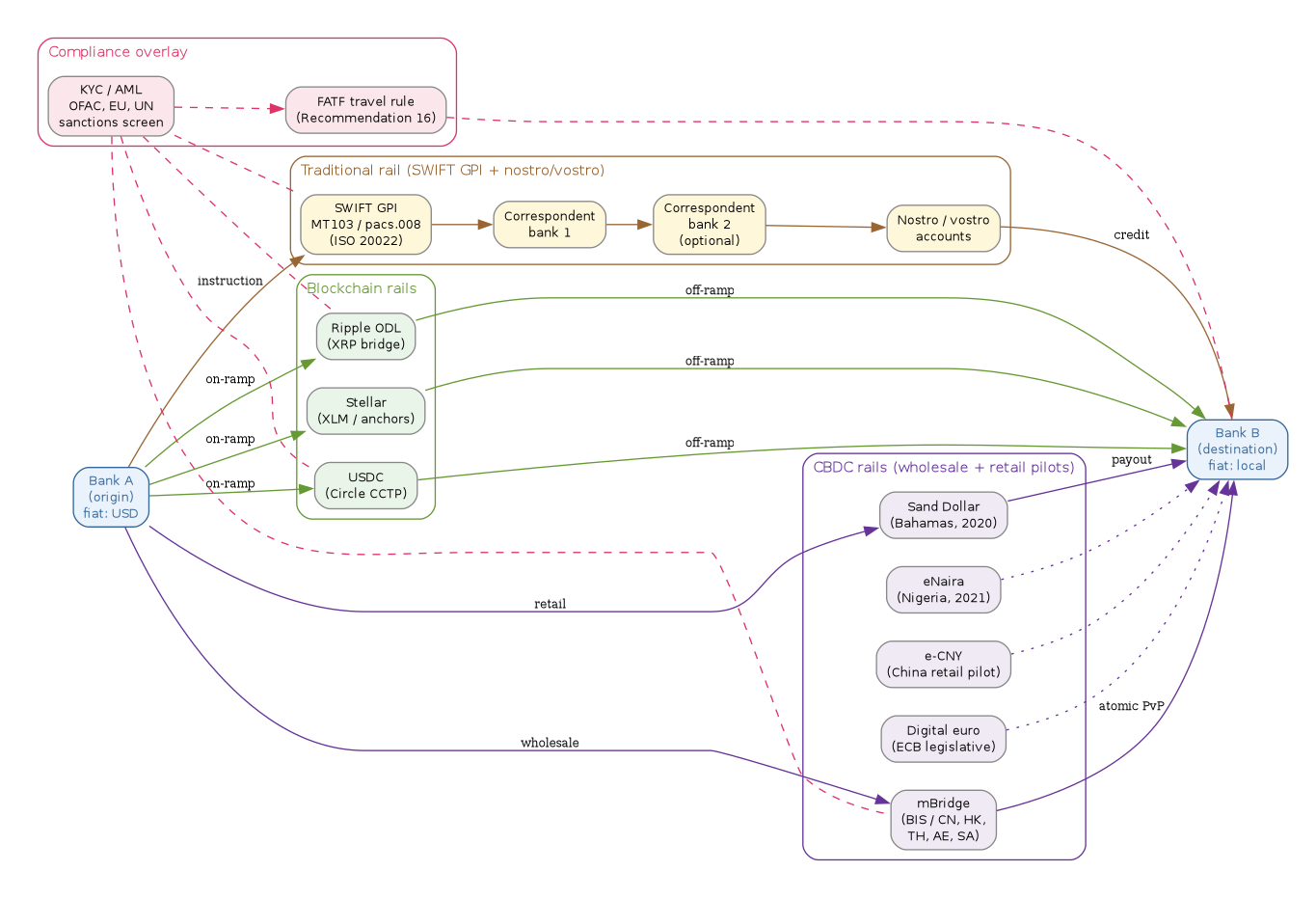
The three clusters compete on different axes. SWIFT GPI optimises for reach (11,000+ institutions, 200+ countries) and reuses bank balance sheets as nostro float. Blockchain rails optimise for settlement finality and the ability to bridge thin currency pairs without a pre-funded nostro on each side. CBDC rails optimise for central-bank control over money supply and instant gross settlement, with PvP (payment-versus-payment) atomicity demonstrated by mBridge.
4.4. Regulatory Considerations
Cross-border blockchain payments face complex regulatory requirements:
- Money transmission licenses in each jurisdiction
- Sanctions screening (OFAC, EU, UN lists)
- Anti-money laundering (AML) requirements
- Travel rule compliance (FATF Recommendation 16)
- Data localization requirements in some jurisdictions
5. References
- SWIFT: https://www.swift.com/
- Ripple: https://ripple.com/
- Circle (USDC): https://www.circle.com/
- BIS Innovation Hub: https://www.bis.org/about/bisih/
- FATF Travel Rule: https://www.fatf-gafi.org/
- World Bank Remittance Prices: https://remittanceprices.worldbank.org/
6. Notes
- The 2016 timeframe of this research predates many current stablecoin and CBDC developments, but the fundamental analysis of SWIFT limitations and blockchain potential remains relevant.
- Regulatory clarity has improved significantly since 2016, with frameworks like MiCA in Europe providing clearer guidelines.
- The "blockchain border bank" concept anticipated many developments now being implemented by both crypto-native and traditional financial institutions.
7. Related notes
- Blockchain identity and lending — companion 2016 note on the on-chain credit side of the same architecture.
- Agent token exchange — bot-native rails (x402, agentic micropayments) extend the cross-border settlement question to non-human counterparties.
- Software design — the layered-rails framing in this note maps to the bounded-context vocabulary used there.
8. Postscript (2026)
The 2016 framing held up better than expected on the structural side and worse on the timing. Ripple's On-Demand Liquidity (ODL) gained early traction with Tier-2 corridors but most large banks dropped active ODL pilots between 2022 and 2023; SWIFT GPI plus the ISO 20022 migration (deadline November 2025 for cross-border MX co-existence) absorbed most of the speed and traceability complaints that motivated the original note. CBDC pilots fragmented along policy lines: the Bahamas Sand Dollar launched October 2020, eNaira launched October 2021, the e-CNY remained a domestic retail pilot through 2025, and BIS Project mBridge reached minimum viable product in June 2024 before the BIS exited the project that October — leaving the participating central banks (PBOC, HKMA, BOT, CBUAE, SAMA) to continue independently. On the rails the original note underweighted: instant gross settlement systems (FedNow launched July 2023, SEPA Instant became mandatory 9 October 2025) and stablecoin corridors (Circle CCTP shipped 2023) ate the "fast cross-border" niche without requiring a permissioned blockchain at all. The agentic-finance overlay — x402 micropayments (April 2026) and bot-initiated transfers — is the new question that the original 2016 framing did not anticipate.