Blockchain Border Bank Concept
Table of Contents
1. Overview
Traditional correspondent banking through SWIFT has dominated international transfers for decades, but faces challenges including high fees (averaging 6-7% for remittances), slow settlement times (2-5 business days), limited transparency, and exclusion of unbanked populations.
2. Background
2.1. Traditional Cross-Border Payment Infrastructure
SWIFT was founded in Brussels on 3 May 1973 but did not carry live message traffic until the first message was sent on 9 May 1977; "backbone... since 1973" conflated founding with operational start. The 11,000-institution/200+-country figure matches SWIFT's own circa-2015 reporting.
The Society for Worldwide Interbank Financial Telecommunication (SWIFT) was founded in 1973 and began carrying live payment traffic in 1977, serving as the backbone of international payments since. The network connects over 11,000 financial institutions across 200+ countries. However, SWIFT itself does not move money—it transmits payment instructions between correspondent banks, each of which adds fees and processing time.
Key limitations of traditional systems:
- Settlement delays: 2-5 business days typical
- High costs: Wire fees plus FX spreads
- Opacity: Senders cannot track payment progress
- Exclusion: Requires traditional banking relationships
- Geopolitical risk: Subject to sanctions and deplatforming
2.2. Blockchain as Settlement Layer
Bitcoin (2009) demonstrated that cryptographically secured distributed ledgers could enable peer-to-peer value transfer without intermediaries. Ripple (2012) specifically targeted cross-border payments with its XRP Ledger. Ethereum (2015) introduced programmable smart contracts enabling more complex financial instruments.
3. Key Concepts
3.1. Stablecoins for Cross-Border Settlement
Stablecoins—cryptocurrencies pegged to fiat currencies—address the volatility problem that makes Bitcoin unsuitable for commercial payments.
Major stablecoins for cross-border use:
- USDC (Circle): Regulated, fully reserved, multi-chain
- USDT (Tether): Largest by market cap, controversial reserves
- DAI (MakerDAO): Decentralized, crypto-collateralized
- PYUSD (PayPal): Traditional fintech entry into stablecoins
3.2. Ripple and XRP
Ripple Labs developed RippleNet specifically for financial institution cross-border payments. The XRP cryptocurrency serves as a bridge currency, enabling conversion between any currency pair without requiring direct liquidity pools.
RippleNet components:
- xCurrent: Messaging and settlement between banks
- On-Demand Liquidity (ODL): Uses XRP for instant settlement
- xVia: API for corporates to send payments
3.3. Central Bank Digital Currencies (CBDCs)
Many central banks are exploring or piloting CBDCs for cross-border payments:
- mBridge: BIS Innovation Hub project with China, UAE, Thailand, Hong Kong
- Project Dunbar: Singapore, Australia, Malaysia, South Africa
- Digital Euro: ECB investigating cross-border retail payments
3.4. SWIFT gpi and Blockchain Integration
SWIFT responded to blockchain competition with SWIFT gpi (global payments innovation), reducing average cross-border payment time from 3-5 days to under 30 minutes for many corridors. SWIFT has also explored blockchain integration through experiments with R3 Corda and Hyperledger.
4. Implementation
4.1. Architecture Considerations
Cross-border blockchain payment systems require:
- Fiat on/off ramps: Converting local currency to/from crypto
- Liquidity management: Ensuring sufficient funds in destination currency
- Compliance infrastructure: KYC/AML for all parties
- FX conversion: Real-time or near-real-time currency exchange
- Settlement finality: Legal certainty that payment is complete
4.2. Technical Stack Example
+------------------+     +-------------------+     +------------------+
| Sender Bank      |     | Blockchain Layer  |     | Receiver Bank    |
| - KYC/AML check  |---->| - Smart contracts |---->| - KYC/AML check  |
| - Fiat to stable |     | - Atomic swaps    |     | - Stable to fiat |
| - Compliance     |     | - Settlement      |     | - Local payout   |
+------------------+     +-------------------+     +------------------+
4.3. Settlement-rail comparison diagram
The same Bank-A-to-Bank-B payment can clear through three substantively different rails. The diagram below contrasts the legacy correspondent chain (SWIFT + nostro/vostro accounts), blockchain-native rails (Ripple/XRP, Stellar, USDC), and central-bank rails (mBridge, eNaira, Sand Dollar, e-CNY). KYC/AML and travel-rule overlays apply to all three.
// Cross-border payment settlement -- Bank A (origin) to Bank B
// (destination) via three competing rails: traditional SWIFT/Nostro,
// blockchain (Ripple/Stellar/USDC), and CBDC (mBridge, Sand Dollar,
// eNaira, e-CNY). KYC/AML overlay applies to all rails.
digraph cross_border_settlement {
    rankdir=LR;
    graph [bgcolor="white", fontname="Helvetica", fontsize=11,
           pad="0.3", nodesep="0.3", ranksep="0.5"];
    node  [shape=box, style="rounded,filled", fontname="Helvetica",
           fontsize=10, fillcolor="#dbeafe", color="#888"];
    edge  [color="#aaa"];
    // Tailwind 100/700 pastel palette

    // Origin
    bankA [label="Bank A\n(origin)\nfiat: USD",
           fillcolor="#dbeafe", color="#1d4ed8", fontcolor="#1d4ed8"];

    // Traditional rail: SWIFT messaging + correspondent/nostro chain
    subgraph cluster_swift {
        label="Traditional rail (SWIFT GPI + nostro/vostro)";
        labeljust="l"; color="#a16207"; fontcolor="#a16207"; style="rounded";
        swift_msg [label="SWIFT GPI\nMT103 / pacs.008\n(ISO 20022)",
                   fillcolor="#fef9c3", color="#a16207", fontcolor="#a16207"];
        corr1 [label="Correspondent\nbank 1",
               fillcolor="#fef9c3", color="#a16207", fontcolor="#a16207"];
        corr2 [label="Correspondent\nbank 2\n(optional)",
               fillcolor="#fef9c3", color="#a16207", fontcolor="#a16207"];
        nostro [label="Nostro / vostro\naccounts",
                fillcolor="#fef9c3", color="#a16207", fontcolor="#a16207"];
        swift_msg -> corr1 -> corr2 -> nostro [color="#a16207"];
    }

    // Blockchain rail: Ripple, Stellar, USDC bridges
    subgraph cluster_chain {
        label="Blockchain rails"; labeljust="l";
        color="#15803d"; fontcolor="#15803d"; style="rounded";
        xrp [label="Ripple ODL\n(XRP bridge)",
             fillcolor="#dcfce7", color="#15803d", fontcolor="#15803d"];
        xlm [label="Stellar\n(XLM / anchors)",
             fillcolor="#dcfce7", color="#15803d", fontcolor="#15803d"];
        usdc [label="USDC\n(Circle CCTP)",
              fillcolor="#dcfce7", color="#15803d", fontcolor="#15803d"];
    }

    // CBDC rail: wholesale + retail pilots
    subgraph cluster_cbdc {
        label="CBDC rails (wholesale + retail pilots)";
        labeljust="l"; color="#6b21a8"; fontcolor="#6b21a8"; style="rounded";
        mbridge [label="mBridge\n(BIS / CN, HK,\nTH, AE, SA)",
                 fillcolor="#ede9fe", color="#6b21a8", fontcolor="#6b21a8"];
        sand [label="Sand Dollar\n(Bahamas, 2020)",
              fillcolor="#ede9fe", color="#6b21a8", fontcolor="#6b21a8"];
        enaira [label="eNaira\n(Nigeria, 2021)",
                fillcolor="#ede9fe", color="#6b21a8", fontcolor="#6b21a8"];
        ecny [label="e-CNY\n(China retail pilot)",
              fillcolor="#ede9fe", color="#6b21a8", fontcolor="#6b21a8"];
        deuro [label="Digital euro\n(ECB legislative)",
               fillcolor="#ede9fe", color="#6b21a8", fontcolor="#6b21a8"];
    }

    // KYC/AML overlay applies to all rails
    subgraph cluster_compliance {
        label="Compliance overlay"; labeljust="l";
        color="#b91c1c"; fontcolor="#b91c1c"; style="rounded";
        kyc [label="KYC / AML\nOFAC, EU, UN\nsanctions screen",
             fillcolor="#fee2e2", color="#b91c1c", fontcolor="#b91c1c"];
        travel [label="FATF travel rule\n(Recommendation 16)",
                fillcolor="#fee2e2", color="#b91c1c", fontcolor="#b91c1c"];
        kyc -> travel [style=dashed, color="#b91c1c"];
    }

    // Destination
    bankB [label="Bank B\n(destination)\nfiat: local",
           fillcolor="#dbeafe", color="#1d4ed8", fontcolor="#1d4ed8"];

    // Bank A fans out to each rail
    bankA -> swift_msg [label="instruction", fontsize=9, color="#a16207"];
    bankA -> xrp  [label="on-ramp", fontsize=9, color="#15803d"];
    bankA -> xlm  [label="on-ramp", fontsize=9, color="#15803d"];
    bankA -> usdc [label="on-ramp", fontsize=9, color="#15803d"];
    bankA -> mbridge [label="wholesale", fontsize=9, color="#6b21a8"];
    bankA -> sand    [label="retail",    fontsize=9, color="#6b21a8"];

    // Each rail converges on Bank B
    nostro  -> bankB [label="credit",     fontsize=9, color="#a16207"];
    xrp     -> bankB [label="off-ramp",   fontsize=9, color="#15803d"];
    xlm     -> bankB [label="off-ramp",   fontsize=9, color="#15803d"];
    usdc    -> bankB [label="off-ramp",   fontsize=9, color="#15803d"];
    mbridge -> bankB [label="atomic PvP", fontsize=9, color="#6b21a8"];
    sand    -> bankB [label="payout",     fontsize=9, color="#6b21a8"];
    enaira  -> bankB [style=dotted, color="#6b21a8"];
    ecny    -> bankB [style=dotted, color="#6b21a8"];
    deuro   -> bankB [style=dotted, color="#6b21a8"];

    // Compliance overlay touches every rail (dashed, grey)
    kyc -> swift_msg [style=dashed, color="#b91c1c", arrowhead=none];
    kyc -> xrp       [style=dashed, color="#b91c1c", arrowhead=none];
    kyc -> usdc      [style=dashed, color="#b91c1c", arrowhead=none];
    kyc -> mbridge   [style=dashed, color="#b91c1c", arrowhead=none];
    travel -> bankB  [style=dashed, color="#b91c1c", arrowhead=none];
}
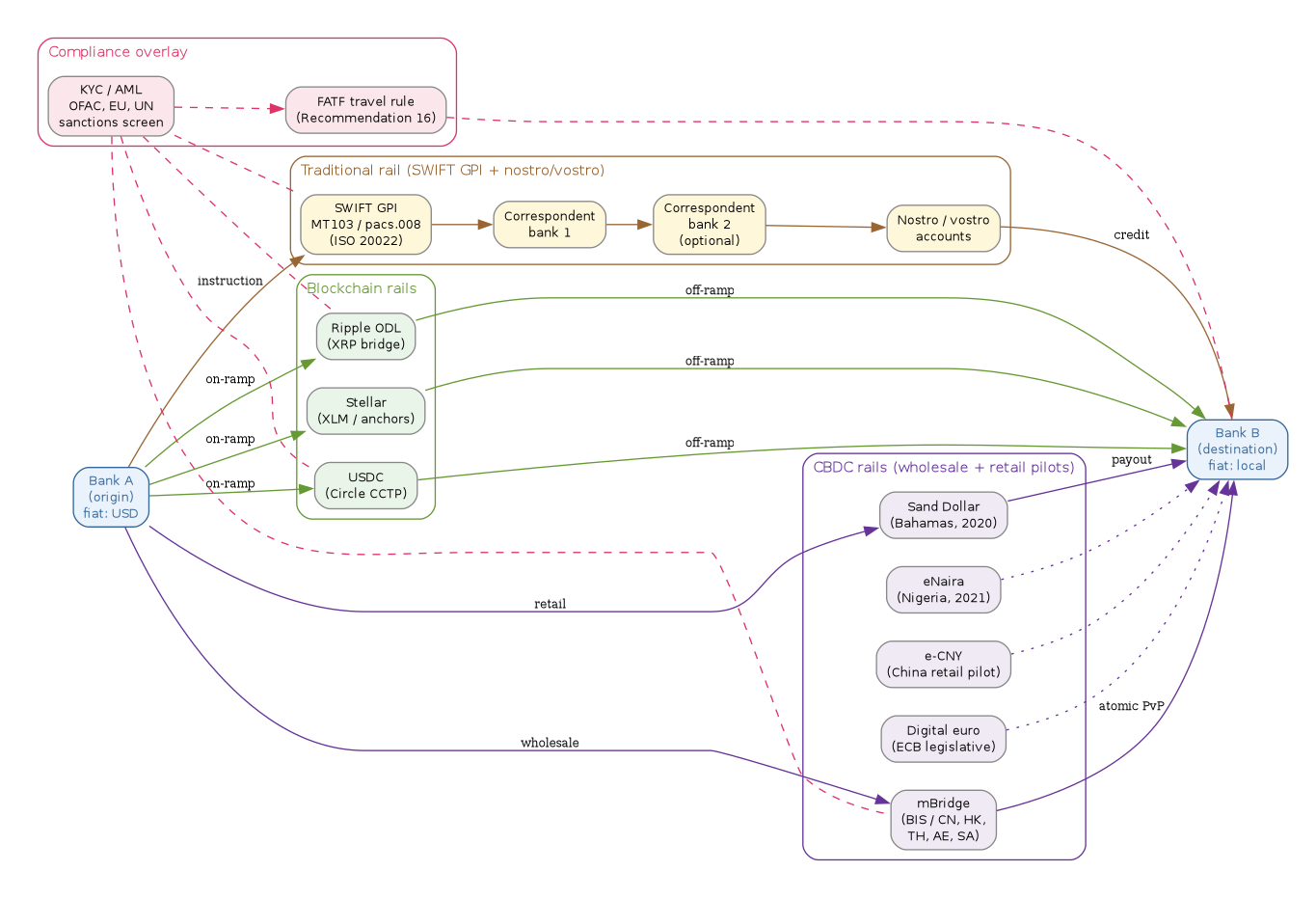
The three clusters compete on different axes. SWIFT GPI optimises for reach (11,000+ institutions, 200+ countries) and reuses bank balance sheets as nostro float. Blockchain rails optimise for settlement finality and the ability to bridge thin currency pairs without a pre-funded nostro on each side. CBDC rails optimise for central-bank control over money supply and instant gross settlement, with PvP (payment-versus-payment) atomicity demonstrated by mBridge.
4.4. Regulatory Considerations
Cross-border blockchain payments face complex regulatory requirements:
- Money transmission licenses in each jurisdiction
- Sanctions screening (OFAC, EU, UN lists)
- Anti-money laundering (AML) requirements
- Travel rule compliance (FATF Recommendation 16)
- Data localization requirements in some jurisdictions
5. References
- SWIFT: https://www.swift.com/
- Ripple: https://ripple.com/
- Circle (USDC): https://www.circle.com/
- BIS Innovation Hub: https://www.bis.org/about/bisih/
- FATF Travel Rule: https://www.fatf-gafi.org/
- World Bank Remittance Prices: https://remittanceprices.worldbank.org/
6. Notes
- Regulatory clarity has improved significantly since 2016, with frameworks like MiCA in Europe providing clearer guidelines.
7. Related notes
- Blockchain identity and lending – companion 2016 note on the on-chain credit side of the same architecture.
- Agent token exchange – bot-native rails (x402, agentic micropayments) extend the cross-border settlement question to non-human counterparties.
- Software design – the layered-rails framing in this note maps to the bounded-context vocabulary used there.
8. Postscript (2026)
Checked against BIS's own project page: mBridge reached MVP mid-2024 and the BIS concluded its direct operational role in October 2024, handing the project to its founding central banks (PBOC, HKMA, BOT, CBUAE, plus SAMA which joined in 2024) -- matching the dates given here.
The 2016 framing held up better than expected on the structural side and worse on the timing. Ripple's On-Demand Liquidity (ODL) gained early traction with Tier-2 corridors but most large banks dropped active ODL pilots between 2022 and 2023; SWIFT GPI plus the ISO 20022 migration (deadline November 2025 for cross-border MX co-existence) absorbed most of the speed and traceability complaints that motivated the original note. CBDC pilots fragmented along policy lines: the Bahamas Sand Dollar launched October 2020, eNaira launched October 2021, the e-CNY remained a domestic retail pilot through 2025, and BIS Project mBridge reached minimum viable product in June 2024 before the BIS exited the project that October – leaving the participating central banks (PBOC, HKMA, BOT, CBUAE, SAMA) to continue independently. On the rails the original note underweighted: instant gross settlement systems (FedNow launched July 2023, SEPA Instant became mandatory 9 October 2025) and stablecoin corridors (Circle CCTP shipped 2023) ate the "fast cross-border" niche without requiring a permissioned blockchain at all. The agentic-finance overlay – x402 micropayments (April 2026) and bot-initiated transfers – is the new question that the original 2016 framing did not anticipate.