Architectural Patterns
1. Content
1.1. Introduction
Architectural patterns in agentic systems define how autonomous agents interact, manage state, and accomplish tasks. This section explores core patterns for task execution, memory management, and agent coordination.
1.2. Main Content
1.2.1. Core Pattern Categories
1.2.1.1. Manager-Coordinator-Executor (MCE)
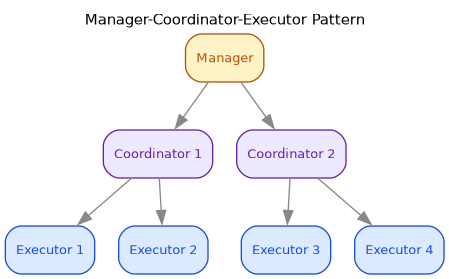
- Components
- Manager
- High-level task planning and resource allocation
- Coordinator
- Task decomposition and workflow management
- Executor
- Specialized task execution and direct actions
- Implementation Examples
class Manager:
    def allocate_task(self, task):
        coordinator = self.select_coordinator(task)
        return coordinator.process(task)

class Coordinator:
    def process(self, task):
        subtasks = self.decompose(task)
        executors = [self.assign_executor(t) for t in subtasks]
        return self.monitor_execution(executors)

class Executor:
    def execute(self, subtask):
        result = self.perform_action(subtask)
        return self.validate_result(result)
1.2.1.2. Hand-off Pattern
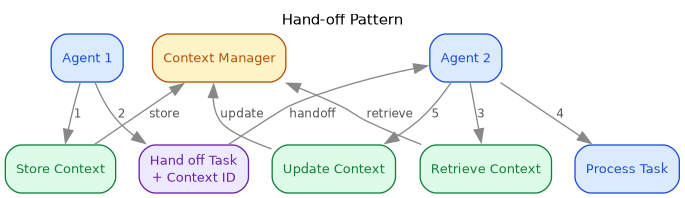
- Key Components
- Context Storage
- Maintains task state and history
- Transfer Protocol
- Defines hand-off mechanics
- State Validation
- Ensures context integrity
- Implementation Example
class ContextManager:
    def store_context(self, context_id, state):
        return self.vector_store.upsert({
            'id': context_id,
            'state': state,
            'timestamp': datetime.now(),
            'metadata': self.get_metadata()
        })

class TaskHandoff:
    def transfer(self, from_agent, to_agent, task, context_id):
        context = self.context_manager.get_context(context_id)
        return HandoffProtocol(
            source=from_agent,
            target=to_agent,
            task=task,
            context=context
        ).execute()
1.2.1.3. Memory-Centric Pattern
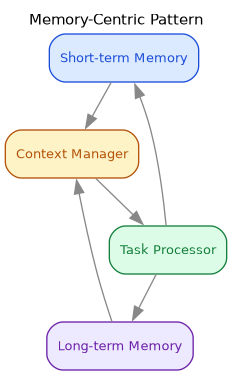
- Components
- Short-term Memory
- Active context and current task state
- Long-term Memory
- Historical patterns and learned behaviors
- Context Manager
- Memory orchestration and retrieval
- Implementation Example
class MemorySystem:
    def __init__(self):
        self.stm = ShortTermMemory()
        self.ltm = LongTermMemory()
        self.context = ContextManager()

    def process_task(self, task):
        current_context = self.stm.get_active_context()
        similar_patterns = self.ltm.find_similar(task)
        execution_plan = self.context.create_plan(
            task, current_context, similar_patterns
        )
        return self.execute_with_memory(execution_plan)
1.2.2. Pattern Integration
1.2.2.1. Cross-Pattern Communication
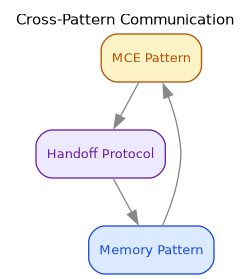
1.2.2.2. Implementation Considerations
- State Management
- Context preservation
- Memory efficiency
- Pattern storage
- Error Handling
- Recovery mechanisms
- State rollback
- Pattern adaptation
- Resource Optimization
- Memory allocation
- Compute distribution
- Context pruning
1.3. Summary
Key architectural patterns enable:
- Structured task decomposition and execution
- Efficient context management and transfer
- Integration of short and long-term memory
- Scalable agent coordination
- Robust error handling and recovery
1.4. Section References
- Design Patterns: Elements of Reusable Agent Architectures
- Microsoft Magentic-One Architecture Documentation
- Vector Database Integration Patterns
- Memory Management in Distributed Systems
- Pattern implementations:
- Manager-Coordinator-Executor
- Anthropic's Agent System
- OpenAI's Assistant API
- Hand-off Systems
- LangChain's Agent Framework
- Auto-GPT Architecture
- Memory Patterns
- MemGPT
- Vector Databases
- Manager-Coordinator-Executor