Yahoo Pipes (2007–2015)
Table of Contents
See also: [BROKEN LINK: *Functional Composition] | [BROKEN LINK: *Mathematics and Type Theory] | [BROKEN LINK: *Canonical Examples: Reversible Ciphers and Irreversible Projections] | [BROKEN LINK: *Reversible Computing]
1. Yahoo Pipes (2007–2015)
Yahoo Pipes was the first mainstream consumer-facing dataflow editor. Users connected rectangular boxes – RSS feed sources, filters, regex transforms, sort and truncate steps – with drawn wires. The output of each box was visible by clicking it. The model was explicit: boxes are functions, wires are composition, intermediate state is inspectable.
Pipes was surjective by default. A filter box discards items that do not match;
the discarded items are gone. There was no unfilter operator and no
reversibility indicator. Users did not miss it because the domain (RSS
aggregation) had no notion of round-tripping. The pipeline was purely
feedforward.
2. Scratch and Blockly
MIT Scratch uses snap-together blocks whose shapes encode type compatibility: a rounded slot accepts a reporter block, a C-shaped slot accepts a sequence. This is a visual type system. The shape constraint prevents certain composition errors structurally, before evaluation.
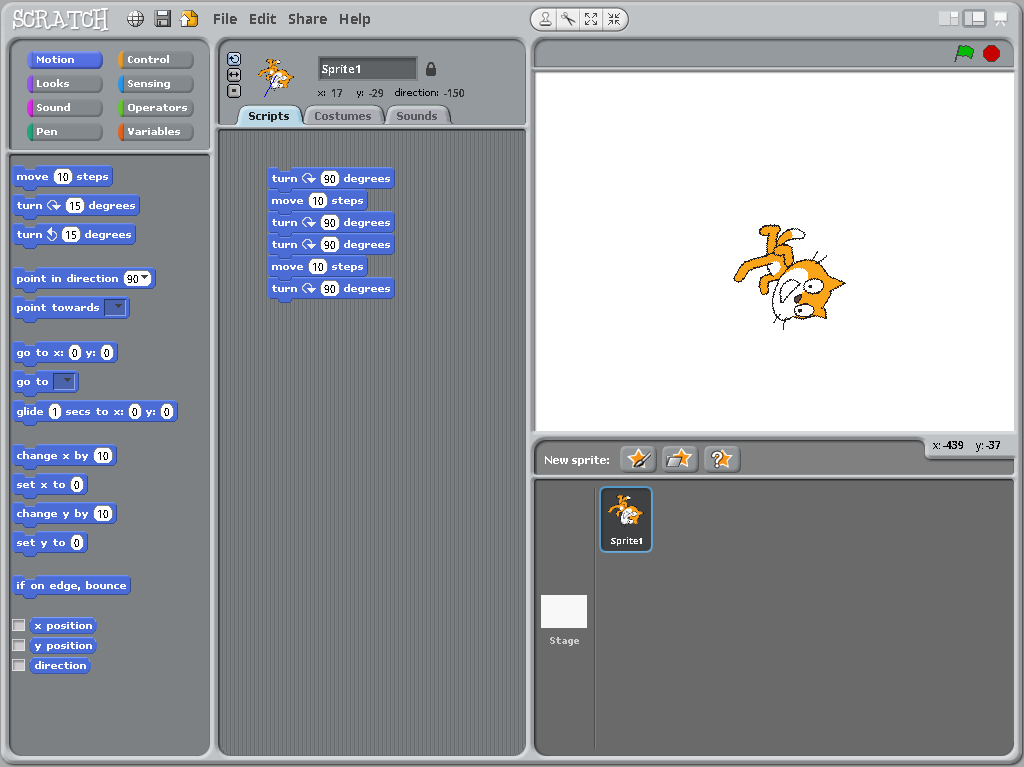
Figure 1: Scratch 1.4 on FreeBSD – snap-together blocks as a visual type system
Blockly (Google, 2012) generalized Scratch's block grammar into a toolkit for building domain-specific visual languages. Both systems are one-directional: a block that computes a value does not carry its inverse. There is no standard mechanism for "undo a block's effect on the data stream."
3. Max/MSP and Pure Data
Max/MSP (Cycling '74, 1980s–present) and Pure Data (Miller Puckette) (??, ????) model audio and multimedia signal flow as a directed graph of objects connected by patch cables. Every object is a function from inlet values to outlet values, evaluated on a scheduler tick.
The signal-flow metaphor is close to the pipeline tool's model. Key difference: audio transforms are typically not invertible in practice even when mathematically invertible. A low-pass filter has a transfer function with a computable inverse, but no one patches that inverse in because the use case does not require round-tripping the audio signal.
4. LabVIEW
LabVIEW (National Instruments, 1986; acquired by Emerson Electric, 2023) introduced dataflow programming for instrument control. A VI (Virtual Instrument) executes when sufficient data is available on its required inputs. The language is inherently parallel: nodes without data dependencies execute concurrently.
LabVIEW's contribution to the lineage is the notion that a node's execution model is determined by its data dependencies, not by statement order. The pipeline tool is simpler (sequential, not concurrent) but inherits the idea that the graph topology is the program.
5. Node-RED
Node-RED (Nick O'Leary and Dave Conway-Jones at IBM, 2013; now OpenJS Foundation) wires together event-driven JavaScript nodes over HTTP,
MQTT, and other message buses. A node receives a message object, may mutate
or replace its payload field, and emits a new message. The mutation-in-place
model differs from a pure functional pipeline: nodes can be stateful.
For reversibility purposes, stateful nodes are problematic. If a node's output depends on accumulated state (a counter, a cache hit), the inverse function would need to reconstruct that state. Node-RED does not model this; neither does any deployed version of such a tool the author knows of.
6. Unreal Blueprints
Unreal Engine's Blueprint visual scripting system is a dataflow graph for game logic. It handles both control flow (execution pins, shown as white arrows) and data flow (typed value pins, shown in colors by type). The dual-pin model is an explicit separation of concerns: "when to run" versus "what to compute."
The pipeline tool collapses this duality: there is no separate control flow. Every step runs on each input. Blueprint's value-typed pins are the closer analogy – a string output pin can only wire to a string input pin, enforcing type compatibility before execution.
7. Forth
Charles Moore's Forth (??, a) compiles user-defined words into sequences of machine operations. A Forth program is a sequence of words applied to a shared stack. The composition model is concatenation: putting two word sequences next to each other composes them. There is no function application syntax because juxtaposition is application.
: celsius-to-fahrenheit  ( n -- n )   9 * 5 / 32 + ;
: fahrenheit-to-celsius  ( n -- n )   32 - 5 * 9 / ;

100 celsius-to-fahrenheit .    \ prints 212
212 fahrenheit-to-celsius .    \ prints 100
Forth words are explicit inverses when the programmer writes them. The language
offers no built-in mechanism to derive or verify the inverse. The stack comment
notation ( n -- n ) documents the stack effect; a type system for reversibility
would need to track whether f and g satisfy g . f = id.
8. HP-48 RPN Calculator
The HP-48 and its descendants implement a visual stack: the screen shows the top four or more stack levels labeled 1 through 4 (and higher). Every operation consumes arguments from the stack and pushes results. The user sees the entire stack state after each keystroke.
This is the closest consumer-device analogue to the pipeline tool's
intermediate-value display. The HP-48's UNDO operation restores the stack to
its state before the last command – a single-step inverse. It does not compose
inverses; it only reverses the most recent operation by saving state. The
information is preserved in the saved snapshot, not derived from the operation's
mathematical inverse.
9. PostScript
PostScript (Adobe, 1982) is a stack-based page description language. Operators
pop arguments and push results. A PostScript program is a sequence of tokens
that transforms a graphics state. The graphics state is not invertible in
PostScript's execution model: fill paints pixels and discards the path. There
is no unfill. PostScript is a canonical example of a stack-machine language
where most operations are irreversible in practice.
10. Factor and Joy
Factor (Slava Pestov, 2003) and Joy (Manfred von Thun, 1990s) are concatenative languages that make the stack model explicit in the type system. Joy's insight: a Joy program is a function from stack to stack. Composition is concatenation. Quotations (anonymous functions) are first-class stack values.
Factor adds a static stack-effect type system: every word declares its stack
effect, and the compiler verifies consistency. This is one step toward a
reversibility type system: a word whose stack effect is ( a -- b ) could
additionally declare a companion word with effect ( b -- a ), and the
compiler could verify their composition equals the identity on the domain.
No mainstream concatenative language implements this today. It remains a research target.