Claude Code Features: 2026 Q2
Speculative notes on the current feature surface and likely Q2 direction
Table of Contents

1. Overview
This is a working note, not a specification. It captures the Claude Code feature surface as observed in 2026 Q1–Q2 and speculates on where the product is moving.
Claude Code in 2026 Q2 is no longer "a CLI that calls an LLM." It is an agent harness with its own execution semantics — persistent memory, hook-driven automation, subagent delegation, and worktree-based isolation — where the model is one component among several.
2. The current feature surface
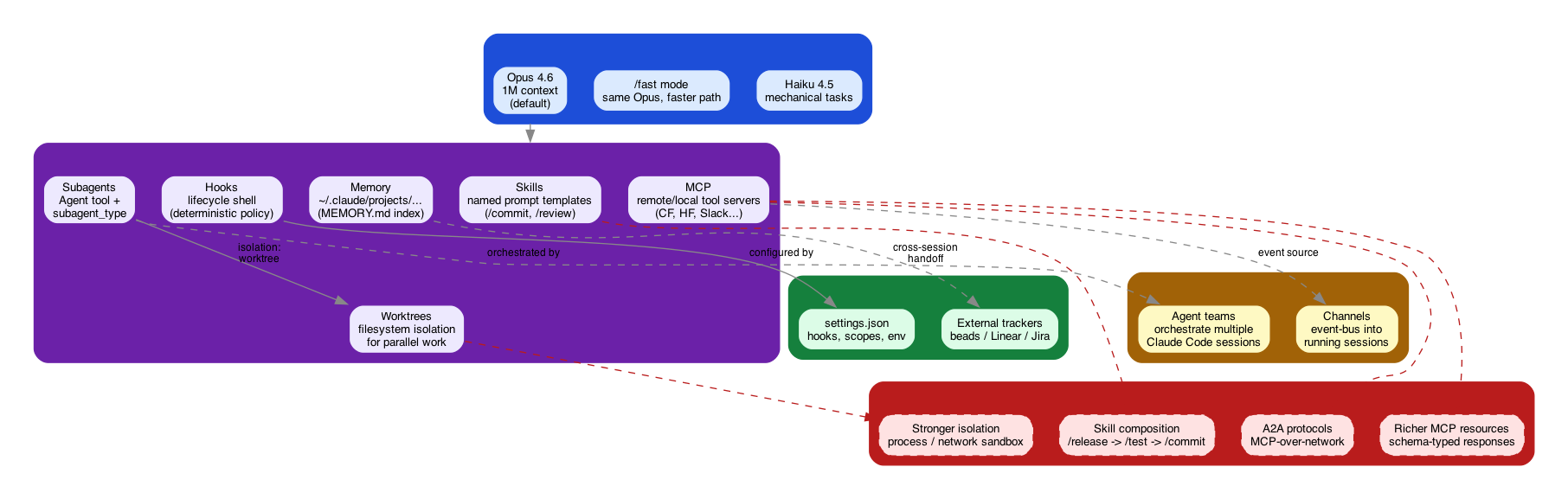
2.1. Model and context
Update (2026-07-25): the default is now Claude Opus 5 (claude-opus-5,
launched 2026-07-24), which became Claude Code's default in v2.1.219. It keeps
the 1M context window and Opus-tier pricing ($5/$25 per Mtok, same as Opus
4.8 — a changelog line reading "$10/$50 per Mtok" scopes that figure to
fast mode, not base Opus 5 pricing; it is not a conflict with Anthropic's
launch page). On Artificial Analysis it tops the Intelligence Index at 61 (max
effort), just ahead of Fable 5 at 60 — "Fable-level performance at Opus
price." fast mode now covers Opus 5 and Opus 4.8 (Opus 4.7 was dropped).
The April snapshot below is preserved as written.
Update (2026-10-08): Opus 5.5 (claude-opus-5-5, released 2026-09-22, $4/$20
per Mtok) has since replaced Opus 5 as Claude Code's default Opus model.
- Opus 4.6 with 1M context. The default model for substantive work. The 1M context window changes the shape of agent tasks: entire repositories, long research threads, and multi-day sessions fit without summarization. Compaction still happens but is less frequent.
- /fast mode. Same Opus 4.6 model, faster output path. Tradeoff: slightly less deliberation for much lower latency. Useful for exploratory edits and interactive pair-programming.
- Haiku 4.5 (
claude-haiku-4-5-20251001). The lightweight option when you know the task is mechanical.
2.2. Hooks
Hooks are shell commands wired to lifecycle events in settings.json.
They run in the harness, not the model, which means they are deterministic
and auditable. Common uses:
SessionStartto prime beads, gossip, or telemetryPreToolUse/PostToolUseto enforce policy (rejectrm -rf, log writes, attach attribution)UserPromptSubmitto inject repo-specific context
Hooks are the correct primitive for "from now on whenever X do Y" rules. Asking the model to remember a behavioral rule is fragile; a hook is not.
2.3. Skills
User-invocable skills (/commit, /review, /security-review, etc.)
are prompt templates with tool scopes. They expand to full prompts at
call time and are discoverable at startup.
- Named, composable prompts that encode workflow conventions
- Tool-list restriction per skill
- Discoverable through
/completion
2.4. MCP (Model Context Protocol)
MCP servers provide tools over a local or remote transport. In 2026 Q1 we see:
- Cloudflare Developer Platform MCP (D1, R2, KV, Hyperdrive, Workers)
- Hugging Face MCP (models, datasets, spaces, papers)
- Gmail / Calendar / Drive MCPs for personal workflow
- Atlassian, Slack, Linear for team workflow
- Local MCPs for filesystem, git, and project-specific tooling
MCPs are becoming the standard way to hand an agent an API, replacing ad-hoc tool definitions in the harness.
2.5. Subagents
The Agent tool with subagent_type lets a parent agent delegate to a
specialized child. Observed patterns in practice:
Explore/Planfor research-heavy tasks that would pollute the parent context- Role-based agents (
code-reviewer,security-expert,sre,debugger) for perspectives - Isolation via
worktree: the child operates on a git worktree and returns the branch name
Subagents are most valuable as context firewalls. Their findings compress into a single message in the parent conversation instead of hundreds of tool calls.
2.6. Worktree isolation
git worktree add inside the repo under worktrees/ (gitignored) lets
multiple Claude sessions run in parallel without stepping on each
other. Combined with isolation: worktree on subagents, this becomes
the basic unit of speculative work.
2.7. Memory
The file-based memory system at
~/.claude/projects/{project}/memory/ persists across sessions.
MEMORY.md is the loaded index; individual memory files are fetched
lazily. Types:
user— role, preferences, knowledgefeedback— corrections and validated approachesproject— initiatives, deadlines, why decisions were madereference— pointers to external systems
The harness loads MEMORY.md automatically. The model's job is to
keep it curated.
3. What's likely in Q2
Speculative. No inside information.
3.1. Deeper skill composition
Skills that reference skills. /release calling /test then /commit
then /push as a deterministic pipeline, with model judgment gated at
decision points only.
3.2. Richer MCP resource types
MCPs return more structured resources — not just tool results. Think
application/json+schema resources that agents can introspect before
calling tools.
3.3. Stronger subagent isolation
Worktree isolation is a start. The next step is process or network-level isolation for untrusted operations (web fetch, package install, build). This is where Cloudflare Sandbox GA becomes interesting — a persistent sandbox primitive that a subagent can inhabit.
3.4. Agent-to-agent protocols
A2A (agent-to-agent) in Anthropic's framing, MCP-over-network, and Cloudflare's direction around agent-readiness (see Cloudflare Agent Readiness) all point at the same thing: standard ways for agents to discover and invoke each other. Expect Claude Code to consume these standards as first-class MCP transports.
3.5. Tighter beads / task tracker integration
Task tracking outside the conversation (beads, Linear, Jira) is strictly
better than TodoWrite for multi-session work. Expect the harness to
lean harder on external trackers as the source of truth.
4. What this note did not predict
Two primitives appeared in late March 2026 that this note's February framing did not anticipate:
- Channels (
code.claude.com/docs/en/channels) — push events into a running session. An event-bus primitive for Claude Code, not a request/response tool. The worktree/task-tracking framing here covers coordination state but not event propagation. - Agent teams (
code.claude.com/docs/en/agent-teams) — orchestration of multiple Claude Code sessions. Closer to what the subagent section sketches, but the concrete orchestration layer is a harness feature, not a pattern on top of subagents.
The speculative Q2 section below leans on standards (MCP, A2A) and compounding primitives. The actual Q1–Q2 releases added runtime communication primitives inside the harness, which changes the shape of what "subagent" means.
4.1. What actually shipped by 2.1.220 (added 2026-07-25)
Checking the February/April predictions against the Claude Code changelog through v2.1.220 (2026-07-24), the direction was right but the mechanisms landed as concrete harness features, not patterns:
- Subagent isolation and nesting got first-class. The 3.3
prediction resolved:
isolation: "worktree"subagents are real, and as of 2.1.219 subagents spawn nested subagents up to depth 3 — with a concurrency cap (default 20) to bound the fan-out. (A per-session spawn cap of 200 also applied at this cutoff, but v2.1.224 removed it: "concurrency and depth limits still apply" without it.) That is the "orchestration layer as a harness feature" the March gap already flagged, now with guardrails. - Auto mode. A permission tier that runs without per-tool dialogs, with a classifier gating dangerous operations (defaults to Sonnet). Neither the hooks nor the permissions framing here anticipated a model-in-the-loop permission mode.
- Background sessions and remote control. Sessions that keep running across turns, attachable from other clients — an execution-model shift the worktree/tmux section treats only as filesystem isolation.
- EndConversation tool (2.1.214). The harness can now end a session on sustained abuse or jailbreak attempts — a safety primitive, not a capability one.
- /fork (2.1.212) copies a conversation into a new background session; a cheaper checkpoint than the worktree dance this note describes.
- Accessibility: a screen-reader mode (
--ax-screen-reader, 2.1.208). Not on the radar of any prediction here, and the right kind of thing to have missed.
The through-line the speculative section got wrong: it expected capability to arrive as composition of existing primitives. Most of it arrived as new harness primitives with their own semantics (auto mode, background sessions, nested subagents), which is exactly the "runtime primitives, not patterns" correction above — now with three more months of evidence.
5. Open questions
- How does memory interact with 1M context? Is memory still necessary when everything fits in context, or does it become the curated signal within a sea of raw context?
- When does the harness get a first-class isolation primitive? Right now, isolation is either "worktree" (filesystem only) or "run in Docker yourself" (full but DIY).
- What does observability look like for a session that spans 1M tokens across multiple subagents and hooks? OTLP export is a start but the semantics of "what did the agent do" are not yet standardized.
6. Related
6.1. Claude Code reference and comparison
- Claude Code Workshop 2026 — hands-on tutorial covering the full CLI, slash commands, hooks, skills, and agent surface this note speculates about. The workshop is the reference; this note is the forecast.
- CLI Coding Agents — 2026 Q2 Comparison — how Claude Code's surfaces compare against Copilot CLI, Gemini CLI, Codex CLI, Kiro, and OpenCode. Useful for reading which of the features here are convergent (every agent has them) vs divergent (Claude Code's bet).
- Claude Code + Ollama — configuring alternative backends, relevant to the model-portability discussion in §2.1 and the multi-provider direction in §2.4.
6.2. Workflow, isolation, and review
- Agentic Workflow with Claude Code — the daily workflow that hooks, skills, and worktrees enable.
- Sandboxing AI Coding Agents with FreeBSD Jails — the DIY isolation counterpart to the "stronger subagent isolation" speculation in §2.3.
- Elenctic Vibe Code Review — what to do with the code once Claude produces it; the review discipline that complements the generation harness.
6.3. Agent infrastructure and protocols
- Cloudflare Agents Week 2026 — where Claude Code's MCP/A2A direction intersects managed-agent infrastructure (Sandbox GA, Agent Memory, Managed OAuth).
- Terminal AI Agents 2025 — the prior landscape survey; this note picks up where that one left off.
- AI Agent Tool Systems — how MCP tools compose into agent workflows, relevant to §2.4 and §2.5.
- Multi-Agent Workflow Frameworks — LangGraph / CrewAI / AutoGen comparison, relevant to the subagent and agent-teams discussion.
- Evolution of LLM and AI Agent Frameworks — the long arc from prompt engineering to agent harnesses.
- beads/bd — the git-native task tracker referenced
in §2.6 as the complement to
TodoWrite.
6.4. Diagram generation
- Diagram Generation on FreeBSD 15 — how dot/graphviz generates diagrams natively during org-publish, relevant to anyone extending this note with architecture visuals.
Seen at
- Atlassian Team '26 Europe — agent and human work in Jira and the Atlassian MCP release, the external-tracker layer described here.
- Atlassian Team '26 Europe: Operationalize Rovo agents — subagent architectures and evaluations in Rovo, the counterpart to Claude Code subagents.