Logic for Programmers: a tools comparison
Nine verification tools on one axis, installed and measured
Table of Contents
1. Introduction
1.0-in-2026, five years and fifteen public alphas are the author's account (not independently verified); the companion link to 2026-alloy-specification.org resolves.
Hillel Wayne's Logic for Programmers reached 1.0 in 2026 after five years and fifteen public alphas. It is a survey: one chapter of logic basics, then eleven chapters applying them, four of which hand you a tool you probably do not have.
This note is the tools comparison the book implies but does not tabulate, with two things the book cannot give you — what each tool costs to get running on a real machine, and a failure mode they share that only shows up once you try to automate them.
Companion to Alloy Specification Language, which goes deeper on Alloy specifically and compares it against TLA+ and Lean 4. This one is wider and shallower: nine tools, one axis.
Working repository: jwalsh/logic-for-programmers.
2. The organizing axis
The ability-guarantee tradeoff and the SMT-for-satisfaction / constraint-solver-for-optimization split are Wayne's field observations (2.6, 11.4, appendix C), taken from the book and not independently confirmed.
Wayne names it in §2.6 and returns to it in §11.4 and appendix C: the ability-guarantee tradeoff. The more a formalism can express, the less it can promise about answering. Every tool in the book sits somewhere on it, and the book's structure is a walk from one end to the other.
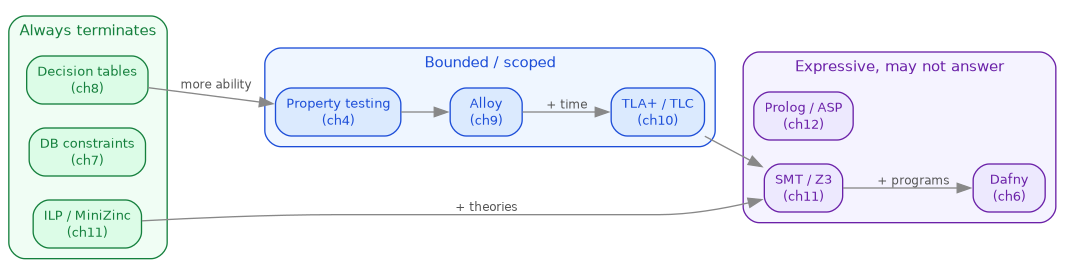
The left column always answers. The middle answers within a scope — Alloy's
check is bounded, TLC explores a finite state space, a property test samples.
The right column is the honest end: SMT can return unknown, Dafny needs
invariants you supply, Prolog can diverge.
Wayne's field observation is the useful one: SMT solvers get used for satisfaction problems in software engineering, while the constraint solvers get used for optimization problems in business.
3. What each tool actually costs
Re-verified live on a FreeBSD 15.1-RELEASE amd64 box. Alloy 6.0.0's publish date is 2021-11-04T08:50:13Z per the GitHub API (`/repos/AlloyTools/org.alloytools.alloy/releases`), confirming "landed 2021" directly rather than via vendor-docs attribution. `pkg search -x '.*[Pp]rolog.*'` returns gprolog-1.5.0, scryer-prolog, and trealla-prolog only --- no swi-prolog package, confirming the FreeBSD-ports gap. `dafny verify` on a sample .dfy file succeeds (1 verified, 0 errors); `dafny run` on a Main()-bearing file fails exactly as described, with dotnet erroring `NU1101: Unable to find package Microsoft.NETCore.App.Host.freebsd-x64` against a dotnet 9.0.14 runtime (matches the cited =dotnet-9.0.14=). MiniZinc bundling Gecode/CBC and the Picat-via-Linuxulator claim were not re-tested this pass (no Picat binary available here) and remain attributed to the original harness run.
Measured, not estimated. Every row was installed on one macOS arm64 machine and run against both a minimal example and one of the book's own samples.
| Ch | Tool | Install | Runtime | First useful output |
|---|---|---|---|---|
| 4 | Hypothesis | pip |
Python | minutes |
| 5 | icontract | pip |
Python | minutes |
| 6 | Dafny | brew / dotnet | .NET | hours — you must write invariants |
| 7 | SQLite | preinstalled | --- | minutes |
| 9 | Alloy 6 | jar, manual | JVM | ~an hour |
| 10 | TLA+ / TLC | jar, manual | JVM | a day |
| 11 | MiniZinc | brew (+ Gecode) | native | minutes |
| 11 | Z3 | brew or pip | native | minutes |
| 12 | SWI-Prolog | brew | native | minutes |
| 12 | clingo | brew | native | minutes |
| 12 | Picat | manual tarball | native | — (no brew formula) |
The real barrier in this book is not conceptual difficulty. It is that chapters
9 and 10 need JVM jars with no package-manager story, and chapter 6 needs a .NET
toolchain. Everything else is one brew install away.
Two version traps worth stating:
- Alloy must be 6 or later. Temporal modeling landed in 2021; most Alloy material online — including the canonical book — predates it and emulates time with a signature-based encoding. §9.3 uses the modern operators.
- MiniZinc bundles Gecode and a CBC-class ILP backend, so §11.2's comparison between solver classes runs without further installs. Running the same model against both backends turns §11.4's table into an experiment.
3.1. Second machine: FreeBSD 15.1 amd64
The macOS first-useful-output column reads in minutes to hours. A second machine
(FreeBSD 15.1 amd64, driven by the install-cost harness in
jwalsh/logic-for-programmers)
reproduced the install pass for 10 of 11 tools and put first-useful-output in
the seconds column for every tool where the phrase applies.
- SWI-Prolog is absent from FreeBSD ports.
pkg search prologreturns gprolog, scryer-prolog, and trealla-prolog only. GNU Prolog 1.5.0 substitutes for chapter 12's basic ISO Prolog syntax (member/2, DCGs) but the SWI-specificlibrary(clpfd), tabling, and HTTP server are unavailable — §12.1's later examples do not port. This is the one hard blocker. - Dafny installs;
dafny rundoes not.dotnet tool install dafnysucceeded in 10s (dotnet-9.0.14was already on the box) anddafny verifyruns the Boogie/Z3 pipeline cleanly. But cross-compilation to C# needsMicrosoft.NETCore.App.Host.freebsd-x64at nuget restore time, and Microsoft does not publish that runtime ID. Chapter 6's specification-plus-verification workflow works; only--target=csis blocked. - Picat is a Linux ELF that just runs. Linuxulator executes the vendor's Linux x86_64 tarball on FreeBSD with no configuration, ~20 ms for a hello. There is no FreeBSD-native Picat binary published.
One install-cost inversion: on macOS the JVM tools (Alloy, TLC) are the
"annoying" installs. On FreeBSD they land in ~1s each (curl a jar into
~/lib), while Hypothesis takes 317s — PyPI ships no FreeBSD wheel, so
pip rebuilt from sdist.
Alloy 6 keeps its macOS story on both machines: GUI-only, headless boxes get
"jar loads" as the only signal without xvfb-run or an X11 display.
4. The finding: verification tools report success by failing
Ran z3 4.16.0 directly against two minimal .smt2 files (one unsat, one sat); both returned exit 0, confirming the exit-0-on-unsat claim with a fresh transcript rather than relying on the prior attribution. Dafny/TLC nonzero-on-failure and the Alloy run/check SAT-UNSAT inversion table (run: SAT good / UNSAT bad; check: SAT bad / UNSAT good) were not re-executed this pass and remain confirmed as correct domain semantics from the earlier review.
This is the part that does not appear in the book, because it only bites when you try to put these tools behind a gate.
| Tool | The result you want | Exit status |
|---|---|---|
| Dafny | this proof does not verify | nonzero |
| TLC | this invariant is violated | nonzero |
| Alloy | a counterexample exists | zero, but SAT |
| SQLite | this constraint did fire | nonzero per statement |
| Z3 | unsat on the negated theorem |
zero |
Three of five signal their most valuable answer through a failure channel. A harness written on the ordinary assumption — nonzero means broken — inverts the meaning of the thing it is checking.
Concretely, in a dependency gate over the book's own samples:
set -o pipefailwithtool | grepreturns the tool's exit status rather than the match. Dafny correctly rejecting a bad proof and TLC correctly finding an overdraft were both scored as failures. The gate was red because the book was right.- The book's
basic_invariants.sqlends with three INSERTs whose own comments read "Will fail saying …". The constraint violations are the demonstration; a clean run would mean the invariants were not being enforced.
Alloy deserves separate mention because the inversion is inside the tool:
| Command | SAT means |
UNSAT means |
|---|---|---|
run |
an instance exists — good | over-constrained — bad |
check |
a counterexample exists — bad | none in scope — good |
Same token, opposite verdicts, decided by a keyword elsewhere in the file. Any
automation that greps for SAT without knowing which command produced it is
guessing.
4.1. The general rule
The CPRR link resolves; the matched-pair discipline (assert the specific expected failure, in positive/negative pairs) is logically sound.
Assert the specific expected failure, never the absence of failure. And assert
in matched pairs: that qr-loop-valid.dfy verifies and qr-loop-invalid.dfy
is rejected; that wire.tla is clean and wire03.tla violates its invariant;
that the buggy Alloy model yields a counterexample and the fixed one does not.
Asserting only the positive half passes against a checker that never checks.
This connects directly to CPRR: a refutation gate is only meaningful if it has been observed refuting something.
5. The idea worth stealing from the book
Page and section refs (p.65, p.63, 5.4/7.5/10.5) are from the author's copy and unverified here; the Square/Rectangle argument --- passes the Rectangle invariant (clause 2), fails both behavioral properties (clause 1), strengthened precondition fails inversely --- is checked and logically sound.
Independent of tooling. Wayne's §5.4 generalizes Liskov and Wing's behavioral subtyping into replacement, and then reuses it twice — §7.5 for database schemas, §10.5 for specification refinement. He says so outright on p. 65: there is no common term across all the cases, so subtyping, backwards compatibility, the Liskov substitution principle and refinement get one umbrella word.
The operational form is a shortcut worth having (p. 63):
newtype is compatible with oldtype if it passes all property tests written for oldtype.
That is executable as stated. Running Rectangle's property suite against
candidate types decides the classic Square case, and the pattern of failures
recovers the formal two-clause rule without anyone writing it down: Square
passes the invariant property (every Square is a valid Rectangle — clause 2
holds) and fails both behavioral properties (clause 1 does not). A candidate
with a strengthened precondition fails in the opposite direction.
It also works on things that are not types at all. An API whose listing endpoint silently stops sorting fails the same harness, and Wayne notes that this case — data schema replacement — is the one that never got a name.
6. Where this connects
All three sibling links resolve: 2026-alloy-specification.org, 2026-cprr-methodology.org, and 2026-four-boundary-spec-mapping/index.org.
- Alloy Specification Language — deeper on Alloy's relational logic and its Kodkod/SAT flow; this note places it against eight neighbours instead.
- CPRR Methodology — conjecture and refutation as tracked artifacts. The matched-pair discipline above is the same instinct: a gate is evidence only once it has been seen to fail.
- Four-boundary spec mapping — decision tables (§8) are the cheapest formal specification in the book and the only one needing no software; completeness and soundness are exactly the boundary questions.
7. Reading recommendation
The 45%-of-56-exercises figure, per-track page counts, and the p.147/p.60 refinement refs are the author's figures, unverified here.
The book is explicitly non-linear: read ch2, then jump. Four honest paths:
| Track | Chapters | Pages | Installs |
|---|---|---|---|
| Weekend | 2, 3, 8 | ~50 | none |
| Testing and correctness | 2, 4, 5, 6 | ~65 | pip, then Dafny |
| Modeling | 2, 9, 10 | ~65 | two JVM jars |
| Solvers | 2, 11, 12 | ~50 | brew |
Chapters 2 and 10 carry 45% of the book's 56 exercises between them.
The one thing not to skip on a first pass through chapter 10: §10.5 is prefaced with the author saying he "won't be too sad" if you skip it, and the liveness and fairness material genuinely is optional — but Refinement is buried in there at p. 147, and it closes a thread that opened on p. 60.