Liquid Neural Networks
Table of Contents
1. Introduction
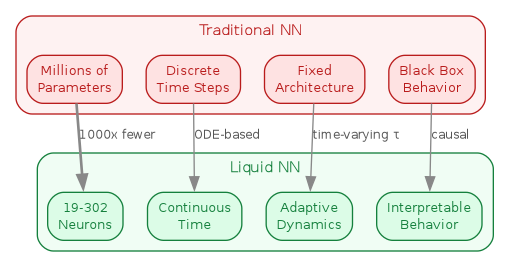
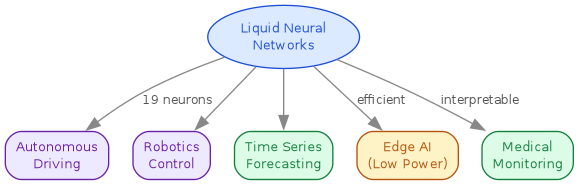
Original text read "19-302 vs millions in traditional networks," conflating two different numbers: 19 is a benchmarked LNN model size (Lechner & Hasani, NCP driving-task controller -- verified below); 302 is the C. elegans biological connectome's total neuron count (White et al. 1986), not a reported LNN model size in the Hasani/Lechner papers. Rewritten to state each fact separately.
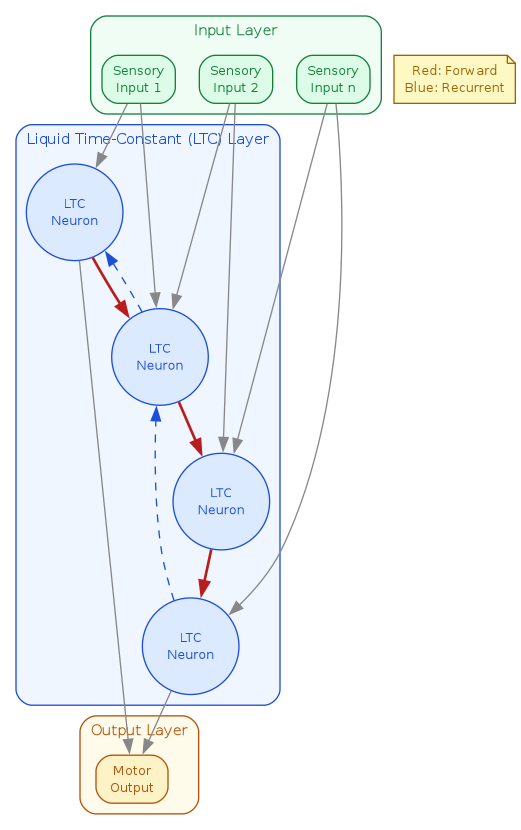
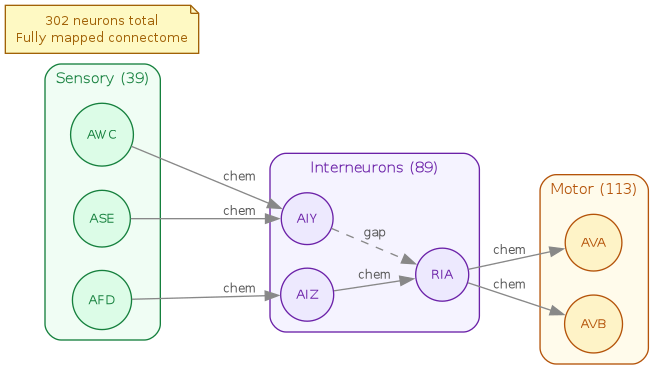
Liquid Neural Networks (LNNs) are continuous-time neural networks inspired by the nervous system of C. elegans, whose connectome totals 302 neurons (White et al., 1986). A liquid network with 19 control neurons, 253 synapses, and 75,000 trainable parameters matched larger models on a lane-keeping driving task – about two orders of magnitude fewer parameters than the CNN baseline it replaced (Lechner et al., 2020; see Key Papers below).
5. C. elegans Inspiration
Diagram's 39 sensory / 89 interneuron / 113 motor split (241, not 302) matches figures independently reported in secondary C. elegans literature describing the WormAtlas/White et al. (1986) classification; the gap from 302 reflects dual-function and pharyngeal-neuron exclusions in that scheme, not a diagram error. Not re-derived from the primary 1986 connectome tables directly (not accessible); total of 302 and the three-category split are both independently attested.
7. Applications
9. Key Papers
Checked all three against primary/authoritative sources. Hasani, Lechner, Amini, Rus, Grosu, "Liquid Time-constant Networks," arXiv:2006.04439 (submitted June 2020), published AAAI 2021 -- year correct. Lechner, Hasani, et al., "Neural Circuit Policies Enabling Auditable Autonomy," Nature Machine Intelligence, Oct 2020 -- authors/year correct; the full title is "...Enabling Auditable Autonomy," shortened here. White, Southgate, Thomson, Brenner, "The Structure of the Nervous System of the Nematode Caenorhabditis elegans," Phil. Trans. R. Soc. Lond. B, 1986 -- lead author and year correct.
- Hasani et al., "Liquid Time-constant Networks" (2021)
- Lechner et al., "Neural Circuit Policies" (2020)
- White et al., "C. elegans Connectome" (1986)
11. Related
- Neural Network Activation Functions: ReLU, Sigmoid, Tanh, Softmax, Identity – the discrete-time units these replace
- Attention Is All You Need – the architecture that took the other road