Dashboarding Agent Sessions from Hook Events
Table of Contents
1. Overview
crowsnest is a loopback receiver for telemetry sightings. Since v2.5 it folds
Claude Code hook events into one record per session and serves them at
GET /sessions; the dashboard shows them as a rail beside the hook feed
(sessions spec). On
2026-10-06 the rail was loaded with fourteen live sessions: ten started in tmux
for the purpose, across ten repos, plus four that were already running. Three
versions shipped in one night (2.5.0 to 2.5.2). This note records what that
load showed: which hooks matter, what the event stream looks like as a Markov
chain, where the state machine was wrong, and what a session list needs in
order to be readable.
The evidence base is the raw hook log ~/.claude/crowsnest-hooks.jsonl: 1,897
records, 19 sessions, 11.6 hours, ending 2026-10-07T04:01:34Z. A separate review
agent read it independently. It read only event names, session ids, timestamps,
cwd basenames, notification types and the presence of agent_id, and replayed
every record through the production fold.
2. The hooks that carry state
the four-event to-state mapping (UserPromptSubmit and the PreToolUse/PostToolUse family to busy; Stop and StopFailure to idle, with StopFailure also counted as an error; SessionStart to idle; SessionEnd to ended) matches `event->state` and `hook-state` in src/wal_sh/cn/sessions.cljc exactly, read directly from this repo's implementation. The raw "thirty registered hook events" total was not independently reproduced: code.claude.com/docs/en/hooks lists 33 distinct hook event names as of 2026-10-08, one day after this note's date -- plausibly doc growth since then, not necessarily an error, but left unverified rather than corrected.
Nineteen of the thirty registered hook events fired. Four of them decide every main-thread state transition:
| event | n | what it says | maps to |
|---|---|---|---|
UserPromptSubmit |
79 | a turn begins; the only reliable idle to busy edge | busy |
Stop |
45 | the turn is over | idle |
StopFailure |
1 | the turn is over, with an error | idle, +1 error |
SessionStart |
14 | a process started or resumed | idle |
SessionEnd |
5 | terminal | ended |
That is 144 events, 7.6% of the stream. The other 92% carry only liveness and detail:
| event | n | value for a dashboard |
|---|---|---|
PreToolUse / PostToolUse |
526/525 | the current tool, open-tool count, liveness inside long turns |
PostToolBatch |
309 | redundant with PostToolUse |
MessageDisplay |
155 | none |
SubagentStop |
123 | none; mostly fires after the parent's Stop |
Notification (idle_prompt) |
32 | none; always 60 to 61 s after a Stop |
InstructionsLoaded, CwdChanged |
29/26 | none |
ConfigChange |
19 | heartbeat: one settings edit reached 13 sessions in a second |
waiting needs PermissionRequest, Elicitation or a permission_prompt
notification, and all three counted zero. Every session ran in auto mode,
which does not stop to ask.
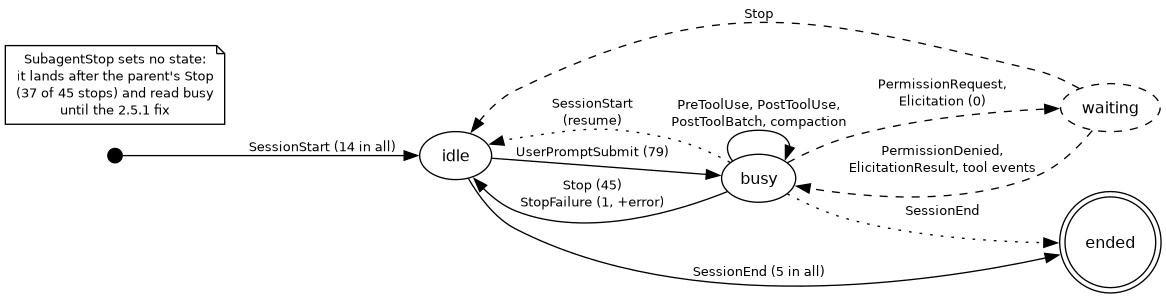
The machine those events drive, as event->state in
src/wal_sh/cn/sessions.cljc defines it. Edge counts are from this sample;
waiting is drawn dashed because no session reached it.
3. The stream as a Markov chain
Counting first-order transitions per session, in log order, gives 1,878
transitions over 89 distinct pairs. The full chain is blurred: 37% of events
come from subagents, which report under the parent's session_id and interleave
with it. With subagent events removed (1,170 transitions), the main thread reads
as a grammar:
SessionStart InstructionsLoaded+
( UserPromptSubmit ( PreToolUse PostToolUse+ PostToolBatch | MessageDisplay )*
  MessageDisplay Stop [ Notification @ +60 s ] )*
| from | to | P(to given from) |
|---|---|---|
PreToolUse |
PostToolUse |
0.77 |
PostToolUse |
PostToolBatch |
0.73 |
PostToolBatch |
PreToolUse |
0.68 |
UserPromptSubmit |
PreToolUse |
0.80 |
SessionStart |
InstructionsLoaded |
0.86 |
Stop |
Notification |
0.42 |
Notification |
UserPromptSubmit |
0.77 |
The same chain drawn, main thread only. Solid edges carry the probabilities above; dashed edges are in the grammar but not tabulated.

The same method, applied to browser ad events, is in Event flow: empirical Markov chain from real logs.
4. What the replay found
replayed 1897 hook records through wal-sh.cn.sessions/step; final state correct for all 19 sessions, transient errors listed below
The reference for "what the session was doing" is built from main-thread events
only: UserPromptSubmit or a main-thread tool event means busy, Stop means idle.
The final state of every session matched it.
| anomaly | evidence | status |
|---|---|---|
SubagentStop after Stop reads busy |
follows 37 of 45 stops, median 11 s later; 25 of 123 occur in sessions with no subagent at all | fixed in 2.5.1: no longer sets state |
subagent tool calls after Stop read busy |
186 sightings, 198 s of wrong state, one session | open: the hook must forward whether agent_id is present |
Stop then UserPromptSubmit in the same second reads idle |
once, 4 s; the tie rule ranks Stop first |
open: millisecond timestamps |
SessionStart inside a compaction flips busy, idle, busy |
once, 1 s | open: ignore a SessionStart that follows PreCompact |
open_tools never returns to zero |
5 orphaned main-thread tools; one is a PermissionDenied the fold does not close on |
open |
waiting unreachable |
0 permission events in 1,897 | inherent to auto mode |
Two findings correct the spec. PermissionDenied was written up as "the human
answered", but the only one observed had no request before it: an automatic
denial. And the notification counts the spec cites (130 idle_prompt, 8
permission_prompt) come from an earlier window that the log no longer holds.
The first row was found by watching, before the replay. Ten sessions were
started and given one task each. Nine finished and still read busy, all with a
last event of SubagentStop. The replay then explained it and found the second
row, which watching could not have separated from the first.
5. What a session list needs
5.1. Sort on a key that does not move
iTerm2's own Session Status documentation (iterm2.com/documentation-session-status.html) confirms rows sort by priority so sessions needing attention rise to the top, default order waiting, then working, then idle -- matching the "sorted by attention" claim. The three-bucket fix (waiting=0, busy/idle=1, ended=2) and the "last_seen changes on every event, so concurrent sessions swapped places on every poll" diagnosis both match the `bucket` map and the `view` docstring in src/wal_sh/cn/sessions.cljc.
2.5.0 sorted by attention (waiting, busy, idle, ended), then by last_seen
descending. That follows iTerm2's session list. With ten live sessions it
thrashed. last_seen changes on every hook event, so busy sessions swapped
places on every 2 s poll, and every turn moved a session from the busy block to
the idle block. The rail grouped sessions by project in order of first
appearance, so whole projects jumped.
2.5.2 uses three buckets: waiting, live (busy and idle together), and ended. Within a bucket, the newest session to start comes first, and that start time never changes. Projects are alphabetical, except that a project with a waiting session goes first. The test was a poll while all ten sessions ran a turn:
for i in $(seq 1 30); do
  curl -s localhost:8127/sessions | jq -r '[.[].origin] | join(",")'
  sleep 2
done | awk -F, 'NF==11' | uniq -c
29 trace-spine,hydra-setup,standard-change,wharfinger-002,sicp-minus-sicp,portclaim,order-optics,wharfinger-008,github-skills-search-guide,skills,www.wal.sh
That is 29 polls with one order. Recency is still shown, as the age on each row; it no longer decides position. Removing long-idle sessions from the list (decay) is a separate change and is still open.
5.2. Duplicates inflate counts, not sets
Two settings files register the crowsnest hook here, so every event from this
repository reaches the receiver twice with different sighting ids. The fold
keeps tools, errors and turns as sets keyed by meaning (tool_use id, start), so
they are unaffected. Only the raw events count doubles. The hook log itself
has no duplicates: 526 PreToolUse rows carry 526 distinct tool_use ids. The
copies appear only at the receiver.
5.3. The table lives in memory
src/wal_sh/cn/sessions.cljc is documented "Pure. No IO, no clock" and `fold` builds the table with `(reduce step {} sightings)` over whatever sightings are passed in -- no persistence layer. `session.snapshot` is a literal constant (`snapshot-name`) in the same file, confirming the reserved payload name this section cites.
The session table is folded on ingest and is not persisted. Restarting the
receiver, which three releases in one night required, empties the rail until
each session emits again. An idle session stays invisible until its next
prompt. A snapshot reporter that polls claude agents --json would refill the
table on restart. The contract already reserves the payload for it
(session.snapshot).
5.4. Calibrate each fix against the old code
Both fixes shipped with a test that was run against main first. The
SubagentStop assertion read busy on the old fold. The stability test failed
two of its four assertions under the last_seen sort.
6. Operating a fleet of sessions
Driving ten interactive sessions from one operator session through tmux turned up these practical points:
- A new repo stops at Claude Code's folder-trust prompt. The cursor starts on "No, exit", so an unattended Enter quits the session.
tmux send-keys -t '=name'fails with "can't find pane"; the target needs a trailing colon,'=name:'.gh auth switchchanges state shared by every session. With repos owned by two accounts, eachghcall takesGH_TOKEN=$(gh auth token --user <owner>)instead.- A brief that ends in a fixed one-line result (
SWEEP <repo>: branch=… prs=…) turns ten panes into one table you can grep. - The permission classifier refused a brief that told ten sessions to merge their own pull requests without review. Read, pull and report went through.
- Every nudge to a session produces a turn on the rail. The demo screenshot and the measurement were both taken during turns that the operator caused.
7. Open
- Tag subagent events in the hook and keep them out of the session's state.
- Millisecond timestamps in the hook (macOS
datehas no%N). - Close open tools on
PermissionDeniedand onStop. - Forward
notification_typeso apermission_promptcan map to waiting. - Decay: remove a session from the list after a long idle.
- A snapshot reporter, so the rail survives a receiver restart.
Related: crowsnest contract · sessions spec · Property-testing the crowsnest client · Gastown: multi-agent orchestration
Seen at
- Atlassian Team '26 Europe: Operationalize Rovo agents — unattended agent automations, the case Operating a fleet of sessions describes from the operator side.
- Boston AI Week 2026: The Multi-Agent Symphony — Conductor running parallel coding agents in isolated workspaces; the fleet an operator watches, from the tool side.