TLA+ for System Design: A CTO/L7 Engineer's Guide
Table of Contents
- 1. Overview
- 2. Background and History
- 3. Key Concepts
- 4. Common Patterns and Specifications
- 5. Real-World Industry Applications
- 6. Tools and Ecosystem
- 7. Learning Resources
- 8. Getting Started: A Practical Path
- 9. Integration with Development Workflow
- 10. Deep Dive Examples
- 11. Conclusion
- 12. References
- Seen at

1. Overview
TLA+ (Temporal Logic of Actions) is a formal specification language for designing, modeling, and verifying concurrent and distributed systems. Created by Leslie Lamport (Turing Award 2013), TLA+ enables engineers to catch critical design bugs before writing any implementation code.
1.1. Why TLA+ Matters for System Design
At scale, distributed systems exhibit behaviors that are nearly impossible to reason about through code review or traditional testing:
- Race conditions that manifest once per million requests
- Deadlocks that occur only under specific failure sequences
- Data corruption from unexpected state interleaving
- Protocol bugs that violate safety invariants
TLA+ addresses these by enabling exhaustive exploration of the state space before implementation.
1.2. The Business Case
| Problem | Traditional Approach | TLA+ Approach |
|---|---|---|
| Design validation | Code review, testing | Mathematical proof |
| Edge case discovery | Production incidents | Model checking |
| Documentation | Prose that diverges | Executable specs |
| Team alignment | Meetings, diagrams | Formal shared model |
| Confidence level | "Probably works" | "Verified correct" |
Amazon's experience: Engineers reported that TLA+ helped them find subtle bugs in DynamoDB, S3, and EBS that would have been extremely difficult to catch otherwise, potentially preventing costly outages.
1.3. E-Commerce Order Lifecycle
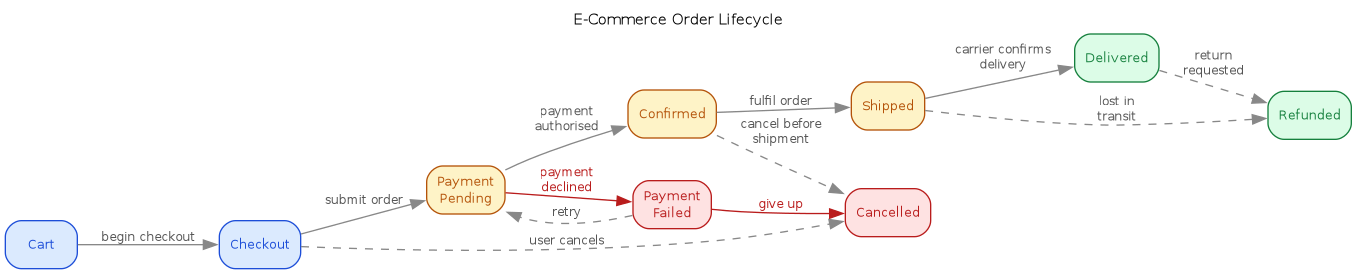
The following state machine shows the order lifecycle that TLA+ can formally verify – from cart through delivery, with explicit failure and cancellation paths. Each state corresponds to a variable assignment in the TLA+ model; transitions are actions whose preconditions guard against invalid state interleaving.
1.4. TLA+ Specification and Verification Workflow
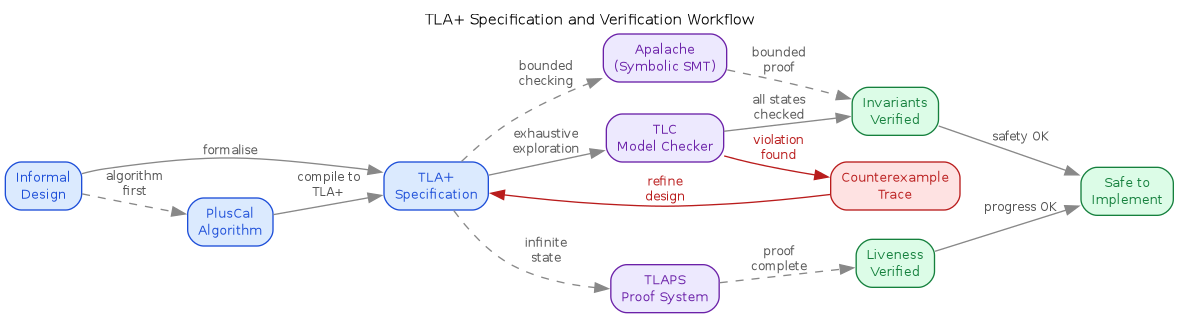
The pipeline below maps the full TLA+ workflow – from informal design to formal specification, through model checking tools (TLC, Apalache, TLAPS), and into either a verified implementation or a counterexample-driven refinement loop.
2. Background and History
2.1. Leslie Lamport and Formal Methods
Leslie Lamport developed TLA+ beginning in 1994, building on decades of work in distributed systems theory:
- 1978: Lamport introduces "Time, Clocks, and the Ordering of Events" - foundational work on logical clocks
- 1982: Byzantine fault tolerance (Lamport, Shostak, Pease)
- 1989: Paxos consensus algorithm (published 1998)
- 1994: TLA (Temporal Logic of Actions) introduced
- 1999: TLA+ specification language and tooling
- 2009: PlusCal algorithmic language added
- 2013: Lamport receives Turing Award
2.2. Relationship to Formal Methods
TLA+ sits in the practical middle ground of formal verification:
                    Rigor
                      ▲
                      │
    Theorem Provers   │   Coq, Isabelle/HOL, Lean
    (Full proofs)     │   ────────────────────────
                      │
    Model Checking    │   TLA+, Alloy, SPIN
    (Exhaustive)      │   ────────────────────────
                      │
    Property Testing  │   QuickCheck, Hypothesis
    (Randomized)      │   ────────────────────────
                      │
    Unit Testing      │   JUnit, pytest
    (Examples)        │
                      └──────────────────────────▶ Ease of Use
3. Key Concepts
3.1. State Machines and Behaviors
TLA+ models systems as state machines. A behavior is an infinite sequence of states:
State₀ → State₁ → State₂ → State₃ → ...
Each transition represents an atomic action that changes the system state.
---- MODULE Counter ----
VARIABLE count

Init == count = 0

Increment == count' = count + 1

Decrement == count > 0 /\ count' = count - 1

Next == Increment \/ Decrement

Spec == Init /\ [][Next]_count
====
Key elements:
VARIABLE: Declares state variablesInit: Initial state predicateNext: Transition relation (what can happen)Spec: Complete specification (init + behavior)- Primed variables (
count'): Next-state values
3.2. Temporal Logic
TLA+ uses temporal operators to express properties over behaviors:
| Operator | Meaning | Example |
|---|---|---|
[]P |
Always P (safety) | [](count >= 0) |
<>P |
Eventually P (liveness) | <>(count = 10) |
[]<>P |
Infinitely often P | []<>(enabled) |
<>[]P |
Eventually always P | <>[](stable) |
P ~> Q |
P leads to Q | request ~> response |
3.3. Safety vs. Liveness Properties
Safety: "Nothing bad ever happens"
- Type invariants
- Mutual exclusion
- Data consistency
Liveness: "Something good eventually happens"
- Requests get responses
- Messages are delivered
- Processes terminate
\* Safety: Account balance never goes negative
TypeInvariant == balance >= 0

\* Liveness: Every withdrawal request eventually completes
Liveness == \A r \in requests : <>(r.completed)
3.4. Specification vs. Implementation
TLA+ specifications are not programs. They describe what a system does, not how:
| Specification (TLA+) | Implementation (Code) |
|---|---|
| Abstract state | Concrete data structures |
| Non-determinism | Specific choices |
| Atomic actions | Multiple instructions |
| Infinite behaviors | Actual execution |
| Mathematical sets | Arrays, hash maps |
3.5. Model Checking with TLC
TLC (TLA+ Model Checker) exhaustively explores the state space:
- Start from initial states
- Apply all enabled actions
- Check invariants at each state
- Track visited states (no infinite loops)
- Report any property violations
┌────────────────────────────────────────────────────┐
│                  State Space                        │
│                                                     │
│    S₀ ──▶ S₁ ──▶ S₄                               │
│     │      │      │                                 │
│     ▼      ▼      ▼                                 │
│    S₂ ──▶ S₃ ──▶ S₅ ◀── Invariant violation!      │
│                  ▲                                  │
│                  │                                  │
│           Error trace provided                      │
│                                                     │
└────────────────────────────────────────────────────┘
TLC features:
- Symmetric model symmetry optimization
- Multi-threaded exploration
- Distributed checking across machines
- Counterexample traces for debugging
3.6. PlusCal: Higher-Level Syntax
PlusCal is an algorithmic language that compiles to TLA+, making specifications more accessible:
---- MODULE TransferPlusCal ----
EXTENDS Integers, TLC

CONSTANTS Accounts, InitBalance

(*--algorithm Transfer
variables
    balance = [a \in Accounts |-> InitBalance];

define
    TotalConstant ==
        LET Sum(S) == IF S = {} THEN 0
                      ELSE LET x == CHOOSE x \in S : TRUE
                           IN balance[x] + Sum(S \ {x})
        IN Sum(Accounts) = Cardinality(Accounts) * InitBalance
end define;

process Transfer \in 1..3
variables from, to, amount;
begin
    ChooseAccounts:
        from := CHOOSE a \in Accounts : TRUE;
        to := CHOOSE a \in Accounts : a /= from;
        amount := CHOOSE n \in 1..balance[from] : TRUE;
    DoTransfer:
        if balance[from] >= amount then
            balance[from] := balance[from] - amount;
            balance[to] := balance[to] + amount;
        end if;
end process;

end algorithm; *)
====
PlusCal advantages:
- Familiar imperative syntax
- Labels define atomicity
- Processes model concurrency
- Compiles to readable TLA+
4. Common Patterns and Specifications
4.1. Two-Phase Commit
---- MODULE TwoPhaseCommit ----
EXTENDS Integers, FiniteSets

CONSTANTS RM  \* Resource Managers

VARIABLES
    rmState,      \* State of each RM
    tmState,      \* State of Transaction Manager
    tmPrepared,   \* RMs that have prepared
    msgs          \* Messages in transit

vars == <<rmState, tmState, tmPrepared, msgs>>

Message == [type: {"Prepare", "Commit", "Abort", "Prepared", "Aborted"}]

TypeOK ==
    /\ rmState \in [RM -> {"working", "prepared", "committed", "aborted"}]
    /\ tmState \in {"init", "preparing", "committed", "aborted"}
    /\ tmPrepared \subseteq RM
    /\ msgs \subseteq Message

Init ==
    /\ rmState = [r \in RM |-> "working"]
    /\ tmState = "init"
    /\ tmPrepared = {}
    /\ msgs = {}

\* Transaction Manager sends Prepare to all RMs
TMPrepare ==
    /\ tmState = "init"
    /\ tmState' = "preparing"
    /\ msgs' = msgs \cup {[type |-> "Prepare"]}
    /\ UNCHANGED <<rmState, tmPrepared>>

\* RM receives Prepare and responds
RMPrepare(r) ==
    /\ rmState[r] = "working"
    /\ [type |-> "Prepare"] \in msgs
    /\ rmState' = [rmState EXCEPT ![r] = "prepared"]
    /\ msgs' = msgs \cup {[type |-> "Prepared"]}
    /\ UNCHANGED <<tmState, tmPrepared>>

\* RM can choose to abort
RMChooseAbort(r) ==
    /\ rmState[r] = "working"
    /\ rmState' = [rmState EXCEPT ![r] = "aborted"]
    /\ msgs' = msgs \cup {[type |-> "Aborted"]}
    /\ UNCHANGED <<tmState, tmPrepared>>

\* TM receives Prepared from RM
TMRcvPrepared(r) ==
    /\ tmState = "preparing"
    /\ [type |-> "Prepared"] \in msgs
    /\ tmPrepared' = tmPrepared \cup {r}
    /\ IF tmPrepared' = RM
       THEN /\ tmState' = "committed"
            /\ msgs' = msgs \cup {[type |-> "Commit"]}
       ELSE /\ UNCHANGED tmState
            /\ UNCHANGED msgs
    /\ UNCHANGED rmState

\* TM receives Aborted and aborts transaction
TMRcvAborted ==
    /\ tmState = "preparing"
    /\ [type |-> "Aborted"] \in msgs
    /\ tmState' = "aborted"
    /\ msgs' = msgs \cup {[type |-> "Abort"]}
    /\ UNCHANGED <<rmState, tmPrepared>>

\* RM commits
RMCommit(r) ==
    /\ rmState[r] = "prepared"
    /\ [type |-> "Commit"] \in msgs
    /\ rmState' = [rmState EXCEPT ![r] = "committed"]
    /\ UNCHANGED <<tmState, tmPrepared, msgs>>

\* RM aborts
RMAbort(r) ==
    /\ rmState[r] \in {"working", "prepared"}
    /\ [type |-> "Abort"] \in msgs
    /\ rmState' = [rmState EXCEPT ![r] = "aborted"]
    /\ UNCHANGED <<tmState, tmPrepared, msgs>>

Next ==
    \/ TMPrepare
    \/ TMRcvAborted
    \/ \E r \in RM :
        \/ RMPrepare(r)
        \/ RMChooseAbort(r)
        \/ TMRcvPrepared(r)
        \/ RMCommit(r)
        \/ RMAbort(r)

\* Safety: No RM commits if any RM aborts
Consistency ==
    \A r1, r2 \in RM :
        ~ (rmState[r1] = "committed" /\ rmState[r2] = "aborted")

Spec == Init /\ [][Next]_vars

THEOREM Spec => []Consistency
====
4.2. Distributed Lock (Lease-Based)
---- MODULE DistributedLock ----
EXTENDS Integers, Naturals

CONSTANTS
    Nodes,        \* Set of nodes
    MaxTime       \* Maximum simulation time

VARIABLES
    lock,         \* Current lock holder (or "none")
    leaseEnd,     \* When current lease expires
    time,         \* Global logical time
    requests      \* Pending lock requests

vars == <<lock, leaseEnd, time, requests>>

TypeOK ==
    /\ lock \in Nodes \cup {"none"}
    /\ leaseEnd \in 0..MaxTime
    /\ time \in 0..MaxTime
    /\ requests \subseteq Nodes

Init ==
    /\ lock = "none"
    /\ leaseEnd = 0
    /\ time = 0
    /\ requests = {}

\* Node requests the lock
Request(n) ==
    /\ n \notin requests
    /\ requests' = requests \cup {n}
    /\ UNCHANGED <<lock, leaseEnd, time>>

\* Lock is granted with a lease
Grant(n, duration) ==
    /\ n \in requests
    /\ \/ lock = "none"
       \/ time >= leaseEnd  \* Lease expired
    /\ lock' = n
    /\ leaseEnd' = time + duration
    /\ requests' = requests \ {n}
    /\ UNCHANGED time

\* Node releases lock early
Release(n) ==
    /\ lock = n
    /\ lock' = "none"
    /\ leaseEnd' = time
    /\ UNCHANGED <<time, requests>>

\* Time advances
Tick ==
    /\ time < MaxTime
    /\ time' = time + 1
    /\ UNCHANGED <<lock, leaseEnd, requests>>

\* Lease expires
Expire ==
    /\ lock /= "none"
    /\ time >= leaseEnd
    /\ lock' = "none"
    /\ UNCHANGED <<leaseEnd, time, requests>>

Next ==
    \/ \E n \in Nodes : Request(n)
    \/ \E n \in Nodes, d \in 1..5 : Grant(n, d)
    \/ \E n \in Nodes : Release(n)
    \/ Tick
    \/ Expire

\* Safety: At most one node holds the lock at any time
MutualExclusion ==
    \A n1, n2 \in Nodes :
        (lock = n1 /\ lock = n2) => n1 = n2

\* Liveness: Every request is eventually granted
EventualGrant ==
    \A n \in Nodes :
        (n \in requests) ~> (lock = n)

Spec == Init /\ [][Next]_vars /\ WF_vars(Next)
====
4.3. Message Queue with Ordering
---- MODULE OrderedQueue ----
EXTENDS Sequences, Integers, FiniteSets

CONSTANTS
    Producers,    \* Set of producer processes
    Consumers,    \* Set of consumer processes
    MaxQueueLen   \* Maximum queue length

VARIABLES
    queue,        \* The message queue
    produced,     \* Messages produced by each producer
    consumed,     \* Messages consumed by each consumer
    nextSeq       \* Next sequence number per producer

vars == <<queue, produced, consumed, nextSeq>>

Message == [producer: Producers, seq: Nat, data: Nat]

TypeOK ==
    /\ queue \in Seq(Message)
    /\ Len(queue) <= MaxQueueLen
    /\ produced \in [Producers -> Seq(Message)]
    /\ consumed \in [Consumers -> Seq(Message)]
    /\ nextSeq \in [Producers -> Nat]

Init ==
    /\ queue = <<>>
    /\ produced = [p \in Producers |-> <<>>]
    /\ consumed = [c \in Consumers |-> <<>>]
    /\ nextSeq = [p \in Producers |-> 1]

\* Producer sends a message
Produce(p, data) ==
    /\ Len(queue) < MaxQueueLen
    /\ LET msg == [producer |-> p, seq |-> nextSeq[p], data |-> data]
       IN /\ queue' = Append(queue, msg)
          /\ produced' = [produced EXCEPT ![p] = Append(@, msg)]
          /\ nextSeq' = [nextSeq EXCEPT ![p] = @ + 1]
    /\ UNCHANGED consumed

\* Consumer receives a message (FIFO)
Consume(c) ==
    /\ Len(queue) > 0
    /\ LET msg == Head(queue)
       IN /\ queue' = Tail(queue)
          /\ consumed' = [consumed EXCEPT ![c] = Append(@, msg)]
    /\ UNCHANGED <<produced, nextSeq>>

Next ==
    \/ \E p \in Producers, d \in 1..10 : Produce(p, d)
    \/ \E c \in Consumers : Consume(c)

\* Safety: FIFO ordering is preserved per producer
FIFOOrdering ==
    \A c \in Consumers :
        \A i, j \in 1..Len(consumed[c]) :
            (i < j /\ consumed[c][i].producer = consumed[c][j].producer)
            => consumed[c][i].seq < consumed[c][j].seq

\* Safety: No message duplication
NoDuplication ==
    \A c1, c2 \in Consumers :
        \A i \in 1..Len(consumed[c1]) :
            \A j \in 1..Len(consumed[c2]) :
                (c1 /= c2 \/ i /= j) =>
                    consumed[c1][i] /= consumed[c2][j]

Spec == Init /\ [][Next]_vars

THEOREM Spec => [](FIFOOrdering /\ NoDuplication)
====
4.4. Raft Consensus (Simplified)
---- MODULE RaftLeaderElection ----
EXTENDS Integers, FiniteSets

CONSTANTS
    Server,       \* Set of servers
    MaxTerm       \* Maximum term for model checking

VARIABLES
    currentTerm,  \* Current term for each server
    votedFor,     \* Who this server voted for in current term
    state,        \* follower, candidate, or leader
    votesGranted  \* Votes received by candidates

vars == <<currentTerm, votedFor, state, votesGranted>>

Quorum == {Q \in SUBSET Server : Cardinality(Q) * 2 > Cardinality(Server)}

TypeOK ==
    /\ currentTerm \in [Server -> 0..MaxTerm]
    /\ votedFor \in [Server -> Server \cup {NONE}]
    /\ state \in [Server -> {"follower", "candidate", "leader"}]
    /\ votesGranted \in [Server -> SUBSET Server]

Init ==
    /\ currentTerm = [s \in Server |-> 0]
    /\ votedFor = [s \in Server |-> NONE]
    /\ state = [s \in Server |-> "follower"]
    /\ votesGranted = [s \in Server |-> {}]

\* Server times out and starts election
StartElection(s) ==
    /\ state[s] \in {"follower", "candidate"}
    /\ currentTerm[s] < MaxTerm
    /\ currentTerm' = [currentTerm EXCEPT ![s] = @ + 1]
    /\ state' = [state EXCEPT ![s] = "candidate"]
    /\ votedFor' = [votedFor EXCEPT ![s] = s]
    /\ votesGranted' = [votesGranted EXCEPT ![s] = {s}]

\* Server grants vote to candidate
RequestVote(candidate, voter) ==
    /\ state[candidate] = "candidate"
    /\ currentTerm[candidate] >= currentTerm[voter]
    /\ \/ votedFor[voter] = NONE
       \/ votedFor[voter] = candidate
    /\ currentTerm' = [currentTerm EXCEPT ![voter] = currentTerm[candidate]]
    /\ votedFor' = [votedFor EXCEPT ![voter] = candidate]
    /\ votesGranted' = [votesGranted EXCEPT ![candidate] = @ \cup {voter}]
    /\ state' = [state EXCEPT ![voter] = IF currentTerm[voter] < currentTerm[candidate]
                                          THEN "follower" ELSE @]

\* Candidate wins election
BecomeLeader(s) ==
    /\ state[s] = "candidate"
    /\ votesGranted[s] \in Quorum
    /\ state' = [state EXCEPT ![s] = "leader"]
    /\ UNCHANGED <<currentTerm, votedFor, votesGranted>>

\* Server discovers higher term
StepDown(s, term) ==
    /\ term > currentTerm[s]
    /\ currentTerm' = [currentTerm EXCEPT ![s] = term]
    /\ state' = [state EXCEPT ![s] = "follower"]
    /\ votedFor' = [votedFor EXCEPT ![s] = NONE]
    /\ UNCHANGED votesGranted

Next ==
    \/ \E s \in Server : StartElection(s)
    \/ \E c, v \in Server : RequestVote(c, v)
    \/ \E s \in Server : BecomeLeader(s)
    \/ \E s \in Server, t \in 1..MaxTerm : StepDown(s, t)

\* Safety: At most one leader per term
ElectionSafety ==
    \A s1, s2 \in Server :
        (state[s1] = "leader" /\ state[s2] = "leader" /\
         currentTerm[s1] = currentTerm[s2])
        => s1 = s2

Spec == Init /\ [][Next]_vars

THEOREM Spec => []ElectionSafety
====
5. Real-World Industry Applications
5.1. Amazon Web Services
Their 2015 paper "How Amazon Web Services Uses Formal Methods" describes extensive use:
5.1.1. DynamoDB
The blockquote attributed to "Amazon DynamoDB team" does not appear in either Amazon source (Newcombe et al., "Use of Formal Methods at Amazon Web Services," 2014 technical report, fetched directly; CACM 2015 version checked via proxy fetch). Per the primary source, TLC found 1 subtle bug in DynamoDB's main replication algorithm (shortest error trace: 35 steps) plus 2 more bugs in other algorithms -- 3 bugs total, matching the paper's own summary table ("DynamoDB ... Found 3 bugs, some requiring traces of 35 steps"). The "two bugs" detail in the quote instead matches the paper's account of S3's network algorithm ("Model checking revealed two subtle bugs in the algorithm"), not DynamoDB. Replaced with a verbatim sentence from the primary source.
- Verified replication protocol correctness
- Found subtle bugs in the original design
- Caught edge cases in failure recovery
"This was a very subtle bug; the shortest error trace exhibiting the bug contained 35 high level steps." – Newcombe, Rath, Zhang, Munteanu, Brooker, Deardeuff, "Use of Formal Methods at Amazon Web Services" (2014)
5.1.2. S3 (Simple Storage Service)
- Modeled internal consistency protocols
- Verified garbage collection doesn't delete live data
- Caught concurrency bugs in background processes
5.1.3. EBS (Elastic Block Store)
- Verified snapshot consistency
- Modeled replication across availability zones
- Found bugs in volume migration logic
5.1.4. Internal Tooling
Amazon built internal tools around TLA+:
- IDE integration with their development environment
- CI/CD integration for spec checking
- Training programs for engineers
5.2. Microsoft
5.2.1. Azure Cosmos DB
The blockquote attributed to "Azure Cosmos DB team" does not appear in the project's own primary source, the Azure/azure-cosmos-tla GitHub repository (fetched directly). That README states instead: "The Cosmos DB engineering team heavily relies on TLA+ for specifying distributed algorithms and protocols mathematically and model checking them for correctness to verify the design decisions and address the corner cases induced by concurrency and faults." Replaced with this verbatim sentence.
Microsoft used TLA+ extensively for Cosmos DB's global distribution:
- Five consistency levels formally verified
- Conflict resolution protocols modeled
- Partition split operations validated
"The Cosmos DB engineering team heavily relies on TLA+ for specifying distributed algorithms and protocols mathematically and model checking them for correctness to verify the design decisions and address the corner cases induced by concurrency and faults." – Azure/azure-cosmos-tla, GitHub repository README
5.2.2. Xbox Live
- Modeled multiplayer game state synchronization
- Verified matchmaking queue fairness
- Validated anti-cheat detection timing
5.2.3. Other Microsoft Products
- Azure Storage
- Coyote (previously P#) - C# concurrency testing
- Service Fabric distributed systems
5.3. Elasticsearch
Elasticsearch used TLA+ for their distributed replication:
- Primary-backup replication protocol
- Cluster state management
- Shard allocation decisions
They open-sourced their specifications, providing valuable learning resources.
5.4. MongoDB
MongoDB employed TLA+ for:
- Replica set elections
- Sharding protocol changes
- Transaction isolation verification
5.5. CockroachDB
CockroachDB (distributed SQL database) uses TLA+ for:
- Raft consensus implementation
- Distributed transaction protocols
- Schema change coordination
5.6. Other Notable Users
| Company | Use Case |
|---|---|
| Confluent | Kafka replication protocol |
| PingCAP | TiDB distributed transactions |
| Thales | Safety-critical embedded systems |
| Intel | Cache coherence protocols |
6. Tools and Ecosystem
6.1. TLA+ Toolbox
The official IDE for TLA+:
- Spec editor with syntax highlighting
- TLC model checker integration
- TLAPS proof assistant integration
- Trace explorer for counterexamples
Download: https://lamport.azurewebsites.net/tla/toolbox.html
6.2. VS Code Extensions
6.2.1. TLA+ Nightly (recommended)
Extension ID: alygin.vscode-tlaplus
Features:
- Syntax highlighting
- TLC integration
- PlusCal translation
- Error diagnostics
- Code snippets
6.2.2. TLA+ (Official Microsoft)
Extension ID: alygin.vscode-tlaplus-nightly
More experimental features, faster updates.
6.3. TLC Model Checker
TLC is the workhorse of TLA+ verification:
# Run model checker from command line
java -jar tla2tools.jar -modelcheck YourSpec.tla

# With configuration file
java -jar tla2tools.jar -modelcheck -config YourSpec.cfg YourSpec.tla

# Distributed mode (multiple workers)
java -jar tla2tools.jar -modelcheck -workers 4 YourSpec.tla
Configuration file (.cfg):
SPECIFICATION Spec
INVARIANT TypeOK
INVARIANT Safety
PROPERTY Liveness

CONSTANT
    Nodes = {n1, n2, n3}
    MaxMessages = 5
6.4. TLAPS (TLA+ Proof System)
For when model checking isn't enough (infinite state spaces):
THEOREM TypeCorrect == Spec => []TypeOK
  <1>1. Init => TypeOK
    BY DEF Init, TypeOK
  <1>2. TypeOK /\ [Next]_vars => TypeOK'
    <2>1. CASE Action1
      BY <2>1 DEF TypeOK, Action1
    <2>2. CASE Action2
      BY <2>2 DEF TypeOK, Action2
    <2>3. CASE UNCHANGED vars
      BY <2>3 DEF TypeOK
    <2>4. QED
      BY <2>1, <2>2, <2>3 DEF Next
  <1>3. QED
    BY <1>1, <1>2, PTL DEF Spec
TLAPS integrates with SMT solvers (Z3, CVC4) and proof assistants (Isabelle).
6.5. Apalache: Symbolic Model Checker
Apalache is a modern symbolic model checker for TLA+:
- Bounded model checking
- Handles larger state spaces than TLC
- Type inference and checking
- SMT-based verification
# Type checking
apalache-mc typecheck YourSpec.tla

# Bounded model checking
apalache-mc check --length=10 YourSpec.tla

# Check specific invariant
apalache-mc check --inv=Safety YourSpec.tla
Advantages over TLC:
- Better handling of integer arithmetic
- Symbolic exploration (not explicit enumeration)
- Type annotations for clarity
6.6. Formal Verification Tool Comparison
| Tool | Approach | Strengths | Limitations |
|---|---|---|---|
| TLC | Explicit model checking | Complete exploration | Memory bound |
| Apalache | Symbolic/SMT | Large state spaces | Bounded depth |
| TLAPS | Theorem proving | Infinite systems | Manual effort |
6.7. Complementary Tools
6.7.1. Alloy
Lightweight formal modeling, good for data models:
sig Node {
    neighbors: set Node
}

fact symmetric {
    all n1, n2: Node | n1 in n2.neighbors <=> n2 in n1.neighbors
}

pred connected {
    all n1, n2: Node | n1 in n2.^neighbors
}

run connected for 5 Node
6.7.2. SPIN/Promela
Process algebra approach, good for protocol verification:
mtype = { request, response };
chan channel = [10] of { mtype, int };

proctype Client(int id) {
    channel ! request, id;
    channel ? response, id;
}
7. Learning Resources
7.1. Official Resources
7.1.1. Lamport's TLA+ Video Course
The TLA+ Video Course by Leslie Lamport himself:
- 10+ hours of video lectures
- Starts from basics
- Covers PlusCal and TLC
- Free on Lamport's website
7.1.2. TLA+ Home Page
https://lamport.azurewebsites.net/tla/tla.html
- Language reference
- Tool downloads
- Example specifications
- Research papers
7.2. Books
7.2.1. Practical TLA+ (Hillel Wayne)
Practical TLA+: Planning Driven Development (Apress, 2018)
- Practical, example-driven approach
- Focuses on software engineers (not academics)
- Real-world scenarios
- PlusCal-first teaching
7.2.2. Specifying Systems (Lamport)
Specifying Systems: The TLA+ Language and Tools for Hardware and Software Engineers
- Free PDF available
- Comprehensive reference
- More theoretical depth
- Complete language specification
7.3. Online Resources
7.3.1. Learn TLA+
Hillel Wayne's online tutorial:
- Interactive examples
- Progressive difficulty
- Modern tooling focus
7.3.2. TLA+ Community Resources
- Example specifications
- Tool source code
- Community contributions
7.3.3. Dr. TLA+ Series
Video series covering specific algorithms:
- Paxos
- Raft
- Two-Phase Commit
- Byzantine Paxos
7.4. Papers and Articles
7.4.1. Essential Papers
- "How Amazon Web Services Uses Formal Methods" (2015)
- Newcombe, Rath, Zhang, Munteanu, Brooker, Deardeuff
- CACM, April 2015
- https://cacm.acm.org/magazines/2015/4/184701-how-amazon-web-services-uses-formal-methods/fulltext
- "Use of Formal Methods at Amazon Web Services" (2014)
- Detailed technical report
- http://research.microsoft.com/en-us/um/people/lamport/tla/formal-methods-amazon.pdf
- "The TLA+ Proof System: Building a Heterogeneous Verification Platform" (2012)
- TLAPS architecture paper
7.4.2. Blog Posts and Tutorials
- Hillel Wayne's TLA+ Posts - Excellent practical examples
- Pragmatic Formal Modeling - Industry-focused guide
- Introduction to Formal Verification - Beginner-friendly
7.5. Community
7.5.1. TLA+ Google Group
https://groups.google.com/g/tlaplus
Active community, Lamport occasionally participates.
7.5.2. TLA+ Discord/Slack
Community chat channels for real-time help.
7.5.3. Conferences
- Strange Loop (frequent TLA+ talks)
- PODC (Principles of Distributed Computing)
- DISC (Distributed Computing)
8. Getting Started: A Practical Path
8.1. Week 1-2: Foundations
- Watch Lamport's Video Course (Lectures 1-5)
- Install TLA+ Toolbox
- Work through Die Hard example
- Read "Practical TLA+" Chapters 1-3
8.2. Week 3-4: Core Concepts
- Complete video course
- Model a simple protocol (mutex, producer-consumer)
- Learn PlusCal syntax
- Run TLC model checker
8.3. Week 5-6: Real Applications
- Study Amazon's published specs
- Model a system from your own work
- Learn to interpret counterexamples
- Practice finding bugs intentionally
8.4. Week 7-8: Advanced Topics
- Temporal properties and liveness
- TLAPS basics (optional)
- Apalache for larger state spaces
- Review industry case studies
8.5. Ongoing Practice
- Spec new designs before implementing
- Keep a library of reusable patterns
- Share specs for code review
- Mentor others
9. Integration with Development Workflow
9.1. When to Use TLA+
TLA+ is most valuable for:
| Good Fit | Poor Fit |
|---|---|
| Distributed protocols | CRUD applications |
| Consensus algorithms | UI logic |
| Concurrency primitives | Single-threaded code |
| Failure handling | Well-understood patterns |
| Critical infrastructure | Rapid prototypes |
9.2. Design Phase Integration
┌─────────────────────────────────────────────────────────┐
│                   Design Process                        │
│                                                         │
│  Requirements ──▶ Informal Design ──▶ TLA+ Spec         │
│       │                                   │             │
│       │                                   ▼             │
│       │                            Model Checking       │
│       │                                   │             │
│       │              ┌────────────────────┼────────┐    │
│       │              │                    │        │    │
│       │         Bug Found?           Verified      │    │
│       │              │                    │        │    │
│       │              ▼                    ▼        │    │
│       │         Fix Design          Implementation │    │
│       │              │                    │        │    │
│       │              └────────────────────┘        │    │
│       │                                            │    │
│       └────────────────────────────────────────────┘    │
│                                                         │
└─────────────────────────────────────────────────────────┘
9.3. CI/CD Integration
# .github/workflows/tla-check.yml
name: TLA+ Model Checking

on:
  push:
    paths:
      - 'specs/**/*.tla'
      - 'specs/**/*.cfg'

jobs:
  model-check:
    runs-on: ubuntu-latest
    steps:
      - uses: actions/checkout@v4

      - name: Install TLA+ Tools
        run: |
          wget https://github.com/tlaplus/tlaplus/releases/download/v1.8.0/tla2tools.jar

      - name: Run TLC
        run: |
          for spec in specs/*.tla; do
            java -jar tla2tools.jar -modelcheck "$spec"
          done
9.4. Documentation as Specification
TLA+ specs serve as executable documentation:
docs/
├── architecture.md      # High-level overview
├── protocols/
│   ├── replication.tla  # Formal spec
│   ├── replication.cfg  # Model config
│   └── replication.md   # Plain English explanation
└── decisions/
    └── ADR-001-consistency-model.md
10. Deep Dive Examples
Explore complete TLA+ specifications for common system design patterns:
- E-Commerce Order State Machine - Models cart, order, shipment, and status synchronization in microservices. Detects state mismatches, race conditions, and partition failures.
- Traffic Lights & Communication Protocol - Two small TLC-checked specs: a controller-driven traffic light across three intersections, and a PlusCal priority-buffered message protocol with drop-on-full.
10.1. Ball Replacement Urn Problem
An urn contains n balls, each black or white. Repeatedly draw two balls at random. If they are the same color, discard both and put one black ball back. If they are different colors, discard the black and put the white ball back. The urn shrinks by one ball each step. What color is the last remaining ball?

The invariant: each step either removes two white balls or zero white balls. The parity of white balls is preserved across every transition. Therefore the last ball is white if the initial count of white balls is odd, black if even.
---------------------------- MODULE UrnBalls ----------------------------
EXTENDS Naturals

CONSTANTS N, W0  \* total balls, initial white count (W0 <= N)

VARIABLES black, white

Init == /\ white = W0
        /\ black = N - W0

DrawSame == /\ (black + white) > 1
            /\ \/ /\ black >= 2          \* drew BB
                  /\ black' = black - 1  \* remove 2, add 1 black
                  /\ white' = white
               \/ /\ white >= 2          \* drew WW
                  /\ white' = white - 2  \* remove 2 white
                  /\ black' = black + 1  \* add 1 black

DrawDiff == /\ black >= 1
            /\ white >= 1
            /\ black' = black - 1  \* discard the black
            /\ white' = white      \* white survives

Next == DrawSame \/ DrawDiff

ParityInvariant == (white % 2) = (W0 % 2)

Termination == <>(black + white = 1)

LastBallColor == [](black + white = 1 =>
                    IF W0 % 2 = 1 THEN white = 1
                                  ELSE black = 1)
=====================================================================
TLC model-checks this instantly for small N. The ParityInvariant holds
in every reachable state. LastBallColor is the temporal property: once the
urn has one ball, its color matches the parity of W0.
11. Conclusion
- Catch bugs before implementation: Find design flaws when they're cheap to fix
- Build confidence: Know your system handles edge cases
- Improve communication: Specs are precise, executable documentation
- Learn deeply: Formal modeling forces rigorous thinking
"TLA+ won't find the bug in your code. It will find the bug in your design." – Leslie Lamport (paraphrased)
12. References
12.1. Core References
- Lamport, L. (2002). Specifying Systems: The TLA+ Language and Tools for Hardware and Software Engineers.
- Wayne, H. (2018). Practical TLA+: Planning Driven Development. Apress.
- Newcombe, C., et al. (2015). How Amazon Web Services Uses Formal Methods. CACM.
12.2. Industry Case Studies
- Amazon DynamoDB formal specification
- Microsoft Azure Cosmos DB consistency proofs
- Elasticsearch replication protocol specs
- CockroachDB Raft implementation
12.3. Tools
- TLA+ Toolbox: https://lamport.azurewebsites.net/tla/toolbox.html
- Apalache: https://apalache.informal.systems/
- VS Code Extension: https://marketplace.visualstudio.com/items?itemName=alygin.vscode-tlaplus
12.4. Learning Paths
- Lamport Video Course: https://lamport.azurewebsites.net/video/videos.html
- Learn TLA+: https://learntla.com/
- TLA+ Examples Repository: https://github.com/tlaplus/Examples
Seen at
- BugBash 2026 — Gabriela Moreira's Behaviors as the backbone of software correctness (Quint, TLA+).
- SPLASH/ISSTA 2026 — Specy and PRDTs: specifications learned from traces, and verified consensus protocols.