Effective TypeScript: Strategies and Patterns
Table of Contents
- 1. Effective TypeScript
- 2. Type System
- 2.1. Editors
- 2.2. Sets of Values
- 2.3. Type Space vs. Value Space
- 2.4. Type Declarations
- 2.5. Avoid Object Wrapper Types
- 2.6. Excessive Property Checking
- 2.7. Function Expressions
- 2.8. Type vs. Interface
- 2.9. Operations and Generics
- 2.10. Index Signatures
- 2.11. Arrays, Tuples, and ArrayLike
- 2.12. readonly
- 2.13. Mapped Types
- 3. Type Inference
- 4. Type Design
- 5. Working with any
- 6. Types Declarations and @types
- 7. Writing and Running Code
- 8. Migration
- 9. 2026 Review
- 9.1. TypeScript 5.7 and 5.8 (late 2025 through 2026)
- 9.2. The Go Rewrite of tsc (announced March 2025)
- 9.3. TypeScript in Node.js (–experimental-strip-types, Node 23+)
- 9.4. Deno 2.x and Bun – TypeScript-first runtimes
- 9.5. Type System Advances
- 9.6. TypeScript in the Agent Era
- 9.7. Compilation Targets Diagram
2. Type System
2.1. Editors
2.2. Sets of Values
2.4. Type Declarations
2.7. Function Expressions
2.8. Type vs. Interface
2.10. Index Signatures
2.12. readonly
2.13. Mapped Types
3. Type Inference
3.1. Variables
3.2. Type Widening
3.3. Type Narrowing
3.5. Aliases
3.6. async vs Callbacks
3.7. Context
4. Type Design
4.1. Valid States
4.3. Documentation
4.5. Unions of Interfaces
4.9. Problem Domain
4.10. Brands
5. Working with any
5.3. Hide Unsafe
5.4. Evolving any
5.5. Use unknown
5.6. Monkey Patching
5.7. Track Type Coverage
6. Types Declarations and @types
6.1. devDependencies
6.2. Three Versions
6.3. Exports
6.4. TSDoc
6.5. this in Callbacks
6.6. Conditional Types
6.7. Mirror Types
6.8. Testing Types
8. Migration
8.1. Modern JavaScript
8.2. @ts-checking
8.3. allowJs
8.4. Module Conversion
8.5. noImplicitAny
9. 2026 Review
9.1. TypeScript 5.7 and 5.8 (late 2025 through 2026)
TypeScript 5.7 (November 2025) and 5.8 (early 2026) continued the pattern of
incremental precision: --isolatedDeclarations stabilization for parallel
d.ts emit, import attributes GA, --noUncheckedSideEffectImports, and
--erasableSyntaxOnly (prerequisite for native TS execution). The 5.8 cycle
hardened const type parameters and graduated NoInfer from experimental to
stable.
Notable changes across the two releases:
satisfiesoperator fully adopted across major libraries and frameworksconsttype parameters allow callers to pin literal types without assertionsNoInfer<T>prevents type inference from flowing through a specific site--isolatedDeclarationsenables build tools to parallelize .d.ts generation--erasableSyntaxOnlyrejects enums and namespaces that survive erasure, enabling drop-in compatibility with Node.js native strip-types mode
9.2. The Go Rewrite of tsc (announced March 2025)
In March 2025 Microsoft announced a port of the TypeScript compiler to Go, targeting a 10x throughput improvement. The key design decisions:
- Structural equivalence to the JS compiler: same AST shapes, same type algorithm, same error messages
- Native concurrency in the Go runtime replaces single-threaded JS semantics
- Language server (tsserver) rewritten alongside the compiler, preserving the LSP surface
- Opt-in via
--newTscflag; expected to become the default in a 7.x release
The port does not change the language itself – only the implementation. Existing code, tsconfig options, and d.ts files are unaffected.
9.3. TypeScript in Node.js (–experimental-strip-types, Node 23+)
Node.js 22.6 introduced --experimental-strip-types, promoted to unflagged in
Node.js 23. The mechanism:
- The loader invokes a lightweight transform (based on
@swc/wasm-typescript) that erases type annotations without re-ordering code - Only erasable syntax is allowed: type annotations, interfaces, type aliases,
generic parameters. Enums and namespaces require
--experimental-transform-types - No tsconfig lookup at runtime; type-checking remains a separate build step
- Compatible with ESM and CJS module resolution
The result is that node --experimental-strip-types app.ts works without a
build step in Node 23, making TypeScript a first-class scripting language on the
platform.
9.4. Deno 2.x and Bun – TypeScript-first runtimes
Deno 2.0 (October 2024) and its subsequent 2.x releases stabilized the transition from Deno 1.x's opinionated stdlib to npm/Node compatibility:
- Full npm package resolution and
node_modulessupport deno compileproduces self-contained binaries from TypeScript entry points- Built-in formatter (
deno fmt), linter (deno lint), and test runner understand TypeScript natively - JSR (JavaScript Registry) as the preferred module registry, with mandatory type declarations
Bun continues to support TypeScript by default via its built-in transpiler (Zig + JavaScriptCore), with sub-millisecond startup times for most scripts. Bun added a native lockfile format in 1.x and stabilized its macros API.
9.5. Type System Advances
9.5.1. satisfies operator maturity
satisfies (introduced in 4.9) reached ubiquity in 2026: it validates an
expression against a type without widening the inferred type. This is the
idiomatic replacement for many as-cast patterns.
type Palette = Record<string, [number, number, number] | string>;

const colors = {
  red: [255, 0, 0],
  green: "#00ff00",
  blue: [0, 0, 255],
} satisfies Palette;

// Narrowed to string (not string | [number,number,number]) because satisfies
// validates without widening the inferred type.
const hexGreen: string = colors.green;
const redChannel: number = colors.red[0];
9.5.2. const type parameters
A const modifier on a generic parameter tells the compiler to infer the
narrowest possible (literal / tuple / readonly) type for the argument.
// Without `const`, T widens to string[] and Page becomes string.
function route<const T extends readonly string[]>(paths: T): T {
  return paths;
}

const pages = route(["home", "about", "contact"]);
type Page = (typeof pages)[number]; // "home" | "about" | "contact"
9.5.3. NoInfer utility type
NoInfer<T> blocks type inference from flowing through the wrapped position.
Useful when a function should infer a type from one argument and then validate
(not widen) other arguments against it.
// NoInfer blocks T from being widened by the reducer's return type.
// Without it, a reducer that returns a supertype would silently change T.
function createStore<T>(
  initial: T,
  reducer: (state: NoInfer<T>, action: string) => NoInfer<T>,
): { state: T } {
  return { state: reducer(initial, "init") };
}

const store = createStore(
  { count: 0 },
  (state, _action) => ({ count: state.count + 1 }),
);
9.6. TypeScript in the Agent Era
The Anthropic SDK, Vercel AI SDK, and MCP TypeScript SDK define the current idioms for TypeScript in agent systems.
The Anthropic SDK (@anthropic-ai/sdk) ships full TypeScript declarations for
all message types, tool call schemas, and streaming events. The Vercel AI SDK
(ai package) provides a unified interface across providers with
generateText, streamText, and generateObject (which takes a Zod schema
and returns a validated typed object). The MCP TypeScript SDK
(@modelcontextprotocol/sdk) defines the transport and message types for the
Model Context Protocol.
Common patterns emerging in this space:
- Zod-first tool schemas: tool parameters defined once in Zod, then inferred as TypeScript types and serialized to JSON Schema at runtime
- Discriminated unions for agent message types (user / assistant / tool_result)
satisfiesfor provider configuration objects to preserve string literals while validating against a broader config typeconsttype parameters for typed prompt template functions- Streaming with typed
AsyncIterable<T>return types
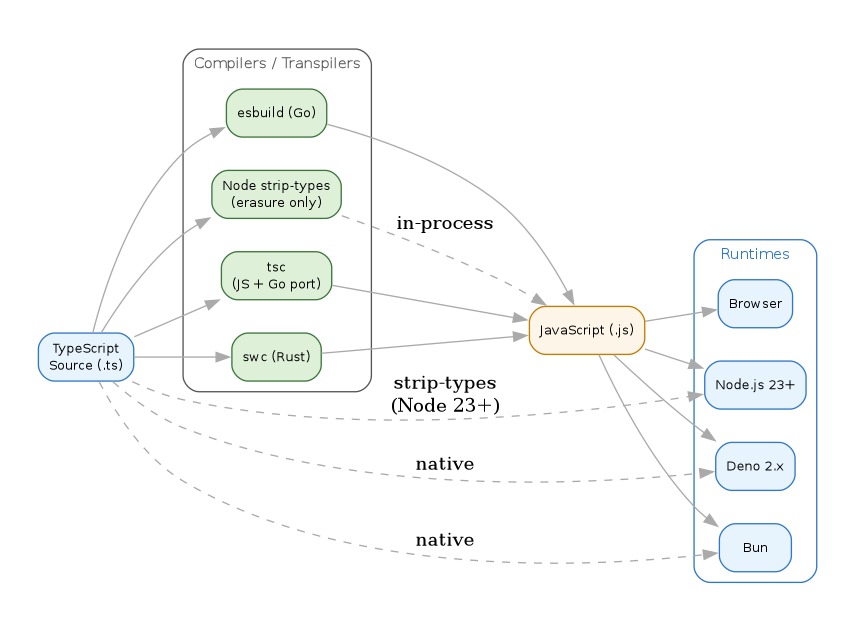
9.7. Compilation Targets Diagram
// TypeScript compilation targets -- 2026
digraph ts_targets {
    rankdir=LR;
    graph [bgcolor="white", fontname="Helvetica", fontsize=11,
           pad="0.4", nodesep="0.35", ranksep="0.6"];
    node  [shape=box, style="rounded,filled", fontname="Helvetica",
           fontsize=10, fillcolor="#dbeafe", color="#888"];
    edge  [color="#aaa"];

    ts_source [label="TypeScript\nSource (.ts)", fillcolor="#e8f4fd", color="#3178c6"];

    subgraph cluster_compilers {
        label="Compilers / Transpilers"; style="rounded"; color="#555"; fontcolor="#555";
        tsc     [label="tsc\n(JS + Go port)", fillcolor="#dff0d8", color="#3c763d"];
        swc     [label="swc (Rust)",          fillcolor="#dff0d8", color="#3c763d"];
        esbuild [label="esbuild (Go)",        fillcolor="#dff0d8", color="#3c763d"];
        strip   [label="Node strip-types\n(erasure only)", fillcolor="#dff0d8", color="#3c763d"];
    }

    js_out [label="JavaScript (.js)", fillcolor="#fdf5e8", color="#c67b00"];

    subgraph cluster_runtimes {
        label="Runtimes"; style="rounded"; color="#3178c6"; fontcolor="#3178c6";
        node_rt   [label="Node.js 23+",  fillcolor="#e8f4fd", color="#3178c6"];
        deno_rt   [label="Deno 2.x",     fillcolor="#e8f4fd", color="#3178c6"];
        bun_rt    [label="Bun",          fillcolor="#e8f4fd", color="#3178c6"];
        browser   [label="Browser",      fillcolor="#e8f4fd", color="#3178c6"];
    }

    ts_source -> tsc;
    ts_source -> swc;
    ts_source -> esbuild;
    ts_source -> strip;

    tsc     -> js_out;
    swc     -> js_out;
    esbuild -> js_out;
    strip   -> js_out [style=dashed, label="in-process"];

    js_out -> node_rt;
    js_out -> deno_rt;
    js_out -> bun_rt;
    js_out -> browser;

    // Direct native TS execution paths (no separate JS artifact)
    ts_source -> deno_rt [style=dashed, color="#aaa", label="native"];
    ts_source -> bun_rt  [style=dashed, color="#aaa", label="native"];
    ts_source -> node_rt [style=dashed, color="#aaa", label="strip-types\n(Node 23+)"];
}