Dependency management, 1994-2026
The system layer (distributions, ports, Nix, installers, images) and the language registries, read through their changelogs, specs and incident reports
Table of Contents
- Argument
- How to read the diagrams
- Timeline
- Part I: the system layer
- Part II: language ecosystems
- Perl and CPAN
- Python: pip, Poetry and uv
- Java: Maven and Gradle
- PHP: PEAR and Composer
- Ruby: RubyGems and Bundler
- JavaScript: npm, Yarn and pnpm
- .NET: NuGet
- Apple platforms: CocoaPods, Carthage, Swift Package Manager
- Rust: Cargo
- Elixir: mix and Hex
- Go modules
- Clojure: tools.deps (
deps.edn) - C and C++: no default, then Conan and vcpkg
- Lean 4: Lake and Reservoir
- Part III: across ecosystems
- Sources
Argument
Most managers surveyed here started in one of two places. Some allowed duplicates and accepted the bloat: npm's nested trees, Windows side-by-side assemblies and per-app copies (installers), and Nix, where coexistence is the default. The others allowed one version per package and settled conflicts silently: Maven's nearest-wins, tools.deps' newest-wins, pip's first-found before 2020. Over thirty years they converged on four changes.
Refuse rather than pick. pip 20.3 added a backtracking resolver, npm 7 errors on
unplaceable peers, Gradle fails on capability conflicts, cargo refuses two crates with one
links name, and mix refuses diverged requirements unless the root says override: true
(Hex). At the system layer apt 3.1.10 turned on a backtracking solver in 2025 and
FreeBSD's pkg has used a SAT solver since 2014 (dpkg/APT, pkg).
Record exact versions with hashes. Lockfiles came first and hashes later. Carton's
snapshot has none (CPAN); Bundler's lock checksums became the default only in
4.0, in 2025 (Ruby); PEP 751 makes them mandatory (Python). Go kept go.sum even
under minimal version selection (Go). Hex wrote checksums into mix.lock for nine
years without comparing them (mix.lock): a lock has to be checked to count.
Sign the artifact and record where it came from. Secure APT (2005), OpenBSD's signify (2014), Nix 2.0's required signatures (2018) and NuGet repository signing (2018) came before trusted publishing on PyPI, RubyGems, crates.io and nuget.org (2023-2025) and build provenance in BuildKit (containers). Opt-in trust goes unused: Docker Content Trust was under 0.05% of pulls when it was retired.
Slow down new releases. Release-age cooldowns arrived in pnpm (2025), then npm, Hex, Bundler and Composer (2026); registries narrowed removal to fixed windows or none (npm, Hex, NuGet). Packagist made stable versions immutable in 2026 (PHP).
Whether one version or many is right stayed open. Go, mix, SwiftPM, vcpkg and Homebrew
keep one per package; npm, cargo across majors and Nix keep many
(comparison table). One-version systems settle a disagreement by refusing or by an
override at the root: mix's override: true, Maven's dependencyManagement, NuGet's central
pins (Java, NuGet).
Incidents forced most of the changes (incidents): left-pad produced unpublish limits,
the 2021 account takeovers mandatory 2FA, dependency confusion scoped names and
first-index, Shai-Hulud short-lived tokens and cooldowns. xz showed the limit of
hashing: a hash proves you got what was published, not what is in source control.
How to read the diagrams
Every diagram in this note uses one key. Colour says what role a thing plays, shape says what kind of thing it is, and the pair is the same in every section: a purple note is always a file or rule someone writes, a green cylinder always a place packages live. Grey edges carry packages or requests, red edges a refusal or failure, dashed edges an opt-in or a fallback. Clusters only group: a cluster of one kind takes that kind's colour, a mixed one is blue.

Timeline
Forty-four milestones from the sections below, one column per era. The table after the diagram holds every dated row.
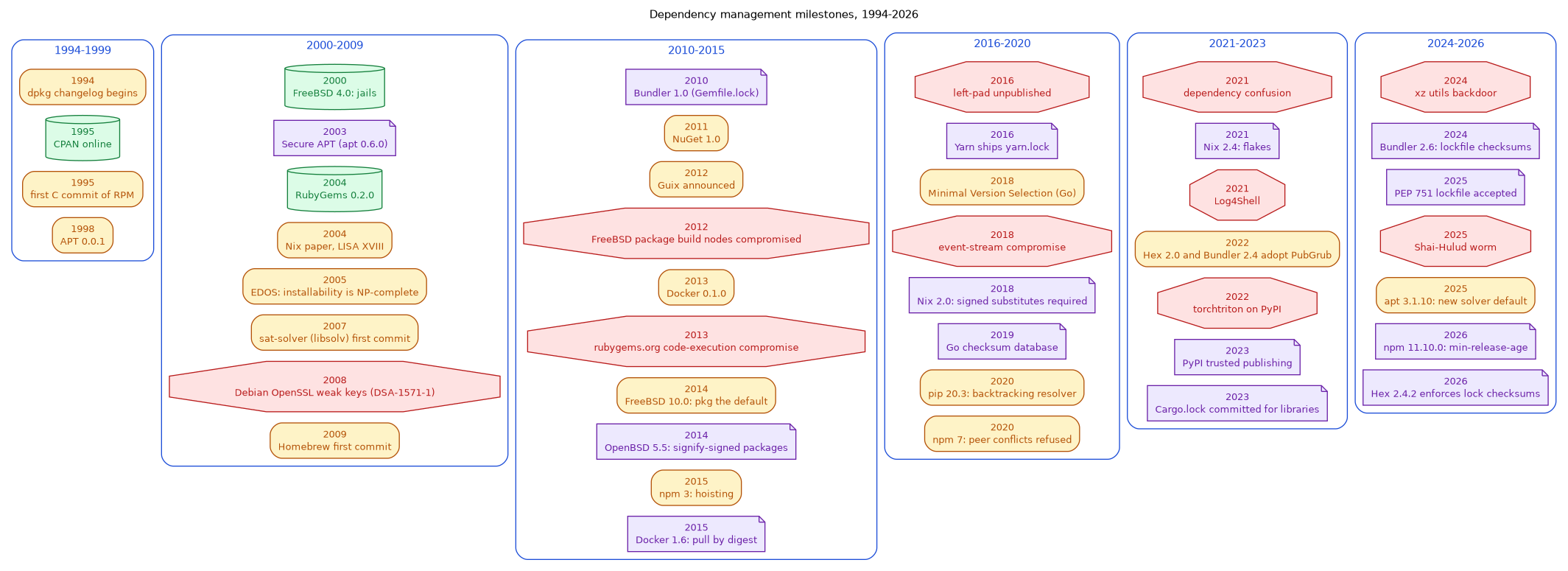
Keyed sources such as [cpan-3] resolve in that section's own Sources list; bare numbers resolve in the numbered Sources. Rows dated by product release rather than by calendar date, and undated rows, come last, in their section's order.
| date | ecosystem | event | source |
|---|---|---|---|
| 1994-08-20 | BSD ports | bsd.port.mk header date, Jordan K. Hubbard |
[ports-1] |
| 1994-08-25 | Linux (dpkg/RPM) | dpkg changelog begins, 0.93.5, Ian Murdock | [linux-4] |
| 1995-10 | Perl/CPAN | CPAN online | [cpan-17] |
| 1995-11-27 | Linux (dpkg/RPM) | first C commit of RPM | [linux-9] |
| 1996-02-11 | Linux (dpkg/RPM) | dpkg 1.1.0 supports Pre-Depends | [linux-4] |
| 1996-03-05 | Linux (dpkg/RPM) | RPM 2.0, first all-C version | [linux-9] |
| 1997-08 | BSD ports | pkgsrc NetBSD support | [ports-9] |
| 1998 | Perl/CPAN | CPAN Testers begun (Barr, Nandor) | [cpan-18] |
| 1998-03-31 | Linux (dpkg/RPM) | apt 0.0.1 initial release | [linux-5] |
| 1999-03-09 | Linux (dpkg/RPM) | Debian 2.1 "slink" ships APT | [linux-3] |
| 2000-03-14 | FreeBSD | FreeBSD 4.0 announced; jail(8) appears | [fbsd-22][fbsd-21] |
| 2002 | BSD ports | OpenDarwin copyright on MacPorts guide | [ports-19] |
| 2002-08-14 | Perl/CPAN | Module::Signature 0.04 (SIGNATURE files) | [cpan-5] |
| 2003 | Perl/CPAN | META.yml spec written by Ken Williams | [cpan-1] |
| 2003-01 | PHP | PEAR 1.0 released | [php-25] |
| 2003-12-03 | BSD ports | pkgsrc-2003Q4 branch announced |
[ports-12] |
| 2003-12-26 | Linux (dpkg/RPM) | apt 0.6.0 (experimental): apt-secure | [linux-5] |
| 2004-01-29 | BSD ports | FreeBSD CHANGES starts; SIZE lines in distinfo | [ports-3] |
| 2004-03-14 | Ruby | RubyGems 0.2.0, initial public release | [ruby-1] |
| 2004-06-06 | Ruby | RubyGems 0.5.0 introduces ~> pessimistic constraint |
[ruby-1] |
| 2004-11-14..19 | Nix/Guix | Nix paper at LISA XVIII, Atlanta | [nix-1] |
| 2005-01-19 | Linux (dpkg/RPM) | apt 0.6.30 in unstable | [linux-5] |
| 2005-07-13 | Ruby | RubyGems 0.8.11 merges gem signing patch | [ruby-1] |
| 2005-09 | Linux (dpkg/RPM) | EDOS WP2 D1: installability NP-complete | [linux-16] |
| 2005-09-18 | PHP | PEAR 1.4.0: channels | [php-17] |
| 2005-11-08 | BSD ports | FreeBSD SHA256 in checksum targets | [ports-3] |
| 2005-12-17 | Perl/CPAN | CPAN.pm: SHA256 in CHECKSUMS, MD5 dropped | [cpan-3] |
| 2006-01-18 | Nix/Guix | Dolstra thesis defended, Utrecht | [nix-2] |
| 2006-07-22 | Perl/CPAN | CPAN.pm: check_sigs option |
[cpan-3] |
| 2006-09 | Linux (dpkg/RPM) | Mancinelli et al., ASE 2006 | [linux-16] |
| 2006-09-17 | Linux (dpkg/RPM) | Debian openssl 0.9.8c-1 uploaded (weak RNG) | [linux-18] |
| 2007-01-15 | FreeBSD | 6.2: freebsd-update enters base | [fbsd-15] |
| 2007-04-08 | Linux (dpkg/RPM) | Debian 4.0 "etch" released with Secure APT | [linux-8] |
| 2007-09-05 | Linux (dpkg/RPM) | dpkg 1.14.6 implements Breaks | [linux-4] |
| 2007-10-02 | Linux (dpkg/RPM) | sat-solver (later libsolv) first commit | [linux-14] |
| 2007-10-24 | Perl/CPAN | Module::Build 0.2808_01: configure_requires |
[cpan-16] |
| 2007-12-18 | Perl/CPAN | Perl 5.10.0 ships Module::Build and CPANPLUS in core | [cpan-15] |
| 2007-12-20 | Ruby | RubyGems 1.0.0 | [ruby-1] |
| 2008-02-01 | Linux (dpkg/RPM) | Mancoosi project starts | [linux-17] |
| 2008-05-13 | Linux (dpkg/RPM) | DSA-1571-1, CVE-2008-0166 | [linux-18] |
| 2009-01-30 | Ruby | Ruby 1.9.1 ships RubyGems as a bundled library | [ruby-2][ruby-3] |
| 2009-05-20 | Homebrew | First commit, Max Howell | [brew-1] |
| 2010-02-19 | Perl/CPAN | cpanminus 0.01 | [cpan-12] |
| 2010-04 | Perl/CPAN | CPAN::Meta::Spec v2 drafted (phases, relationships, ranges) | [cpan-1] |
| 2010-07-19 | FreeBSD | poudriere first commit | [fbsd-14] |
| 2010-08-29 | Ruby | Bundler 1.0.0 (Gemfile.lock) | [ruby-5] |
| 2010-10-29 | BSD ports | FreeBSD deprecates MD5 in distinfo | [ports-4] |
| 2010-11-09 | .NET/NuGet | NuGet CTP 2; NuPack renamed NuGet | [nuget-5] |
| 2011 | Windows/macOS | Chocolatey created | [inst-19] |
| 2011-01-13 | .NET/NuGet | NuGet 1.0 released (VS 2010 extension) | [nuget-6] |
| 2011-02-08 | Linux (dpkg/RPM) | apt 0.8.11 prefers InRelease | [linux-5] |
| 2011-05-24 | Linux (dpkg/RPM) | satsolver renamed libsolv | [linux-14] |
| 2011-06-08 | PHP | composer/composer repository created | [php-23] |
| 2011-06-29 | Linux (dpkg/RPM) | apt 0.8.16~exp2: EDSP external solvers |
[linux-5] |
| 2011-08-14 | Apple/Swift | CocoaPods repository created | [swift-1] |
| 2012-01 | Linux (dpkg/RPM) | DNF forked from yum | [linux-11] |
| 2012-02-16 | Windows/macOS | Gatekeeper announced with OS X Mountain Lion preview | [inst-29] |
| 2012-03-01 | PHP | Composer 1.0.0-alpha1 | [php-2] |
| 2012-04-13 | PHP | Packagist install counting begins | [php-21] |
| 2012-05-29 | BSD ports | FreeBSD new OPTIONS framework | [ports-3] |
| 2012-07-07 | Nix/Guix | Guix announced on gnu-system-discuss | [guix-1] |
| 2012-08-30 | FreeBSD | pkg 1.0 tagged | [fbsd-6] |
| 2012-10-10 | BSD ports | FreeBSD ports default to pkgng | [ports-3] |
| 2012-11-11 | BSD ports | FreeBSD package build nodes found compromised | [ports-8] |
| 2012-11-17 | FreeBSD | package build infrastructure compromise announced | [fbsd-36] |
| 2013-01-30 | Ruby | rubygems.org code-execution compromise | [ruby-9] |
| 2013-01-31 | Perl/CPAN | cpanm 1.5021: --verify |
[cpan-12] |
| 2013-01-31 | Ruby | All gems verified against mirrors; 80 unverifiable gems yanked | [ruby-9] |
| 2013-02-24 | Ruby | RubyGems 2.0.0: packaged gems carry and verify SHA1 checksums | [ruby-1] |
| 2013-03-15 | Docker/OCI | Hykes, "The future of Linux Containers", PyCon US lightning talk | [oci-3] |
| 2013-03-18 | Python | PEP 440 created (versions and specifiers) | (“Pep 440, ‘Version Identification and Dependency Specification’,” n.d.) |
| 2013-03-20 | Docker/OCI | First Docker release, per Docker's 1.0 post | [oci-2] |
| 2013-03-23 | Docker/OCI | Docker 0.1.0, per changelog | [oci-1] |
| 2013-04-30 | BSD ports | FreeBSD binary package building restored | [ports-8] |
| 2013-05-01 | Docker/OCI | 0.2.1: first named Dockerfile operations | [oci-1] |
| 2013-05-11 | Windows/macOS | Scoop initial commit | [inst-21] |
| 2013-06-05 | Perl/CPAN | Module::Signature 0.72 fixes CVE-2013-2145 | [cpan-5] |
| 2013-06-06 | BSD ports | FreeBSD old OPTIONS macro no longer recognized | [ports-3] |
| 2013-06-11 | Python | pypa/pip#988 "pip needs a dependency resolver" opened | (“Pypa/Pip#988, ‘Pip Needs a Dependency Resolver’, 2013-06-11 to 2020-11-30,” n.d.) |
| 2013-07-23 | Perl/CPAN | Carton 0.9.65: cpanfile.snapshot replaces carton.lock |
[cpan-13] |
| 2013-08-04 | Perl/CPAN | Carton 1.0.0 | [cpan-13] |
| 2013-09-07 | Linux (dpkg/RPM) | first Debian reproducibility rebuild: 24% | [linux-22] |
| 2013-10-29 | FreeBSD | pkg keys moved to /usr/share/keys | [fbsd-8] |
| 2013-12-16 | BSD ports | FreeBSD 2014Q1, first quarterly ports branch, committed | [ports-6] |
| 2013-12-26 | Ruby | RubyGems 2.2.0 warns on too-strict and open-ended dependencies | [ruby-1] |
| 2014 | Elixir/Hex | Hex resolver algorithm "essentially the same" from early 2014 until 2.0 | (“Hex Blog, ‘Hex V2.0 Released with New Version Solver’, 2022-10-30,” n.d.) |
| 2014-01-20 | FreeBSD | 10.0: pkg default, pkg_add removed from base |
[fbsd-1] |
| 2014-01-29 | .NET/NuGet | NuGet 2.8: patch versions resolve lowest, -DependencyVersion |
[nuget-7] |
| 2014-04-02 | FreeBSD | 2014Q2 branched (2014Q1 was the experimental first) | [fbsd-4] |
| 2014-05-01 | BSD ports | OpenBSD 5.5: signify-signed releases and packages | [ports-18] |
| 2014-05-20 | Apple/Swift | CocoaPods trunk announced (0.33): first-publisher ownership | [swift-2] |
| 2014-06-09 | Docker/OCI | Docker 1.0; Docker Hub named as a platform component | [oci-2] |
| 2014-07-23 | FreeBSD | pkg 1.3.0: SAT solver | [fbsd-5] |
| 2014-08-09 | Linux (dpkg/RPM) | dpkg 1.17.11 versioned Provides | [linux-4] |
| 2014-09-01 | BSD ports | FreeBSD removes pkg_install support from ports |
[ports-3] |
| 2014-09-01 | FreeBSD | ports tree supports only pkg(8) | [fbsd-3] |
| 2014-10 | Windows/macOS | Chocolatey community moderation begins | [inst-20] |
| 2014-11-18 | Apple/Swift | Carthage 0.1 | [swift-17] |
| 2014-11-27 | Java | MNG-5728 (checksum policy warn to fail) opened | (“Mng-5728, Default Checksum Policy,” n.d.) |
| 2015 (unconfirmed) | Linux (dpkg/RPM) | Fedora 22: DNF replaces yum (accepted change) | [linux-12] |
| 2015-03-11 | Ruby | Bundler 1.9.0.pre adopts Molinillo resolver |
[ruby-5] |
| 2015-04-16 | Docker/OCI | Engine 1.6 and Registry 2.0: pull/run by repo@digest |
[oci-6] |
| 2015-04-17 | Perl/CPAN | Carmel 0.1.0 | [cpan-14] |
| 2015-04-20 | Ruby | gem yank permanently deletes the .gem file |
[ruby-13] |
| 2015-05-03 | Ruby | Bundler 1.10.0.pre; lockfiles gain BUNDLED WITH |
[ruby-5] |
| 2015-06-01 | Perl/CPAN | Perl 5.22.0 removes Module::Build from core | [cpan-15] |
| 2015-06-12 | Nix/Guix | Nix 1.9: signed binary caches, new signature format | [nix-8] |
| 2015-06-22 | Docker/OCI | Open Container Initiative launched | [oci-11] |
| 2015-06-26 | JavaScript | npm 3.0.0 published (hoisting) | (“Npm Registry Metadata for Npm (Time Field: 3.0.0, 7.0.0),” n.d.) |
| 2015-08-11 | Docker/OCI | Engine 1.8: Content Trust, disabled by default | [oci-1] |
| 2015-08-12 | Docker/OCI | "Introducing Docker Content Trust" (TUF via Notary) | [oci-14] |
| 2015-11-14 | PHP | composer.lock gains content-hash (1.0.0-alpha11) | [php-2] |
| 2015-12-03 | Apple/Swift | Swift open-sourced with Swift Package Manager | [swift-18] |
| 2016-02-04 | Docker/OCI | Engine 1.10: content-addressable local image storage | [oci-1] |
| 2016-03 | JavaScript | left-pad: 273 packages unpublished; unpublish restricted | (“Npm Blog, ‘Kik, Left-Pad, and Npm’, 2016-03,” n.d.) |
| 2016-03-11 | Elixir/Hex | Hex 0.11.2 verifies registry signatures | (“Hex Changelog.Md (Entries Cited by Version and Date),” n.d.) |
| 2016-04-05 | PHP | Composer 1.0.0 | [php-2] |
| 2016-05-04 | Apple/Swift | Specs repo post-mortem: GitHub CPU limits, sharding by hashed name | [swift-3] |
| 2016-05-15 | Elixir/Hex | Hex 0.12.0 writes checksums into mix.lock |
(“Hex Changelog.Md (Entries Cited by Version and Date),” n.d.) |
| 2016-07-22 | Python | PEP 503 amended with data-requires-python |
(“Distutils-Sig, ‘Released: Pip V9.0.0’, 2016-11. ; Python/Peps Pr #56 (Data-Requires-Python),” n.d.) |
| 2016-08 | Windows/macOS | Chocolatey 0.10.0 enforces checksums for non-secure downloads | [inst-20] |
| 2016-09-19 | C/C++ | vcpkg announced (Windows, ports-collection model) | [cpp-12] |
| 2016-09-21 | Homebrew | 1.0.0: Homebrew Cask integrated into Homebrew/brew | [brew-6] |
| 2016-10-11 | JavaScript | Yarn released with yarn.lock |
(“Yarn Blog, ‘Introducing Yarn’, 2016-10-11,” n.d.) |
| 2016-11-02 | Python | pip 9.0.0 enforces Requires-Python | (“Distutils-Sig, ‘Released: Pip V9.0.0’, 2016-11. ; Python/Peps Pr #56 (Data-Requires-Python),” n.d.)(“Pip, ‘Changelog’ (8.0.0, 9.0.0, 9.0.1, 20.2, 20.3),” n.d.) |
| 2016-11-03 | Linux (dpkg/RPM) | RPM 4.13.0: boolean dependencies | [linux-9] |
| 2016-12-11 | PHP | lock hash dropped, content-hash only (1.3.0-RC) | [php-2] |
| 2016-12-24 | Elixir/Hex | Hex 0.15.0 adds mix hex.retire |
(“Hex Changelog.Md (Entries Cited by Version and Date),” n.d.) |
| 2016-12-29 | Ruby | Bundler 1.14.0.pre.1 validates registry gem checksums on install | [ruby-5] |
| 2017 | Apple/Swift | SE-0145 Package.pins in Swift 3.1 |
[swift-19] |
| 2017-03 | .NET/NuGet | NuGet 4.0 with VS 2017: PackageReference (notes page dated 2017-03-03) | [nuget-8] |
| 2017-03 | C/C++ | pkg-config 0.29.2, current release | [cpp-1] |
| 2017-04-18 | Elixir/Hex | Hex 0.16.0 multiple repositories | (“Hex Changelog.Md (Entries Cited by Version and Date),” n.d.) |
| 2017-05-04 | Apple/Swift | Package.pins renamed Package.resolved |
[swift-20] |
| 2017-06-22 | Elixir/Hex | Hex 0.16.1 adds mix hex.audit |
(“Hex Changelog.Md (Entries Cited by Version and Date),” n.d.) |
| 2017-07-19 | Docker/OCI | OCI image-spec 1.0.0 | [oci-12] |
| 2017-07-20 | Python | pypa/pip#4625 (file overwrite between distributions) opened | (“Pypa/Pip#4625, ‘Pip Overwrites Existing Files Unconditionally during Installation’, Opened 2017-07-20,” n.d.) |
| 2017-08-21 | Linux (dpkg/RPM) | Debian Policy 4.1.0 mentions reproducible builds | [linux-22] |
| 2017-08-28 | Elixir/Hex | Hex 0.17.0 organizations; default repo always hexpm |
(“Hex Changelog.Md (Entries Cited by Version and Date),” n.d.) |
| 2017-10-12 | Linux (dpkg/RPM) | RPM 4.14.0: with/without/unless | [linux-9] |
| 2017-10-22 | Perl/CPAN | PAUSE operating model published | [cpan-2] |
| 2017-11-30 | BSD ports | FreeBSD FLAVORS and *_CONFLICTS_* variants |
[ports-3] |
| 2018 (unconfirmed) | .NET/NuGet | NuGet 4.9 / VS 15.9: packages.lock.json, locked mode, trustedSigners |
[nuget-12] |
| 2018-01-10 | C/C++ | Conan 1.0, "commitment to stability" | [cpp-7] |
| 2018-02-21 | Go | Russ Cox, "Minimal Version Selection" | (“Russ Cox, ‘Minimal Version Selection’, 2018-02-21,” n.d.) |
| 2018-02-22 | Nix/Guix | Nix 2.0: signatures required for substitutes by default | [nix-9] |
| 2018-03 | .NET/NuGet | NuGet 4.6 / VS 15.6: signing (notes page dated 2018-03-07) | [nuget-16] |
| 2018-03-07 | Windows/macOS | MSIX announced at Windows Developer Day | [inst-16] |
| 2018-03-07 | Go | golang/go#24301 modules proposal opened | (“Golang/Go#24301, ‘Cmd/Go: Add Package Version Support to Go Toolchain’, 2018-03-07, Accepted,” n.d.) |
| 2018-05 | .NET/NuGet | nuget.org accepts author-signed packages | [nuget-17] |
| 2018-05-21 | Go | golang/go#24301 accepted | (“Golang/Go#24301, ‘Cmd/Go: Add Package Version Support to Go Toolchain’, 2018-03-07, Accepted,” n.d.) |
| 2018-06-26 | Rust | cargo#5657 --minimal-versions opened |
(“Rust-Lang/Cargo#5657, ‘Dependencies Resolution with –Minimal-Versions’, Opened 2018-06-26,” n.d.) |
| 2018-07-14 | JavaScript | npm 6.2.0 docs give a 72-hour unpublish window (6.1.0, 2018-05-24, said 24) | (“Npm Cli Npm-Unpublish Docs at V6.1.0 (24 Hours) and V6.2.0 (72 Hours),” n.d.) |
| 2018-07-31 | Homebrew | Jenkins GitHub token leak reported | [brew-19] |
| 2018-08-10 | .NET/NuGet | nuget.org repository-signs all new submissions | [nuget-17] |
| 2018-11 | JavaScript | event-stream / flatmap-stream compromise | (“Npm Blog, ‘Details About the Event-Stream Incident’, 2018-11,” n.d.) |
| 2018-12 | Nix/Guix | Guix v0.16.0, oldest time-machine target | [guix-4] |
| 2018-12-11 | FreeBSD | 12.0: VIMAGE on by default | [fbsd-23] |
| 2019 | Apple/Swift | Xcode 11 integrates Swift packages (WWDC19 session 408) | [swift-23] |
| 2019-01-19 | PHP | PEAR go-pear.phar compromise disclosed | [php-19] |
| 2019-02-02 | Homebrew | 2.0.0: Linux official; options removed from core | [brew-5] |
| 2019-05-02 | Nix/Guix | Guix 1.0.0 | [guix-2] |
| 2019-06-01 | Windows/macOS | macOS 10.15 notarization cutoff for Developer ID builds | [inst-31] |
| 2019-07-05 | Ruby | strong_password 0.0.7 hijacked (CVE-2019-13354) |
[ruby-19] |
| 2019-07-16 | Windows/macOS | microsoft/winget-pkgs repository created | [inst-26] |
| 2019-08 | Ruby | rest-client 1.6.10-1.6.13 hijacked via compromised account |
[ruby-16] |
| 2019-08-05 | Apple/Swift | CocoaPods 1.8 beta: CDN default spec source | [swift-4] |
| 2019-08-07 | JavaScript | npm RFC 0025 (install peer deps) PR opened | (“Npm Rfc 0025, ‘Install Peer Dependencies’,” n.d.) |
| 2019-08-14 | Nix/Guix | RFC 0062 content-addressed paths started | [nix-10] |
| 2019-08-29 | Go | module mirror and checksum database launched | (“Go Blog, ‘Module Mirror and Checksum Database Launched’, 2019-08-29,” n.d.) |
| 2019-09-03 | Go | Go 1.13: proxy and sumdb on by default | (“Go Blog, ‘Module Mirror and Checksum Database Launched’, 2019-08-29,” n.d.)(“Go Release History (Go1.13, 2019-09-03),” n.d.) |
| 2019-09-04 | Apple/Swift | SwiftPM PubGrub resolver enabled by default (shipped Swift 5.2) | [swift-22] |
| 2019-11-12 | Homebrew | Brewfile.lock.json added (homebrew-bundle#552) |
[brew-16] |
| 2020 | Apple/Swift | SE-0272 binary targets with required checksum (Swift 5.3) | [swift-24] |
| 2020-01-24 | JavaScript | Yarn 2 (Berry) first stable release | (“Maël Nison, ‘Introducing Yarn 2!’, 2020-01-24,” n.d.) |
| 2020-02-03 | Elixir/Hex | Hex 0.20.2: outer checksum over the whole tarball | (“Hex Changelog.Md (Entries Cited by Version and Date),” n.d.) |
| 2020-02-17 | Java | Gradle 6.2: dependency verification metadata | (“Gradle 6.2 Release Notes; ‘Verifying Dependencies’,” n.d.) |
| 2020-05-19 | Windows/macOS | Windows Package Manager preview at Build 2020 | [inst-22] |
| 2020-07-01 | Nix/Guix | Guix channel commit authentication described | [guix-5] |
| 2020-07-21 | Python | pypa/pip#8606 (index priority) opened | (“Pypa/Pip#8606, ‘Index-Url Extra-Index-Url Install Priority Order’,” n.d.) |
| 2020-09-14 | C/C++ | vcpkg manifests (flagged) and binary caching (default on) | [cpp-13] |
| 2020-10-13 | JavaScript | npm 7.0.0 published (peer deps installed, ERESOLVE) | (“Npm Registry Metadata for Npm (Time Field: 3.0.0, 7.0.0),” n.d.) |
| 2020-10-24 | PHP | Composer 2.0: platform check, PEAR support removed | [php-5][php-6] |
| 2020-11-02 | Docker/OCI | Docker Hub pull rate limits begin phasing in | [oci-22] |
| 2020-11-30 | Python | pip 20.3: backtracking resolver default; pip#988 closed | (“Pip User Guide, ‘Changes to the Pip Dependency Resolver in 20.3 (2020)’; Constraints Files,” n.d.)(“Pypa/Pip#988, ‘Pip Needs a Dependency Resolver’, 2013-06-11 to 2020-11-30,” n.d.) |
| 2021 (unconfirmed) | .NET/NuGet | NuGet 5.9 / .NET 5.0.200 SDK: dotnet list package --vulnerable |
[nuget-21] |
| 2021-01 | Apple/Swift | Carthage 0.37.0 encourages XCFrameworks | [swift-15] |
| 2021-02-02 | JavaScript | npm 7 generally available | (“Github Blog, ‘Npm 7 Is Now Generally Available’, 2021-02-02,” n.d.) |
| 2021-02-05 | Homebrew | 3.0.0: new bottle block syntax, Apple Silicon | [brew-7] |
| 2021-02-09 | cross-ecosystem | Birsan, "Dependency Confusion" | (“Alex Birsan, ‘Dependency Confusion: How I Hacked into Apple, Microsoft and Dozens of Other Companies’, 2021-02-09,” n.d.) |
| 2021-02-18 | C/C++ | vcpkg versioning: builtin-baseline, version>=, overrides (experimental) |
[cpp-14] |
| 2021-03-03 | Python | python-poetry#3747 (caret upper bounds) opened | (“Python-Poetry#3747. ; #8291. ; #10136. ; Poetry-Relax,” n.d.) |
| 2021-04-12 | Homebrew | 3.1.0: bottles move to GitHub Packages | [brew-7b] |
| 2021-04-18 | Homebrew | review-cask-pr bypass reported |
[brew-20] |
| 2021-04-19 | Apple/Swift | CocoaPods trunk RCE (Justicz) disclosed and fixed | [swift-5] |
| 2021-04-22 | PHP | CVE-2021-29472 reported; fixed in 2.0.13 / 1.10.22 | [php-9] |
| 2021-05-05 | Docker/OCI | OCI distribution-spec 1.0.0 | [oci-13] |
| 2021-05-19 | C/C++ | vcpkg versioning, manifests, registries, binary caching GA | [cpp-15] |
| 2021-05-26 | Windows/macOS | Windows Package Manager 1.0 | [inst-23] |
| 2021-07-28 | Docker/OCI | cosign 1.0.0 | [oci-17] |
| 2021-10-11 | Python | pip#9187 (slow resolver) closed | (“Pypa/Pip#9187, ‘New Resolver Takes a Very Long Time to Complete’,” n.d.) |
| 2021-10-25 | Homebrew | 3.3.0: opt-in API install; linuxbrew-core merged | [brew-8] |
| 2021-11-01 | Nix/Guix | Nix 2.4: flakes, nix command, experimental-feature flags | [nix-3] |
| 2021-11-15 | JavaScript | GitHub announces mandatory 2FA for popular npm packages | (“Github Blog, ‘Github’s Commitment to Npm Ecosystem Security’, 2021-11-15,” n.d.) |
| 2021-11-23 | Perl/CPAN | CHECKSUMS/signature bypass disclosed (CVE-2020-16156) | [cpan-8] |
| 2021-12 | Java | Log4Shell (CVE-2021-44228) | (“Google Security Blog, ‘Understanding the Impact of Apache Log4j Vulnerability’, 2021-12,” n.d.) |
| 2021-12-08 | PHP | allow-plugins (2.2.0-RC1) | [php-2] |
| 2021-12-09 | Python | Schreiner, "Should You Use Upper Bound Version Constraints?" | (“Henry Schreiner, ‘Should You Use Upper Bound Version Constraints?’, 2021-12-09,” n.d.) |
| 2021-12-21 | Ruby | Bundler 2.3.0 honours locked BUNDLED WITH version |
[ruby-5] |
| 2022 | Apple/Swift | Swift 5.6: Package.resolved v2, TOFU fingerprints |
[swift-21] |
| 2022 | Apple/Swift | Swift 5.7: SE-0292 registry, SE-0339 module aliasing | [swift-25] |
| 2022-01 | JavaScript | colors/faker sabotage | (“Snyk, ‘Open Source Maintainer Pulls the Plug on Npm Packages Colors and Faker’, 2022-01. ; Sonatype,” n.d.) |
| 2022-02-01 | JavaScript | 2FA required for top-100 npm maintainers | (“Github Blog, ‘Top-100 Npm Package Maintainers Now Require 2fa’, 2022-02-01. ; Top-500, 2022-05-31,” n.d.) |
| 2022-04-12 | .NET/NuGet | Central Package Management (NuGet 6.2) announced | [nuget-14] |
| 2022-05 | Python | ctx takeover via expired email domain | (“Python Security-Announce, ‘Incident Report: Malicious Takeover of Ctx Project on Pypi’, 2022-05,” n.d.) |
| 2022-05-10 | Rust | rustdecimal typosquat advisory | (“Rust Blog, ‘Security Advisory: Malicious Crate Rustdecimal’, 2022-05-10. ; Rustsec-2022-0042,” n.d.) |
| 2022-05-25 | PHP | hautelook/phpass malicious versions disclosed | [php-11] |
| 2022-06-13 | Ruby | MFA warnings for owners of gems over 165M downloads | [ruby-10] |
| 2022-08-15 | Ruby | MFA enforced for owners of gems over 180M downloads | [ruby-12] |
| 2022-08-16 | PHP | composer audit (2.4.0) | [php-2] |
| 2022-09-20 | Linux (dpkg/RPM) | RPM 4.18.0: Sequoia OpenPGP backend | [linux-9] |
| 2022-10-13 | C/C++ | WG21 P2656R0, C++ Ecosystem International Standard proposal | [cpp-3] |
| 2022-10-30 | Elixir/Hex | Hex 2.0: PubGrub-based solver | (“Hex Blog, ‘Hex V2.0 Released with New Version Solver’, 2022-10-30,” n.d.) |
| 2022-11-16 | FreeBSD | ocijail, buildah, podman ports added | [fbsd-29] |
| 2022-12-20 | PHP | hard fail on lock not satisfying composer.json (2.5.0) |
[php-2] |
| 2022-12-24 | Ruby | Bundler 2.4.0 replaces Molinillo with PubGrub | [ruby-5][ruby-6] |
| 2022-12-25 | Python | torchtriton dependency-confusion compromise begins (to 12-30) | (“Pytorch, ‘Compromised Pytorch-Nightly Dependency Chain between December 25th and December 30th, 2022’,” n.d.) |
| 2023 (unconfirmed) | .NET/NuGet | NuGet 6.8 / .NET 8 SDK: NuGetAudit in restore | [nuget-21] |
| 2023 | Apple/Swift | Swift 5.9: SE-0391 registry publish and package signing | [swift-27] |
| 2023-01-10 | Docker/OCI | BuildKit 0.11.0 / Buildx 0.10.0: SBOM and SLSA provenance | [oci-19][oci-20] |
| 2023-02-16 | Homebrew | 4.0.0: JSON API install by default | [brew-9] |
| 2023-02-22 | C/C++ | Conan 2.0: revisions on by default, new lockfiles | [cpp-8] |
| 2023-03-20 | .NET/NuGet | JFrog reports 13 malicious typosquat packages; removed | [nuget-22] |
| 2023-04-19 | Docker/OCI | SLSA v1.0 | [oci-21] |
| 2023-04-20 | Python | PyPI trusted publishing | (“Pypi Blog, ‘Introducing ’trusted Publishers’’, 2023-04,” n.d.) |
| 2023-04-26 | Nix/Guix | Guix Full-Source Bootstrap merged (357-byte seed) | [guix-7] |
| 2023-04-28 | Perl/CPAN | CVE-2023-31484: CPAN.pm TLS verification, fixed in 2.35 | [cpan-9] |
| 2023-05-01 | PHP | 14 packages repointed via dormant maintainer accounts | [php-10] |
| 2023-06-16 | Homebrew | Google Analytics removed, data destroyed | [brew-9] |
| 2023-08-08 | Apple/Swift | Package.resolved v3 (originHash) merged; ships in Swift 5.10 |
[swift-28] |
| 2023-08-15 | Docker/OCI | Notation 1.0.0 | [oci-18] |
| 2023-08-29 | Rust | Cargo.lock guidance: commit for libraries too | (“Ed Page, ‘Change in Guidance on Committing Lockfiles’, Rust Blog, 2023-08-29,” n.d.) |
| 2023-10-28 | Apple/Swift | CocoaPods: three trunk vulnerabilities from EVA, sessions reset | [swift-6] |
| 2023-11-14 | Rust | RFC 3537 MSRV-aware resolver started | (“Rfc 3537, ‘Msrv-Resolver’, Start 2023-11-14. ; Rust-Lang/Cargo#9930,” n.d.) |
| 2023-11-20 | FreeBSD | 14.0: base packages first published | [fbsd-17][fbsd-18] |
| 2023-12-14 | Ruby | Trusted publishing (OIDC) on rubygems.org | [ruby-11] |
| 2023-12-15 | Ruby | Bundler 2.5.0 locks Linux platform on macOS by default | [ruby-5] |
| 2024-01-01 | Python | 2FA required for all PyPI users | (“Pypi Blog, ‘Securing Pypi Accounts via Two-Factor Authentication’, 2023-05-25; ‘2fa Requirement for Pypi Begins 2024-01-01’, 2023-12-13,” n.d.) |
| 2024-02-08 | PHP | audit.abandoned defaults to fail (2.7.0) | [php-2] |
| 2024-02-15 | Docker/OCI | OCI image-spec 1.1.0 and distribution-spec 1.1.0 | [oci-12][oci-13] |
| 2024-03-12 | Nix/Guix | Guix advisory for CVE-2024-27297 | [guix-8] |
| 2024-03-28 | Python | PyPI suspends registrations during typosquat campaign | (“Python Infrastructure Status Page, Incident History (Pypi Registration Suspensions),” n.d.) |
| 2024-03-29 | Linux (dpkg/RPM) | xz backdoor disclosed; DSA-5649-1 | [linux-19][linux-20] |
| 2024-03-29 | C/C++ | xz-utils backdoor disclosed; CVE-2024-3094 published | [cpp-21] |
| 2024-03-29 | cross-ecosystem | xz utils backdoor (CVE-2024-3094) | (“Red Hat, Cve-2024-3094. ; Oss-Security, 2024-03-29,” n.d.) |
| 2024-04 | Ruby | 30-day limit on self-service yanks in force (start date unconfirmed) | [ruby-14] |
| 2024-05-14 | Linux (dpkg/RPM) | apt 2.9.3: backtracking solver (alpha) | [linux-5] |
| 2024-05-14 | Homebrew | 4.3.0: opt-in bottle attestation verification | [brew-10] |
| 2024-07-24 | Python | PEP 751 (standard lockfile) created | (“Pep 751, ‘a File Format to Record Python Dependencies for Installation Reproducibility’, Accepted 2025-03-31,” n.d.) |
| 2024-08-13 | Apple/Swift | CocoaPods states maintenance mode | [swift-7] |
| 2024-08-26 | Perl/CPAN | CVE-2024-45321: cpanm insecure HTTP | [cpan-10] |
| 2024-11-04 | C/C++ | ConanCenter legacy (1.x) remote stops receiving updates | [cpp-9] |
| 2024-11-12 | FreeBSD | Foundation: Podman still experimental | [fbsd-30] |
| 2024-11-14 | Python | PyPI digital attestations (PEP 740) | (“Pypi Blog, ‘Pypi Now Supports Digital Attestations’, 2024-11-14. ; Pep 740,” n.d.) |
| 2024-11-27 | Homebrew | Brewfile.lock.json removed (homebrew-bundle#1509) |
[brew-17] |
| 2024-11-30 | Apple/Swift | CocoaPods trunk read-only plan | [swift-8] |
| 2024-12-03 | FreeBSD | 14.2: first official OCI images | [fbsd-31] |
| 2024-12-16 | Ruby | Bundler 2.6.0: CHECKSUMS section, bundle lock --add-checksums |
[ruby-5][ruby-7] |
| 2025-01-07 | JavaScript | pnpm 10.0.0: dependency lifecycle scripts off by default | (“Pnpm Release Notes V10.0.0, V10.16.0, V11.0.0,” n.d.) |
| 2025-01-09 | Rust | Rust 1.84: MSRV-aware resolver stabilized | (“Rust Blog, ‘Announcing Rust 1.84.0’, 2025-01-09,” n.d.) |
| 2025-03-31 | Python | PEP 751 accepted | (“Pep 751, ‘a File Format to Record Python Dependencies for Installation Reproducibility’, Accepted 2025-03-31,” n.d.) |
| 2025-04-29 | Homebrew | 4.5.0: brew bundle built in |
[brew-11] |
| 2025-05 | Apple/Swift | New pods may not use prepare_command |
[swift-8] |
| 2025-06-03 | GitHub | release asset digests in the API | (“Github Changelog, ‘Releases Now Expose Digests for Release Assets’, 2025-06-03,” n.d.) |
| 2025-07-11 | Rust | crates.io trusted publishing | (“Rust Blog, ‘Crates.Io: Development Update’, 2025-07-11 (Trusted Publishing). ; Rfc 3691. ; 2026-01 Update,” n.d.) |
| 2025-07-20 | Ruby | Credential-stealing gems detected; removed by 2025-07-28 | [ruby-17][ruby-18] |
| 2025-07-29 | Docker/OCI | Docker begins retiring DCT; DCT under 0.05% of pulls | [oci-15] |
| 2025-08-18 | Python | PyPI unverifies emails on expiring domains | (“Pypi Blog, ‘Preventing Domain Resurrection Attacks’, 2025-08-18,” n.d.) |
| 2025-09 | .NET/NuGet | nuget.org Trusted Publishing (OIDC) launched | [nuget-23] |
| 2025-09 | JavaScript | Shai-Hulud worm; npm token and 2FA changes announced | (“Github Blog, ‘Our Plan for a More Secure Npm Supply Chain’, 2025-09,” n.d.) |
| 2025-09-12 | JavaScript | pnpm 10.16.0: minimumReleaseAge |
(“Pnpm Release Notes V10.0.0, V10.16.0, V11.0.0,” n.d.) |
| 2025-09-22 | Linux (dpkg/RPM) | RPM 6.0.0: signature checking enforced by default | [linux-9] |
| 2025-10-15 | Windows/macOS | support ends for Visual C++ 2015 Redistributable | [inst-12] |
| 2025-10-25 | Linux (dpkg/RPM) | apt 3.1.10: new solver on by default | [linux-5] |
| 2025-10-28 | GitHub | immutable releases generally available | (“Github Changelog, ‘Immutable Releases Are Now Generally Available’, 2025-10-28,” n.d.) |
| 2025-11-11 | .NET/NuGet | .NET 10 / NuGet 7.0: audit defaults to transitive for net10.0 | [nuget-21][nuget-26] |
| 2025-11-13 | PHP | updates block versions with advisories by default (2.9.0) | [php-2] |
| 2025-12-02 | FreeBSD | 15.0: pkgbase install option (tech preview); dist sets to go in 16 | [fbsd-19] |
| 2025-12-03 | Ruby | RubyGems/Bundler 4.0.0: lockfile_checksums on by default |
[ruby-1] |
| 2026-02-11 | JavaScript | npm 11.10.0: min-release-age |
(“Npm Cli Changelog.Md (11.10.0, 2026-02-11: Min-Release-Age),” n.d.) |
| 2026-02-18 | Apple/Swift | Trunk verification-token fix (8 to 20 chars) | [swift-9] |
| 2026-03-10 | Homebrew | 5.1.0: brew version-install |
[brew-12] |
| 2026-04-26 | Perl/CPAN | Module::Signature deprecated | [cpan-5] |
| 2026-04-28 | JavaScript | pnpm 11.0.0: one-day release-age default, strictDepBuilds default |
(“Pnpm Release Notes V10.0.0, V10.16.0, V11.0.0,” n.d.) |
| 2026-04-30 | Homebrew | Opt-in lockfile PR closed (Homebrew/brew#22110) | [brew-18] |
| 2026-04-30 | Elixir/Hex | Hex 2.4.2 enforces lock checksums (CVE-2026-32148) | (“Ghsa-Hmv9-4mfr-M92v / Cve-2026-32148, ‘Lockfile Checksums Not Verified in Hex Allows Dependency Integrity Bypass’, 2026-04-30,” n.d.) |
| 2026-05-28 | PHP | Composer 2.10: malware filter lists, policy block | [php-2] |
| 2026-06-03 | Ruby | RubyGems/Bundler 4.0.13 adds cooldown |
[ruby-1] |
| 2026-06-11 | Homebrew | 6.0.0: tap trust; internal API default | [brew-13] |
| 2026-06-28 | Elixir/Hex | Hex 2.5.0: release-age cooldown, dependency policies | (“Hex Changelog.Md (Entries Cited by Version and Date),” n.d.) |
| 2026-07-07 | PHP | Packagist stable versions immutable; soft deletion with reasons | [php-13] |
| 2026-08-17 | .NET/NuGet | New nuget.org API keys capped at 30 days | [nuget-23] |
| 2026-09-24 | Java | Maven 4.0.0-rc-7, still a release candidate | (“Maven, ‘Release History’ (4.0.0-Rc-7),” n.d.) |
| 2026-10-23 | Elixir/Hex | Hex 2.6.0: reproducible package builds | (“Hex Changelog.Md (Entries Cited by Version and Date),” n.d.) |
| 2026-10-29 | PHP | Composer 2.11: opt-in cooldown | [php-16] |
| 2026-11-06 | Elixir/Hex | Hex 2.7.0: --check-unused-ignores |
(“Hex Changelog.Md (Entries Cited by Version and Date),” n.d.) |
| 2026-11-12 | PHP | Packagist artifact storage/signing plan published | [php-15] |
| 2026-11-17 | FreeBSD | pkg 2.9.3 | [fbsd-6] |
| 2026-11-17 | .NET/NuGet | nuget.org staged publishing | [nuget-24] |
| 2026-12-02 | Apple/Swift | Planned: trunk stops accepting new podspecs | [swift-8] |
| 2026-12-08 | Docker/OCI | Scheduled shutdown of notary.docker.io |
[oci-16] |
| before 2000 | Windows/macOS | installers overwrite shared system DLLs | [inst-2] |
| undated | Windows/macOS | Windows Installer 1.0 ships with Office 2000 | [inst-7] |
| Windows 2000 | Windows/macOS | Windows File Protection; Windows Installer 1.1; app-directory side-by-side | [inst-1][inst-2][inst-7] |
| Windows XP | Windows/macOS | manifest-based side-by-side assemblies; Windows Installer 2.0 | [inst-4][inst-8] |
| VS 2005 / .NET 2.0 | Windows/macOS | ClickOnce | [inst-15] |
| Windows Vista | Windows/macOS | WFP becomes Windows Resource Protection; Windows Installer 4.0 | [inst-3][inst-8] |
| Windows 7 | Windows/macOS | Windows Installer 5.0 | [inst-8] |
| VS 2017 | Windows/macOS | one v14 VC++ redistributable shared by VS 2017-2026 | [inst-12] |
| undated | C/C++ | CMake 3.11 adds FetchContent (configure-time fetch) | [cpp-5] |
| undated | C/C++ | CMake 3.14 adds FetchContent_MakeAvailable | [cpp-6] |
| undated | C/C++ | Meson 0.55.0 adds wrap [provide] |
[cpp-18] |
| undated | C/C++ | CMake 3.24 adds FIND_PACKAGE_ARGS / OVERRIDE_FIND_PACKAGE | [cpp-6] |
Part I: the system layer
Linux distributions: dpkg/APT and RPM
assembly: removed the unconfirmed zypper/yum sentence; epoch and no-lockfile sentences kept as (unconfirmed); EDOS ASE 2006 PDF still not opened (ACM 403, HAL bot wall; Crossref metadata only); timeline rows merged; earlier (research-agent, 2026-11-22T20:06:53Z): Dates/versions checked against dpkg+apt changelogs, Debian Policy, rpm.org timeline, Fedora change pages, libsolv git log, DSAs; ASE 2006 PDF and yum/zypper origins not opened.
Origins. dpkg's changelog begins on 1994-08-25 with dpkg 0.93.5 by Ian Murdock [linux-4].
Ian Jackson later took over, renamed the original tool dpkg-deb, and wrote a front-end
dpkg that added Dependencies and Conflicts [linux-3]. RPM's first C commit is dated
1995-11-27; RPM 2.0 (1996-03-05) was "the first version entirely in C" [linux-9]. The
1997 date sometimes given for RPM does not match rpm.org's own timeline.
Relationships. Debian Policy defines a graded vocabulary [linux-1]:
Depends: "an absolute dependency", checked at configure time.Pre-Depends: forces dpkg "to complete installation of the packages named before" unpacking. Added in dpkg 1.1.0, 1996-02-11 [linux-4].Recommends/Suggests: strong-but-not-absolute, and merely useful.Conflicts: dpkg "will refuse to allow the packages to be unpacked".Breaks: weaker; blocks configuring the broken package, usually with an "earlier than" clause. Parsed but rejected in dpkg 1.13.23 (2006-10-12), implemented in 1.14.6 (2007-09-05, #379140) [linux-4]. Policy still notes cases written asConflictsbecause "Breaksdid not yet exist" [linux-1].Provides: names a virtual package. Versioned Provides arrived in dpkg 1.17.11 (2014-08-09) [linux-4] and may only use=[linux-1].Replaces: file takeover, and which package goes when two conflict [linux-1].
RPM added boolean dependencies in 4.13.0 (alpha 2015-07-24, final 2016-11-03); 4.14.0
(2017-10-12) added with, without and unless [linux-9][linux-10]. The operators are
and, or, if=/=else, with, without, unless [linux-10].
Version ordering. Debian versions are [epoch:]upstream_version[-debian_revision].
Epochs compare first, numerically; then the strings alternate lexical and numeric runs,
where "a tilde sorts before anything, even the end of a part", so 1.0~beta1 < 1.0
[linux-2]. The epoch is what lets a package go backwards in upstream numbering (unconfirmed). The xz
revert avoided one by spelling the downgrade 5.6.1+really5.4.5-1 [linux-19], which sorts
above 5.6.1-1 under the same rules.
Resolution. APT 0.0.1 was uploaded 1998-03-31 [linux-5] and first shipped in Debian 2.1 "slink", 1999-03-09 [linux-3]. Its resolver was heuristic, and the EDOS analysis says why: "Checking whether a single package P can be installed, given a repository R, is NP-complete", by reduction from 3SAT, for both DEB and RPM constraint languages [linux-15][linux-16]. Tools like APT therefore "live dangerously on the edge of intractability" [linux-15]. APT's answers to that:
- 2011-06-29, apt
0.8.16~exp2: EDSP, so front-ends can call external solvers [linux-5]. - 2024-05-14, apt 2.9.3: an alpha "3.0 solver", "fully backtracking … think DPLL" [linux-5].
- 2025-10-25, apt 3.1.10: "Enable the new solver by default" [linux-5].
The RPM side moved first. libsolv's history starts 2007-10-02 as SUSE's sat-solver
(Klaus Kaempf, Michael Schroeder), renamed libsolv on 2011-05-24 [linux-14]; it is "a
free package dependency solver using a satisfiability algorithm" [linux-14]. DNF forked
from yum in 2012-01, was usable from Fedora 18, and became the default in Fedora 22 for
its "modern depsolving technology" [linux-11][linux-12]. It reached libsolv through hawkey,
a "simplified C and Python API to libsolv" [linux-13].
Recording state. Neither family keeps a lockfile: the installed set on the machine is the record (dpkg's status database, RPM's rpmdb) (unconfirmed). Reproducing a system means reproducing the archive snapshot.
Integrity and signing. Secure APT landed in apt 0.6.0 (experimental, 2003-12-26) from
Colin Walters and Isaac Jones: Release.gpg verification, Packages/Sources checksums
against Release, and apt-key [linux-5]. 0.6 reached unstable in apt 0.6.30 (2005-01-19)
[linux-5]; the wiki dates Debian's migration from 2005-02 [linux-7]. The chain: a signed
Release lists checksums of Packages, which lists checksums of each .deb [linux-7]. The Debian
4.0 "etch" announcement (2007-04-08) lists it as verifying downloaded packages [linux-8]. apt 0.8.11
(2011-02-08) tries the clearsigned InRelease before Release.gpg [linux-5]. Later
tightening, per apt-secure(8): 1.1 requires recent authentication data, 1.5 requires
confirming Release-file changes, and unsigned repositories are refused by default
[linux-6][linux-5]. On RPM: a Sequoia OpenPGP backend in 4.18.0 (2022-09-20), and in 6.0.0
(2025-09-22) multiple signatures per package and "enforced signature checking by default"
[linux-9].
Reproducibility. A build is reproducible when "any party can recreate bit-by-bit identical copies" [linux-23]. The idea was raised in Debian in 2000 and 2007; organised work began at DebConf13 (2013-07); the first rebuild found 24% of 5240 sources reproducible (2013-09-07), 83% of main by 2015-02. It entered Policy 4.1.0 on 2017-08-21 [linux-22].
Removal and replacement. Replaces with Conflicts is how one package retires another
[linux-1]. apt's 3.0 solver initially would not offer manually installed packages for
removal; 3.1.10 relaxed that [linux-5].
Dependency hell. Mancoosi (from 2008-02-01) framed it as upgrade paths that diverge "depending on the current state of a system", with "possibly … failing upgrades" [linux-17]. EDOS had built tools for distribution editors; Mancoosi targeted administrators [linux-17].
Incidents.
- Debian OpenSSL (CVE-2008-0166). An "incorrect Debian-specific change" made the RNG predictable, from 0.9.8c-1 (uploaded 2006-09-17) until DSA-1571-1 on 2008-05-13; keys had to be regenerated [linux-18]. The fault was in a distribution patch, outside upstream code.
- xz (CVE-2024-3094). Andres Freund reported on 2024-03-29 that xz 5.6.0 and 5.6.1 were
backdoored, with part "solely in the distributed tarballs" [linux-20]. Debian's
testing/unstable carried it from 5.5.1alpha-0.1 (2024-02-01); no stable release was
affected [linux-19]. Fedora Rawhide got it; Fedora 40 beta shipped the versions without
the working exploit; RHEL was not affected [linux-21]. The path to
sshdran through the distribution patch linkingsshdto libsystemd [linux-20].
Sources
- [linux-1] Debian Policy Manual, ch. 7 "Declaring relationships between packages". https://www.debian.org/doc/debian-policy/ch-relationships.html
- [linux-2] Debian Policy Manual, ch. 5 "Control files and their fields", Version. https://www.debian.org/doc/debian-policy/ch-controlfields.html
- [linux-3] Debian, "A Brief History of Debian", ch. 4 Detailed History. https://www.debian.org/doc/manuals/project-history/detailed.en.html
- [linux-4] dpkg team,
debian/changelog(dpkg), read 2026-11-22. https://salsa.debian.org/dpkg-team/dpkg/-/raw/main/debian/changelog - [linux-5] APT team,
debian/changelog(apt), read 2026-11-22. https://salsa.debian.org/apt-team/apt/-/raw/main/debian/changelog - [linux-6] APT,
apt-secure(8)manual page (unstable). https://manpages.debian.org/unstable/apt/apt-secure.8.en.html - [linux-7] Debian Wiki, "SecureApt". https://wiki.debian.org/SecureApt
- [linux-8] Debian, "Debian GNU/Linux 4.0 released", 2007-04-08. https://chronicles.debian.org/www/News/2007/20070408
- [linux-9] rpm.org, "Timeline". https://rpm.org/timeline.html
- [linux-10] RPM,
rpm-dependencies(7). https://rpm-software-management.github.io/rpm/man/rpm-dependencies.7 - [linux-11] Fedora Project, "Changes/ReplaceYumWithDNF", last updated 2014-03-10. https://fedoraproject.org/wiki/Changes/ReplaceYumWithDNF
- [linux-12] Fedora Project, "Releases/22/ChangeSet". https://fedoraproject.org/wiki/Releases/22/ChangeSet
- [linux-13] rpm-software-management, hawkey README. https://github.com/rpm-software-management/hawkey
- [linux-14] openSUSE, libsolv repository (README and git history). https://github.com/openSUSE/libsolv
- [linux-15] EDOS/Mancoosi, "Algorithmic Considerations" (from EDOS WP2 deliverables), §4.2. https://www.mancoosi.org/edos/algorithmic/
- [linux-16] Mancoosi, EDOS references: EDOS WP2 D1 (2005-09) and D2 (2006-03); Mancinelli, Boender, Di Cosmo, Vouillon, Durak, Leroy, Treinen, "Managing the complexity of large free and open source package-based software distributions", ASE 2006, pp. 199-208 (paper PDF not opened this pass). https://www.mancoosi.org/edos/references/
- [linux-17] Mancoosi project home page. https://www.mancoosi.org/
- [linux-18] Debian Security, DSA-1571-1
openssl, 2008-05-13. https://lists.debian.org/debian-security-announce/2008/msg00152.html - [linux-19] Debian Security, DSA-5649-1 xz-utils, 2024-03-29. https://lists.debian.org/debian-security-announce/2024/msg00057.html
- [linux-20] Andres Freund, "backdoor in upstream xz/liblzma leading to ssh server compromise", oss-security, 2024-03-29. https://www.openwall.com/lists/oss-security/2024/03/29/4
- [linux-21] Red Hat, "Urgent security alert for Fedora 41 and Fedora Rawhide users", 2024-03-29 (updated 2024-03-30). https://www.redhat.com/en/blog/urgent-security-alert-fedora-41-and-rawhide-users
- [linux-22] Reproducible Builds, "History". https://reproducible-builds.org/docs/history/
- [linux-23] Reproducible Builds, "Definitions". https://reproducible-builds.org/docs/definition/
BSD ports collections
assembly: removed the unconfirmed MacPorts-origin sentence; 2014Q1 commit [ports-6] re-opened and confirmed (2013-12-16, r336615); timeline rows merged; earlier (research-agent, 2026-11-22T20:04:58Z): Checked FreeBSD bsd.port.mk/CHANGES/Porter's Handbook, pkgsrc guide, OpenBSD FAQ and man pages, MacPorts guide; MacPorts origin and OpenBSD ports start date not primary-sourced.
FreeBSD's pkg, Poudriere, repository signing and audit tooling have their own section; this one treats the ports tree as a dependency model and compares its four descendants.
Origin. bsd.port.mk still opens with "940820 Jordan K. Hubbard" and declares itself
public domain [ports-1]. A port is a directory of Makefile, patches and checksums; the
collection is the set of those directories [ports-7]. pkgsrc says it "was derived from
FreeBSD's ports system", with NetBSD support dated Aug 1997 [ports-9]. pkg_add(1) on
OpenBSD credits Hubbard with the "Initial design" and Marc Espie with the "Complete
rewrite" [ports-16]. MacPorts began as DarwinPorts under OpenDarwin; its guide carries a
"2002–2004 The OpenDarwin Project" copyright [ports-19].
Version selection. There is none at install time in the Cargo sense. Each port directory
holds one version, so the tree itself is the lockfile: a checkout at a commit pins every
package at once. FreeBSD dependencies name a file and a fallback origin and carry no range:
BUILD_DEPENDS lists "executables or files this port requires to build",
RUN_DEPENDS the run-time equivalent, LIB_DEPENDS lib:dir tuples [ports-2]. Versions
move forward only: PORTEPOCH "must never be decreased or reset to zero" [ports-2].
pkgsrc is the exception that adds ranges: DEPENDS+ ImageMagick>=6.0:../../graphics/ImageMagick=,
with -[0-9]* preferred over -* [ports-10]. OpenBSD checks shared libraries by soname:
"A library with the same exact major number is required", minor equal or higher [ports-15].
MacPorts uses typed specifiers, port:tcl or path:bin/perl:perl5 [ports-19].
Stable trees. All four answer "which versions" by branching the whole tree. pkgsrc cut
pkgsrc-2003Q4 in December 2003 [ports-12] and still releases quarterly branches that
"only gets modified for security updates" [ports-13]. FreeBSD followed with 2014Q1,
committed 2013-12-16 as "a stable branch which will be maintained for 3 month" [ports-6];
quarterly is now cut each January, April, July and October [ports-7]. OpenBSD ties its
-stable ports tree to the release and it "only gets security backports" [ports-14].
Variants. One directory, several builds. OpenBSD has flavors ("a certain set of compilation options") and subpackages [ports-14]. FreeBSD rewrote OPTIONS on 2012-05-29, dropped the old macro on 2013-06-06, and added FLAVORS on 2017-11-30: "a way to have multiple variations of a port" [ports-3]. MacPorts has variants chosen at install time [ports-19].
Integrity. Each port carries distinfo. FreeBSD added SIZE lines on 2004-01-29 and
SHA256 support on 2005-11-08 [ports-3]; portmgr then "deprecates the use of md5 checksums
in distinfo" on 2010-10-29, with old MD5 lines "silently ignored" [ports-4]. The default
today is CHECKSUM_ALGORITHMS?= sha256 [ports-1]. pkgsrc records two digests, BLAKE2s and
SHA512, plus size, and checksums its own patches [ports-11]. OpenBSD and MacPorts both
record size with the hash; MacPorts recommends "rmd160 and sha256" [ports-14][ports-19].
Trust and the registry. Names are governed by commit access to one tree; there is no
publish step. Binary trust is where they diverge. OpenBSD 5.5 (2014-05-01) shipped
releases and packages "cryptographically signed with the signify(1) utility" [ports-18], the tool's first release [ports-17];
pkg_add "rejects unsigned packages" by default and checks keys in /etc/signify [ports-16].
OpenBSD also builds as a regular user, escalating only for install [ports-14].
Removal and the installed record. FreeBSD replaced pkg_install with pkgng as the ports
default on 2012-10-10 and removed pkg_install support on 2014-09-01 [ports-3]; FreeBSD 10.0 had already removed the pkg_* tools from base [ports-5]. MacPorts
keeps old versions installed but inactive: upgrade "deactivates it", stashing the files so
you can go back [ports-19].
Conflicts and duplicates. Duplicates are refused outright. FreeBSD splits
CONFLICTS, CONFLICTS_BUILD and CONFLICTS_INSTALL (the last for "file conflicts,
runtime incompatibilities, etc.") and allows versioned names [ports-2]. pkgsrc conflicts
are declared on both sides (libXaw3d and Xaw-Xpm) so binary tools can refuse before
downloading [ports-10]. OpenBSD's @conflict terminates an install outside replacement
mode [ports-16]. MacPorts -devel ports "only one can be activated at a time" [ports-19].
ABI changes propagate by hand: pkgsrc bumps PKGREVISION "when dependencies have ABI
changes" [ports-10]; FreeBSD has PORTREVISION for the same job [ports-2].
Incidents. On 2012-11-11 FreeBSD found two head nodes of the "legacy third-party package build infrastructure" compromised, probably via a leaked developer SSH key, with exposure from about 2012-09-19 [ports-8]. SVN was audited clean; packages from the window could not be guaranteed; the 9.1 package set was pulled and rebuilt; portsnap was suspended and restored 2012-11-18; CVS distribution was deprecated. Binary package building did not fully return until 2013-04-30 [ports-8]. The source tree survived because it was audited against SVN; the binaries had no equivalent anchor.
Sources
- [ports-1] FreeBSD Project,
Mk/bsd.port.mk(ports tree). https://cgit.freebsd.org/ports/plain/Mk/bsd.port.mk - [ports-2] FreeBSD Project, Porter's Handbook, ch. 5 "Configuring the Makefile". https://docs.freebsd.org/en/books/porters-handbook/makefiles/
- [ports-3] FreeBSD Project, ports
CHANGES, 2004-01-29 onward. https://cgit.freebsd.org/ports/plain/CHANGES - [ports-4] Thomas Abthorpe (portmgr-secretary), "MD5 for distinfo has been deprecated", freebsd-ports, 2010-10-29. https://lists.freebsd.org/pipermail/freebsd-ports/2010-October/064263.html
- [ports-5] FreeBSD Project, FreeBSD 10.0-RELEASE Release Notes. https://www.freebsd.org/releases/10.0R/relnotes/
- [ports-6] Baptiste Daroussin, SVN commit to
branches/2014Q1, svn-ports-branches, 2013-12-16. https://lists.freebsd.org/pipermail/svn-ports-branches/2013-December/000077.html - [ports-7] FreeBSD Project, FreeBSD Handbook, "Installing Applications: Packages and Ports". https://docs.freebsd.org/en/books/handbook/ports/
- [ports-8] FreeBSD Project, "FreeBSD.org intrusion announced November 17th 2012", updated to 2013-04-30. https://www.freebsd.org/news/2012-compromise/
- [ports-9] The pkgsrc Developers, The pkgsrc guide, ch. 1 "Introduction". https://www.netbsd.org/docs/pkgsrc/introduction.html
- [ports-10] The pkgsrc Developers, The pkgsrc guide, "Making your package work". https://www.netbsd.org/docs/pkgsrc/fixes.html
- [ports-11] The pkgsrc Developers, The pkgsrc guide, "Package components". https://www.netbsd.org/docs/pkgsrc/components.html
- [ports-12] Alistair Crooks, "pkgsrc freeze over", tech-pkg, 2003-12-03. https://mail-index.netbsd.org/tech-pkg/2003/12/03/0010.html
- [ports-13] The pkgsrc Developers, The pkgsrc guide (single page). https://www.netbsd.org/docs/pkgsrc/pkgsrc.html
- [ports-14] OpenBSD Project, "Ports - Working with Ports" (FAQ). https://www.openbsd.org/faq/ports/ports.html
- [ports-15] OpenBSD Project, "Ports - Special Porting Topics" (FAQ). https://www.openbsd.org/faq/ports/specialtopics.html
- [ports-16] OpenBSD Project,
pkg_add(1)manual page. https://man.openbsd.org/pkg_add - [ports-17] OpenBSD Project,
signify(1)manual page ("first appeared in OpenBSD 5.5"). https://man.openbsd.org/signify - [ports-18] OpenBSD Project, "OpenBSD 5.5", released 2014-05-01. https://www.openbsd.org/55.html
- [ports-19] The MacPorts Project, MacPorts Guide. https://guide.macports.org/
FreeBSD in depth: pkg, pkgbase, jails and OCI
assembly: removed three unconfirmed sentences (VuXML start, cluster cadence, key/compromise link); file links made relative to includes/; timeline rows merged; earlier (research-agent, 2026-11-22T20:09:51Z): Checked pkg, poudriere, freebsd-update, pkgbase, jail, Bastille, ocijail/runj/Podman and OCI-image claims against release announcements, the Handbook, man pages, mailing-list posts and the src/ports/pkg/Bastille repos; the VuXML start date and the package-cluster details are unconfirmed and marked unconfirmed.
The ports tree itself is covered in the cross-BSD section. This one deals with what the owner runs: binary packages, the base system as packages, and the two ways a jail gets its dependencies, a Bastille template or an OCI image. Site notes that apply: Sandboxing AI Coding Agents with FreeBSD Jails, FreeBSD Agent Sandboxing: Bastille, Capsicum, and Deno, FreeBSD 15.0-RELEASE Upgrade Notes and FreeBSD 15.1-RELEASE: Upgrade Plan.
Binary packages: pkg_tools to pkg
The switch. pkg (once called pkgng) tagged 1.0-alpha1 on 2011-03-24 and 1.0 on
2012-08-30 [fbsd-6]. FreeBSD 10.0 (2014-01-20) made it the default: "pkg(7) is now the
default package management utility", and "pkg_add(1), pkg_delete(1), and related tools
have been removed" from that release [fbsd-1]. The older branches still had pkg_tools.
On 2014-02-03 portmgr gave six months' notice, EoL "at September 1, 2014 in all active
FreeBSD branches" [fbsd-2]. On 2014-09-01 the ports tree was changed "to only support
pkg(8)" [fbsd-3]. So the cut-off came from the ports framework rather than the base system.
The solver. pkg 1.3.0 (2014-07-23) brought "a real SAT solver able to automatically handle conflicts and dynamically discover them". In the same release the audit code moved into the library [fbsd-5]. pkg's NEWS shows the solver still being worked on a decade later: "improve the solver on system without pkgbase", and SAT failures now "explicitly state" when a vital package causes them [fbsd-6]. The current release is 2.9.3, from 2026-11-17 [fbsd-6].
Repositories and ABI. A repository is selected by an ABI string, "for example
FreeBSD:14:amd64". Repository files are read from /etc/pkg/ and
/usr/local/etc/pkg/repos/. A repository with a higher PRIORITY wins, and
FreeBSD: { enabled: NO } is the usual way to switch one off [fbsd-7]. The shipped
config builds the URL from ${ABI}, as in pkg+https://pkg.FreeBSD.org/${ABI}/quarterly,
with mirror_type: "srv" [fbsd-8].
Signing. SIGNATURE_TYPE "Can be one of NONE, PUBKEY or FINGERPRINTS". With
FINGERPRINTS, pkg reads directories of trusted and revoked fingerprints [fbsd-7]. The
project's repositories use fingerprints: "/usr/share/keys/pkg". There is one trusted
key, pkg.freebsd.org.2013102301, moved from /etc/keys on 2013-10-29 "where users are
less likely to modify them" [fbsd-8]. An ECC signer was finished on 2025-01-01 [fbsd-8].
The base-system repository has its own keys under /usr/share/keys/pkgbase-15, added
2025-11-15, plus a backup key "held by security-officer" added 2025-11-22 [fbsd-8].
Quarterly and latest. The first quarterly branch, 2014Q1, was "experimental" and built
only for FreeBSD 10 on i386 and amd64. 2014Q2 (2014-04-02) added FreeBSD 9 [fbsd-4]. The
Handbook says quarterly "provides users with a more predictable and stable experience".
To move to latest you override FreeBSD.conf under /usr/local/etc/pkg/repos and run
pkg update -f [fbsd-9].
Audit and lock. pkg audit -F checks what is installed against VuXML [fbsd-9]. VuXML
is a file in the ports tree, security/vuxml/vuln.xml. Porters add entries with
make newentry and a uuid vid, and test them with pkg audit -f against the flattened
file [fbsd-10]. vuxml.org shows a 2004-2005 copyright for Jacques A. Vidrine [fbsd-11].
pkg lock protects an installed package "against
reinstallation, modification or deletion" [fbsd-9].
The cluster. A dedicated cluster builds the tree for each major release and Tier-1 architecture. Ports marked BROKEN are still attempted "to see if the underlying problem has been resolved" [fbsd-12].
Mixing, UPDATING and MOVED. The Handbook calls mixing ports and packages "generally
ill-advised" and says to keep pkg and the ports tree on the same branch [fbsd-9]. Before
an upgrade, read /usr/ports/UPDATING "from the top of the file" [fbsd-9]. MOVED lists
moved or removed ports, one per line, with pipe-separated fields; a missing
destination "indicates that the port was deleted". It now has 5,821 lines [fbsd-13].
Poudriere: your own repository
Poudriere's first commit was 2010-07-19. It tagged 1.0 on 2012-01-31 and 3.0 on
2013-05-18 [fbsd-14]. It is "primarily designed to test package production" and should
"depend only on base" [fbsd-14]. Each build runs in a jail:
poudriere jail -c -j 13amd64 -v 13.1-RELEASE, then poudriere ports -c -p local, then
bulk -j 13amd64 -p local -z workstation -f <pkglist> [fbsd-9]. "Custom configurations
for these combinations are called sets". poudriere options runs against the same
jail, tree and set, and a 13amd64-local-workstation-make.conf is merged with the
system make.conf [fbsd-9]. Signing uses PKG_REPO_SIGNING_KEY, or a SIGNING_COMMAND
that "supports SIGNATURE_TYPE=FINGERPRINTS" [fbsd-14].
This is how a site pins. The ports tree checkout fixes the versions and the set fixes
the options. Clients then turn off the FreeBSD repository and point at the
Poudriere output over https:// or file:/// [fbsd-9]. pkg has no lockfile. The
repository is the lock.
The base system: freebsd-update and pkgbase
freebsd-update. Written by Colin Percival [fbsd-16]. FreeBSD 6.2 (2007-01-15) added it
to base, "supported by the FreeBSD Security Team", for binary security and errata
updates on i386 and amd64. Upgrades between releases were offered then only as an
experimental option [fbsd-15]. It trusts "an RSA key with SHA256 of KEY" (-k, or the
config file) [fbsd-16]. It will not merge local changes in /etc that conflict with an
update. It lists the files instead [fbsd-16]. Upgrades go forward only [fbsd-17].
pkgbase. "Starting from 14.0-RELEASE" (2023-11-20 [fbsd-18]) the project published the
base system as packages [fbsd-17]. The 14.0 announcement does not mention this
[fbsd-18]. On 14.x pkgbase is experimental. Any 14.0+ host can convert with
pkgbasify, which needs "up to 5GiB additional free space" [fbsd-17]. 15.0-RELEASE
(2025-12-02) put the choice in bsdinstall: "Distribution Sets" maintained by
freebsd-update, or "Packages" from the FreeBSD-base repository. Packages is the
default "for all VM images and images published in public clouds". It is a technology
preview, and "Support for distribution sets is planned for removal in FreeBSD 16"
[fbsd-19]. The 15.0 release notes say FreeBSD-base is in /etc/pkg/FreeBSD.conf,
"disabled by default" [fbsd-20]. On main it is now enabled, pointing at base_latest [fbsd-8].
The Handbook warns that a pkgbase upgrade from 14 to 15 is as experimental as 14's
pkgbase. Its workaround for a known pkg issue is to lock pkg first [fbsd-17].
Mixed resolution. With pkgbase, one solver and one database cover both base and third-party packages, from two repositories with separate keys [fbsd-8]. That is a new failure mode, and pkg's NEWS shows it: vital-package solver errors, and solver fixes for systems with and without pkgbase [fbsd-6]. The upgrade notes linked above record how 15.0 went on nexus.
Containers: jails, Bastille, iocage/pot, OCI and Podman
Jails. "The jail utility appeared in FreeBSD 4.0" (announced 2000-03-14 [fbsd-22]).
Hierarchical jails came in 8.0 and jail.conf in 9.1 [fbsd-21]. vnet=new gives a
jail its own network stack and needs VIMAGE [fbsd-21]. In 12.0 (2018-12-11)
VIMAGE became "enabled by default" [fbsd-23]. 15.0 added jail descriptors [fbsd-20].
Bastille. The repository was created 2018-03-03. The current release is 1.4.4, from
2026-07-12 [fbsd-24]. First you bastille bootstrap 15.0-RELEASE from distribution sets,
or with --pkgbase, which "only supports FreeBSD version 15 and above" [fbsd-24]. Thin
jails are the default. The release is mounted read-only and "shared by all jails created
using that specific release base", so updating it updates them all. A thick jail is "a
complete copy" and is independent after creation [fbsd-24]. Templates are a
Bastillefile of hooks. PKG installs packages inside the jail and HPKG uses "the host
pkg". INCLUDE pulls another template by path or URL [fbsd-24]. OCI jails exist but are
"experimental and might be removed". They need buildah and jq [fbsd-24].
iocage and pot. iocage/iocage was archived after 1.2 (2019-09-26). freebsd/iocage (created 2024-04-04) carries it on, with 1.13 released 2026-06-17 [fbsd-25]. pot describes itself as "another container framework for FreeBSD, based on jails, ZFS and pf". Its last release is 0.16.1, from 2025-03-23 [fbsd-26].
OCI runtimes. runj (2020-10-29) is "an experimental, proof-of-concept" runtime with a
containerd shim that needs containerd 1.5 or later [fbsd-28]. Doug Rabson's ocijail
(2022-05-25) is "an experimental OCI runtime" for buildah and Podman. It is at v0.6.1,
from 2026-09-01 [fbsd-27]. sysutils/ocijail, buildah and podman entered ports
together on 2022-11-16 [fbsd-29].
Podman. The Foundation ran a Podman test programme from 2024-09-02 to 2024-10-11. On
2024-11-12 it called Podman on FreeBSD experimental and targeted production-ready "by
mid-2025" [fbsd-30]. In its 2025-10-31 introduction, Podman is a single
pkg install podman-suite, and "currently needs to be root" [fbsd-34]. The Handbook
agrees: "all Podman containers on FreeBSD must run as root" [fbsd-33]. Neither document
says production-ready.
Official images. Optional OCI image targets were added to release/ on 2024-08-14
[fbsd-32]. 14.1 (2024-06-04) had none [fbsd-37]. 14.2 (2024-12-03): "OCI container images
are now available", as static, dynamic and minimal for four architectures, from
download.freebsd.org [fbsd-31]. The next day a FreeBSD developer showed them loaded with
podman load and noted "everything needs to run as root" [fbsd-35]. 15.0 shipped static, dynamic, runtime, notoolchain and
toolchain images, and these "are also available in the Docker and GitHub container
repositories" [fbsd-19]. The Handbook says that for "the strongest chain of trust" you
should fetch from the release site [fbsd-33].
Incidents
2012 compromise. Two head nodes of the legacy package build infrastructure were compromised, probably through a leaked developer SSH key. It was found on 2012-11-11 and may have begun "as early as the 19th September 2012". It was announced 2012-11-17. "No part of the base FreeBSD system has been put at risk", and freebsd-update ran on separate infrastructure. The 9.1 package set was deleted and rebuilt. Package building came back by April 2013, with pkgng packages to follow [fbsd-36]. The notice gives no signing plan. The trusted pkg key is dated 2013-10-23 [fbsd-8].
How a Bastille template and a FreeBSD OCI image reference dependencies
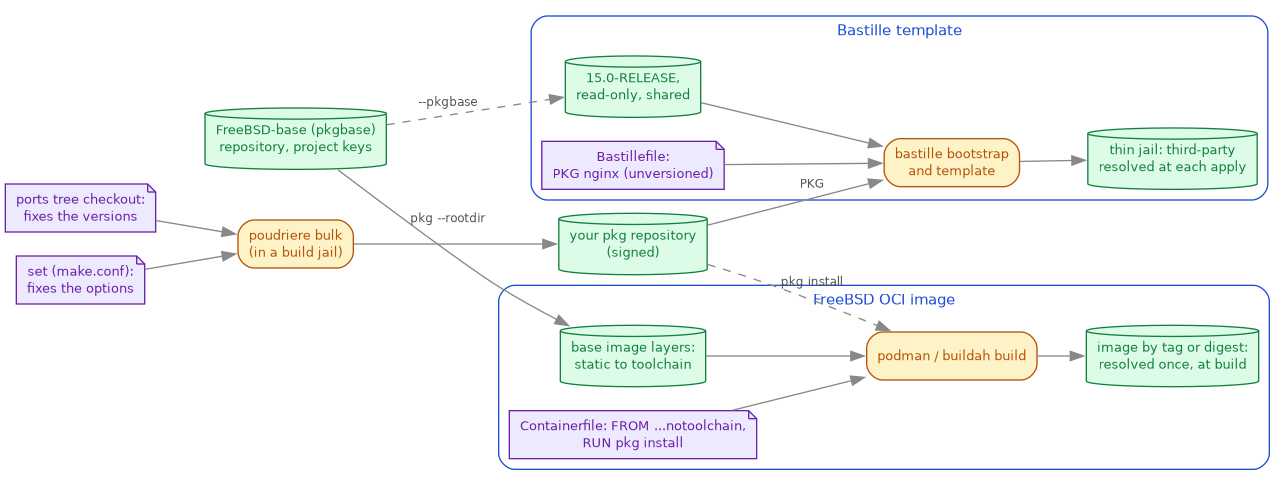
| aspect | Bastille template | FreeBSD OCI image |
|---|---|---|
| base | a bootstrapped 15.0-RELEASE directory (dist sets or --pkgbase) [fbsd-24] |
FROM ghcr.io/freebsd/freebsd-notoolchain:15.1 [fbsd-33] |
| how base is made | download of release sets or pkgbase packages | pkg --rootdir installs FreeBSD-runtime, FreeBSD-rc etc., then drops repo metadata [fbsd-32] |
| layering | thin jail shares one read-only release [fbsd-24] | static, dynamic, runtime, notoolchain, toolchain, each OCI_BASE_IMAGE of the next [fbsd-32] |
| third-party | PKG nginx (unversioned), or HPKG from the host [fbsd-24] |
RUN pkg bootstrap then RUN pkg install -y lang/python3 [fbsd-33] |
| pin | none in the file; pin with your own Poudriere repo | tag (freebsd-runtime:15.0) or digest; pkg layers resolve at build time |
| base update | update the release, which updates every thin jail [fbsd-24] | rebuild or pull a new tag |
| trust | pkg fingerprints in the jail | release-site download preferred over registries [fbsd-33] |
The base layer is the same in both now: pkgbase packages signed by the project. What differs is when third-party names resolve. A Bastillefile resolves them each time it is applied. An image resolves them once, at build time, and the digest keeps that result.
Sources
- [fbsd-1] FreeBSD Release Engineering, "FreeBSD 10.0-RELEASE Announcement", 2014-01-20, https://www.freebsd.org/releases/10.0R/announce/
- [fbsd-2] FreeBSD Ports Management Team, "Time to bid farewell to the old pkg_ tools", freebsd-ports, 2014-02-03, https://lists.freebsd.org/pipermail/freebsd-ports/2014-February/089547.html
- [fbsd-3] B. Daroussin for portmgr, "[HEADSUP] pkg(8) is now the only package management tool", freebsd-pkg, 2014-09-01, https://lists.freebsd.org/pipermail/freebsd-pkg/2014-September/000567.html
- [fbsd-4] B. Daroussin, "[ANNOUNCE] ports 2014Q2 branched", freebsd-ports, 2014-04-02, https://lists.freebsd.org/pipermail/freebsd-ports/2014-April/091293.html
- [fbsd-5] B. Daroussin, "pkg 1.3.0 out!", freebsd-pkg, 2014-07-23, https://lists.freebsd.org/pipermail/freebsd-pkg/2014-July/000421.html
- [fbsd-6] freebsd/pkg, NEWS, tags and releases, accessed 2026-11-22, https://github.com/freebsd/pkg
- [fbsd-7] FreeBSD, pkg.conf(5), accessed 2026-11-22, https://man.freebsd.org/cgi/man.cgi?query=pkg.conf&sektion=5
- [fbsd-8] freebsd-src,
usr.sbin/pkg/FreeBSD.conf.*,share/keys/pkg,share/keys/pkgbase-15and their commit logs, accessed 2026-11-22, https://github.com/freebsd/freebsd-src/tree/main/usr.sbin/pkg - [fbsd-9] FreeBSD Handbook, ch. 4 "Installing Applications: Packages and Ports", accessed 2026-11-22, https://docs.freebsd.org/en/books/handbook/ports/
- [fbsd-10] FreeBSD Porter's Handbook, "Security", accessed 2026-11-22, https://docs.freebsd.org/en/books/porters-handbook/security/
- [fbsd-11] VuXML, home page, accessed 2026-11-22, https://www.vuxml.org/
- [fbsd-12] FreeBSD Porter's Handbook, "Keeping Up", accessed 2026-11-22, https://docs.freebsd.org/en/books/porters-handbook/keeping-up/
- [fbsd-13] freebsd-ports,
MOVED, accessed 2026-11-22, https://github.com/freebsd/freebsd-ports/blob/main/MOVED - [fbsd-14]
freebsd/poudriere, README,poudriere.conf.sample, tags and first commit, accessed 2026-11-22, https://github.com/freebsd/poudriere - [fbsd-15] K. Smith, "FreeBSD 6.2-RELEASE Announcement", 2007-01-15, https://www.freebsd.org/releases/6.2R/announce/
- [fbsd-16] FreeBSD, freebsd-update(8), accessed 2026-11-22, https://man.freebsd.org/cgi/man.cgi?query=freebsd-update&sektion=8
- [fbsd-17] FreeBSD Handbook, ch. 26 "Updating and Upgrading FreeBSD", accessed 2026-11-22, https://docs.freebsd.org/en/books/handbook/cutting-edge/
- [fbsd-18] FreeBSD Release Engineering, "FreeBSD 14.0-RELEASE Announcement", 2023-11-20, https://www.freebsd.org/releases/14.0R/announce/
- [fbsd-19] FreeBSD Release Engineering, "FreeBSD 15.0-RELEASE Announcement", 2025-12-02, https://www.freebsd.org/releases/15.0R/announce/
- [fbsd-20] FreeBSD Release Engineering, "FreeBSD 15.0-RELEASE Release Notes", 2025-12, https://www.freebsd.org/releases/15.0R/relnotes/
- [fbsd-21] FreeBSD, jail(8), accessed 2026-11-22, https://man.freebsd.org/cgi/man.cgi?query=jail&sektion=8
- [fbsd-22] FreeBSD Release Engineering, "FreeBSD 4.0-RELEASE Announcement", 2000-03-14, https://www.freebsd.org/releases/4.0R/announce/
- [fbsd-23] FreeBSD Release Engineering, "FreeBSD 12.0-RELEASE Announcement" (2018-12-11) and Release Notes, https://www.freebsd.org/releases/12.0R/relnotes/
- [fbsd-24] BastilleBSD, docs (
jails/jail-types,templates/hooks,releases/bootstrap) and releases, accessed 2026-11-22, https://github.com/BastilleBSD/bastille/tree/master/docs/chapters - [fbsd-25] iocage repositories, accessed 2026-11-22, https://github.com/iocage/iocage, https://github.com/freebsd/iocage
- [fbsd-26] bsdpot/pot, repository and releases, accessed 2026-11-22, https://github.com/bsdpot/pot
- [fbsd-27] D. Rabson, ocijail, README and releases, accessed 2026-11-22, https://github.com/dfr/ocijail
- [fbsd-28] S. Karp, runj, README, accessed 2026-11-22, https://github.com/samuelkarp/runj
- [fbsd-29] freebsd-ports, commit logs for
sysutils/podman,sysutils/buildah,sysutils/ocijail, accessed 2026-11-22, https://github.com/freebsd/freebsd-ports/tree/main/sysutils/podman - [fbsd-30] FreeBSD Foundation, "Advancing Cloud Native Containers on FreeBSD: Podman Testing Highlights", 2024-11-12, https://freebsdfoundation.org/blog/advancing-cloud-native-containers-on-freebsd-podman-testing-highlights/
- [fbsd-31] FreeBSD Release Engineering, "FreeBSD 14.2-RELEASE Announcement", 2024-12-03, https://www.freebsd.org/releases/14.2R/announce/
- [fbsd-32] freebsd-src,
release/Makefile.oci,release/scripts/make-oci-image.sh,release/tools/oci-image-*.confand commit log, accessed 2026-11-22, https://github.com/freebsd/freebsd-src/blob/main/release/scripts/make-oci-image.sh - [fbsd-33] FreeBSD Handbook, ch. 18 "OCI Containers", accessed 2026-11-22, https://docs.freebsd.org/en/books/handbook/containers/
- [fbsd-34] FreeBSD Foundation, "An introduction to OCI Containers on FreeBSD", 2025-10-31, https://freebsdfoundation.org/blog/oci-containers-on-freebsd/
- [fbsd-35] D. Cottlehuber, "FreeBSD containers" (14.2 OCI images with Podman), 2024-12-04, https://people.freebsd.org/~dch/posts/2024-12-04-freebsd-containers/
- [fbsd-36] FreeBSD Project, "FreeBSD.org intrusion announced November 17th 2012", 2012-11-17, https://www.freebsd.org/news/2012-compromise/
- [fbsd-37] FreeBSD Release Engineering, "FreeBSD 14.1-RELEASE Announcement", 2024-06-04, https://www.freebsd.org/releases/14.1R/announce/
Nix and Guix: the store as the lockfile
Dates, versions and quotes checked against the LISA 2004 paper, the 2006 thesis, Nix release notes and manual, RFC 0062, nixpkgs pkgs/README, and the Guix manual, blog and 2012 announcement.
Origin. Nix was presented at LISA XVIII (Atlanta, 2004-11-14..19) by Dolstra, de Jonge and Visser. The problem was stated as consistency: upgrading or removing one component should not break another, and multiple "versions and variants of a component" should be installable "at the same time" [nix-1]. The fix was "using cryptographic hashes to compute unique paths for component instances" [nix-1]. Dolstra's PhD dissertation, defended 2006-01-18 at Utrecht, formalised it [nix-2].
The store path. A path like /nix/store/bwacc7a5c5n3...-hello-2.1.1 carries "the
cryptographic hash of all inputs involved in building the component" [nix-2]. Change a
compiler flag or a dependency and the path changes, so two dependency sets are two paths,
and coexistence is the default rather than a feature. Runtime dependencies are found by
scanning outputs for other store hashes, which the dissertation defends as an analogue "of
conservative garbage collection" [nix-2].
Version selection. There is no resolver. A version is whatever the package set says it is at a given revision. nixpkgs is one version-set: old versions "should not be kept unless there is a good reason", with GCC the stock exception; contributors needing a different dependency version should "first try modifying your package" [nix-7]. Conflicts are settled by the set's maintainers, once, rather than by each consumer's solver.
Lockfiles. For most of Nix's history there was none. A channel is a URL to a
nixexprs.tar.gz, and the manual admits channel state "is external to the Nix expressions
relying on it", which "may limit reproducibility" [nix-5]. Flakes were the
answer: shipped in Nix 2.4 (2021-11-01, "the first release in more than two years") and
"currently marked as experimental" [nix-3]. flake.lock is JSON, a graph "isomorphic to
the graph of dependencies of the root flake", pinning each input to a revision plus a
narHash of its contents [nix-6]. 2.4 also introduced experimental-feature flags; before
them unstable features "were merely documented as unstable", "a source of confusion and
controversy" [nix-4]. flakes is still on that list, and nix flake still prints "This program is
experimental" [nix-4][nix-6].
Integrity and trust. Input addressing says what was meant to be built, not what the
bytes are. Binary deployment came through substitutes: a store path can be fetched instead
of built [nix-1]. The dissertation names the cost: users "have to trust" that a remotely built
output really came from its derivation, and proposes a content-addressed store as the fix
[nix-2]. In practice the fix was signatures. Nix 1.7 had experimental signed caches; 1.9
(2015-06-12) changed the format incompatibly and checked against binary-cache-public-keys
[nix-8]. Nix 2.0 (2018-02-22) made substitutes "require signatures by default", removed
OpenSSL signing, and exempted content-addressed paths [nix-9]. RFC 0062 (started 2019-08-14,
Hufschmitt) returned to the dissertation's idea for derivations, citing "build cutoffs" and noting
the trust-model implications; it sits behind the ca-derivations flag [nix-10][nix-4].
Reproducibility versus determinism. The sources keep them apart. Nix gives "deterministic references to all of its dependencies", but "this alone is not sufficient: builds may still leak timestamps" [nix-11]. A clean rebuild can't prove reproducibility: "you might simply have gotten lucky" [nix-11].
Removal. Nothing is uninstalled. "Nix has no explicit operation to delete a store path – that would be unsafe". Users drop roots and the collector removes unreachable paths [nix-1].

Guix. Announced 2012-07-07 by Ludovic Courtès as "a purely functional package management
tool" in Guile Scheme, on Nix's "low-level build and storage mechanisms" [guix-1]. 1.0.0
came 2019-05-02 after "seven years" and 19 0.x releases [guix-2]. Guix's lock is the
commit: guix describe -f channels pins every channel, and guix time-machine replays it.
The manual compares this to lock files, except "you are effectively pinning the entire
package set" [guix-3]. Time travel stops at v0.16.0 (2018-12), the oldest channel-capable
commit, and "no security fixes are provided for old versions" [guix-4].
Trust and names. Guix signs substitutes, as Nix does, and also authenticates the git
history that defines packages [guix-5]. Since the 2020-07-01 design, a commit is authentic only if signed by a key in each parent's .guix-authorizations
[guix-5]; users anchor trust with a channel introduction [guix-6]. In nixpkgs a name is an attribute in one curated tree;
extra versions belong "in the attribute name" [nix-7].
Bootstrapping. On 2023-04-26 Guix merged the Full-Source Bootstrap: a graph of "more than 22,000 nodes rooted in a 357-byte program", for x86 Linux [guix-7]. Three years earlier, the seeds had been cut to Mes, MesCC-Tools and a static Guile 2.0.9 [guix-7].
Incidents.
- CVE-2024-27297 (2024-03). A fixed-output derivation, which has network access because its hash is known in advance, could be corrupted by passing file descriptors over Unix sockets. Reported to Nix; Guix was affected through daemon code shared "from an older version of Nix" [guix-8].
Sources
- [nix-1] Eelco Dolstra, Merijn de Jonge, Eelco Visser, "Nix: A Safe and Policy-Free System for Software Deployment", LISA XVIII, 2004-11. https://edolstra.github.io/pubs/nspfssd-lisa2004-final.pdf
- [nix-2] Eelco Dolstra, "The Purely Functional Software Deployment Model", PhD dissertation, Universiteit Utrecht, defended 2006-01-18. https://edolstra.github.io/pubs/phd-thesis.pdf
- [nix-3] NixOS, Nix Reference Manual, "Release 2.4 (2021-11-01)". https://nix.dev/manual/nix/latest/release-notes/rl-2.4
- [nix-4] NixOS, Nix Reference Manual, "Experimental Features". https://nix.dev/manual/nix/latest/development/experimental-features
- [nix-5] NixOS, Nix Reference Manual, "nix-channel". https://nix.dev/manual/nix/latest/command-ref/nix-channel
- [nix-6] NixOS, Nix Reference Manual, "nix flake" (Lock files). https://nix.dev/manual/nix/latest/command-ref/new-cli/nix3-flake
- [nix-7] NixOS, nixpkgs
pkgs/README.md. https://github.com/NixOS/nixpkgs/blob/master/pkgs/README.md - [nix-8] NixOS, Nix Reference Manual, "Release 1.9 (2015-06-12)". https://nix.dev/manual/nix/latest/release-notes/rl-1.9
- [nix-9] NixOS, Nix Reference Manual, "Release 2.0 (2018-02-22)". https://nix.dev/manual/nix/latest/release-notes/rl-2.0
- [nix-10] Théophane Hufschmitt, RFC 0062 "Simple content-addressed store paths", start 2019-08-14. https://github.com/NixOS/rfcs/blob/master/rfcs/0062-content-addressed-paths.md
- [nix-11] NixOS, "Reproducible Builds". https://reproducible.nixos.org/
- [guix-1] Ludovic Courtès, "[ANN] Guix, functional package management from Guile", gnu-system-discuss, 2012-07-07. https://lists.gnu.org/archive/html/gnu-system-discuss/2012-07/msg00000.html
- [guix-2] Ludovic Courtès, "GNU Guix 1.0.0 released", 2019-05-02. https://guix.gnu.org/en/blog/2019/gnu-guix-1.0.0-released/
- [guix-3] GNU Guix Reference Manual, "Replicating Guix". https://guix.gnu.org/manual/en/html_node/Replicating-Guix.html
- [guix-4] GNU Guix Reference Manual, "Invoking guix time-machine". https://guix.gnu.org/manual/en/html_node/Invoking-guix-time_002dmachine.html
- [guix-5] Ludovic Courtès, "Securing updates", 2020-07-01. https://guix.gnu.org/en/blog/2020/securing-updates/
- [guix-6] GNU Guix Reference Manual, "Channel Authentication". https://guix.gnu.org/manual/en/html_node/Channel-Authentication.html
- [guix-7] Janneke Nieuwenhuizen, Ludovic Courtès, "The Full-Source Bootstrap: Building from source all the way down", 2023-04-26. https://guix.gnu.org/en/blog/2023/the-full-source-bootstrap-building-from-source-all-the-way-down/
- [guix-8] John Kehayias, "Fixed-Output Derivation Sandbox Bypass (CVE-2024-27297)", 2024-03-12. https://guix.gnu.org/en/blog/2024/fixed-output-derivation-sandbox-bypass-cve-2024-27297/
Homebrew
assembly: removed three unconfirmed sentences (bottle start, analytics start, researcher name); supply-chain page cited at its current URL; timeline rows merged; earlier (research-agent, 2026-11-22T20:03:55Z): Checked versions, bottles, API, bundle lockfile, analytics, attestations, incidents against docs.brew.sh, brew.sh posts, GitHub PRs and advisories; analytics start date and the 2018 researcher's name are unconfirmed.
Origin. The first commit in Homebrew/legacy-homebrew is Max Howell's, 2009-05-20:
"I'll start with a rare Belgian yeast and Sussex hops" [brew-1]. A formula is a Ruby
class, so reading one runs it. The project now says Ruby "cannot be safely inspected
without executing it" [brew-4], and most of what follows is a response to that.
Version selection. There is none to speak of. Homebrew is "a rolling release package
manager" and does not install arbitrary older versions [brew-15]. One formula, one
current version. The exception is the versioned formula, foo@1.2.rb with class
FooAT12, allowed only where it differs in major/minor, upstream ships security fixes
for that branch, and no more than five versions exist unless popular [brew-2]. Today
python@3.9 through python@3.15 are in core, 3.9 and 3.10 deprecated [brew-22b]. The
one global rule resembles cargo's links: a formula "must not depend on the same
formulae at two different versions" in its recursive dependencies [brew-2]. 5.1.0
(2026-03-10) added brew version-install to extract and install an older version in
one step [brew-12].
Options. 2.0.0 (2019-02-02) removed every option from homebrew-core. Formulae with options "had to be built from source" and could not be tested on CI [brew-5]. Binary packages won over configurability.
Integrity. A formula pins each download to a sha256 in the reviewed file, and a
mismatch fails the install [brew-4]. Bottles carry one sha256 per platform tag inside a
bottle do block, plus an optional manifest_sha256 for the GitHub Packages manifest
[brew-3]. 3.0.0 (2021-02-05) changed the block to one :cellar per platform [brew-7].
3.1.0 (2021-04-12) moved bottles to GitHub Packages "due to Bintray's shutdown on May
1st 2021" [brew-7b].
Recording what was installed. No lockfile, on principle. brew bundle gained
Brewfile.lock.json in homebrew-bundle#552, merged 2019-11-12. Even then the author
wrote there would "never" be a proper lockfile, because pinning OpenSSL forever is "a
bad idea" [brew-16]. It recorded a "last known good build" and was never an install target. It
was removed in #1509, merged 2024-11-27, because the follow-up work "never
materialized" [brew-17]. A 2026 PR to bring it back as opt-in was closed on 2026-04-30.
A maintainer's reason: core "only carries current versions" of transitive deps [brew-18].
The bundle docs now say it "does not and will not" have one [brew-15]. brew bundle
itself moved into brew in 4.5.0 (2025-04-29) [brew-11].
Distribution. 3.3.0 (2021-10-25) added opt-in HOMEBREW_INSTALL_FROM_API to avoid
"the (large, slow) local checkouts" [brew-8]. 4.0.0 (2023-02-16) made JSON from
formulae.brew.sh the default, "the largest change" to updates since the repo split
[brew-9]. The API files are now JWS-signed and verified before use [brew-4]. 6.0.0
(2026-06-11) made the single-download internal API the default [brew-13].
Provenance. 4.3.0 (2024-05-14): with HOMEBREW_VERIFY_ATTESTATIONS set, brew install
verifies bottle attestations via gh, "still in beta" [brew-10]. In 2026-11 it is still
opt-in, pending a pure-Ruby verifier, and backed by Sigstore's transparency log [brew-4].
Names and taps. Official names are "maintainer-curated, not first-come-first-served", and removed names are not handed to strangers [brew-4]. Casks merged into Homebrew/brew in 1.0.0 (2016-09-21) [brew-6]. Taps are third-party Ruby, and 6.0.0 introduced tap trust: such taps must be "explicitly trusted" before their code runs [brew-13].
Linux. 2.0.0 made "Linuxbrew" official, with its own linuxbrew-core [brew-5]. 3.3.0
migrated Linux users to homebrew-core [brew-8].
Removal. deprecate! warns, disable! fails, and disabled packages are removed "one
year after their disable date" [brew-21]. Zero installs in 90 days is one deprecation
criterion [brew-21].
Analytics. Anonymous, InfluxDB, retained 365 days, off with brew analytics off or
HOMEBREW_NO_ANALYTICS=1 [brew-14]. Google Analytics ran alongside until 2023-06-16, when
it was dropped and its data destroyed [brew-9]. Counts are
public: ca-certificates had 5,385,532 installs from 2025-11-22 to 2026-11-22 [brew-22].
Incidents.
- Jenkins token (2018-07-31). A GitHub token "with recently elevated scopes" leaked from Homebrew's Jenkins and allowed push to brew and core. GitHub confirmed no pushes were made. Branch protection followed. A GPG-signing proposal was "rejected non-unanimously" [brew-19].
- Cask review bypass (2021-04-18).
review-cask-prauto-approved version-only PRs, and agit_diffparser flaw let it ignore injected lines. Both bots were removed, and cask PRs now need a maintainer [brew-20]. - Client advisories. 2026 brought sixteen GHSAs against Homebrew/brew, from
.pkgroot execution (2026-04-27) to a tap-trust bypass inbrew info(2026-10-26) [brew-23].
Sources
- [brew-1] Max Howell, first commit 29d85578, Homebrew/legacy-homebrew, 2009-05-20. https://github.com/Homebrew/legacy-homebrew/commit/29d85578e75170a6c0eaebda4d701b46f1acf446
- [brew-2] Homebrew, "Formulae Versions", docs.brew.sh. https://docs.brew.sh/Versions
- [brew-3] Homebrew, "Bottles", docs.brew.sh. https://docs.brew.sh/Bottles
- [brew-4] Homebrew, "Homebrew Security and Supply Chain", docs.brew.sh (
/Supply-Chain-Securityredirects here). https://docs.brew.sh/Homebrew-Security-and-Supply-Chain - [brew-5] Mike McQuaid, "Homebrew 2.0.0", 2019-02-02. https://brew.sh/2019/02/02/homebrew-2.0.0/
- [brew-6] Homebrew, "Homebrew 1.0.0", 2016-09-21. https://brew.sh/2016/09/21/homebrew-1.0.0/
- [brew-7] Mike McQuaid, "Homebrew 3.0.0", 2021-02-05. https://brew.sh/2021/02/05/homebrew-3.0.0/
- [brew-7b] Mike McQuaid, "Homebrew 3.1.0", 2021-04-12. https://brew.sh/2021/04/12/homebrew-3.1.0/
- [brew-8] Homebrew, "Homebrew 3.3.0", 2021-10-25. https://brew.sh/2021/10/25/homebrew-3.3.0/
- [brew-9] Mike McQuaid, "Homebrew 4.0.0", 2023-02-16. https://brew.sh/2023/02/16/homebrew-4.0.0/
- [brew-10] Homebrew, "Homebrew 4.3.0", 2024-05-14. https://brew.sh/2024/05/14/homebrew-4.3.0/
- [brew-11] Mike McQuaid, "Homebrew 4.5.0", 2025-04-29. https://brew.sh/2025/04/29/homebrew-4.5.0/
- [brew-12] Mike McQuaid, "Homebrew 5.1.0", 2026-03-10. https://brew.sh/2026/03/10/homebrew-5.1.0/
- [brew-13] Mike McQuaid, "Homebrew 6.0.0", 2026-06-11. https://brew.sh/2026/06/11/homebrew-6.0.0/
- [brew-14] Homebrew, "Anonymous Analytics", docs.brew.sh. https://docs.brew.sh/Analytics
- [brew-15] Homebrew, "Homebrew Bundle and Brewfile", docs.brew.sh. https://docs.brew.sh/Brew-Bundle-and-Brewfile
- [brew-16] Mike McQuaid, "Write
Brewfile.lock.jsonfiles", Homebrew/homebrew-bundle#552, merged 2019-11-12. https://github.com/Homebrew/homebrew-bundle/pull/552 - [brew-17] Mike McQuaid, "Remove
Brewfile.lock.jsongeneration", Homebrew/homebrew-bundle#1509, merged 2024-11-27. https://github.com/Homebrew/homebrew-bundle/pull/1509 - [brew-18] mvanhorn, "bundle: reintroduce
Brewfile.lock.jsonfor reproducibility", Homebrew/brew#22110, closed 2026-04-30 (comment by p-linnane). https://github.com/Homebrew/brew/pull/22110 - [brew-19] Mike McQuaid, "Security Incident Disclosure", 2018-08-05. https://brew.sh/2018/08/05/security-incident-disclosure/
- [brew-20] Markus Reiter, "Security Incident Disclosure", 2021-04-21. https://brew.sh/2021/04/21/security-incident-disclosure/
- [brew-21] Homebrew, "Deprecating, Disabling and Removing", docs.brew.sh. https://docs.brew.sh/Deprecating-Disabling-and-Removing
- [brew-22] Homebrew, formula install analytics, 365 days to 2026-11-22. https://formulae.brew.sh/api/analytics/install/365d.json
- [brew-22b] Homebrew, formula JSON API (
python@3.xentries), fetched 2026-11-22. https://formulae.brew.sh/api/formula.json - [brew-23] Homebrew/brew, GitHub security advisories. https://github.com/Homebrew/brew/security/advisories
Installers: Windows and macOS
assembly: removed three unconfirmed sentences (MSI 1.0 year, Authenticode origin, sandbox deadline); timeline rows merged; earlier (research-agent, 2026-11-22T20:04:54Z): Windows/macOS installer history checked against Microsoft Learn, Microsoft blogs, winget repos, Chocolatey/Scoop and Apple docs; three dates (Windows Installer 1.0 year, Authenticode origin, Mac App Store sandbox deadline) lack a primary source and are marked unconfirmed.
On Windows and macOS each application brought its own installer, and the installer decided what to share. The default was bundling; the history is a series of attempts to make sharing safe, or to stop it.
The problem. Microsoft's own wording, in the Windows 2000 application specification: when a shared component "is upgraded (or downgraded) as a result of installing another application", the first application may break, a condition "often referred to as 'DLL Hell'" [inst-1]. The cause: "100% backward compatibility is difficult, if not impossible" [inst-1]. Before Windows 2000, installers "might overwrite shared system files" [inst-2].
Protecting the base (Windows 2000). Windows File Protection watched protected system files and, on replacement, restored them "from the backup stored in the Dllcache folder" [inst-2]. It checked "the file's digital signature" to decide [inst-2]. Vista and Server 2008 renamed it Windows Resource Protection and extended it to registry keys and folders, writable only by TrustedInstaller [inst-3]. The trade: the OS stopped sharing its directory with installers.
Bundling, sanctioned (Windows 2000, XP). The same specification told developers to
install "into the application directory rather than the system directory" and to keep
registry state per version [inst-1]. The .local redirection file makes the loader check
the executable's folder first; it exists because a private DLL "doesn't solve the problem
for COM", which has one registration point [inst-6]. Windows XP added manifest-bound
side-by-side assemblies: "multiple versions of side-by-side assemblies can be used" by
applications "at the same time" [inst-4], resolved by the loader from the
assembly cache (WinSxS). (XP and later [inst-5]). The trade:
upgrading a bundled component "is the responsibility of the application developer"
[inst-1], so a security fix lands once per application.
Bookkeeping (Windows Installer). MSI 1.0 shipped with Office 2000 and 1.1 with Windows
2000 [inst-7]. XP shipped 2.0, Vista 4.0, Windows 7
5.0 [inst-8]. MSI's answer to DLL hell is a set of component rules: each component has a
GUID; "Never create two components that install a resource under the same name" [inst-9].
Shared components are reference-counted. Break the rules and "Uninstalling either
component removes the resource and breaks the other component" [inst-10]. Merge modules
(.msm) deliver shared components into a product's .msi; one "cannot be installed
alone" [inst-11]. The Visual C++ runtime is the longest-running case. 2013 and earlier
"remain installed side by side". Since 2017 one v14 redistributable serves every Visual
Studio through 2026, and it must be at least as new as the build tools [inst-12].
Trust. Authenticode "identifies the publisher" and verifies the code has "no changes since it was signed" [inst-13]. It says who shipped an installer and nothing about what it overwrites.
Isolation without sharing (ClickOnce, MSIX). ClickOnce requires .NET Framework 2.0, usually built with Visual Studio 2005 [inst-15]. Microsoft frames it against MSI: "applications often rely on shared components, with the potential for versioning conflicts"; with ClickOnce "each application is self-contained" in a per-user cache [inst-14]. MSIX was announced 2018-03-07 as "a complete containerization solution" [inst-16]. It runs on Windows 10 1709 and later [inst-18]. It signs every package and hashes every 64 KB block, and it promises uninstall "with no leftover files or registry entries" [inst-17]. Dynamic dependencies on framework packages arrived only with Windows 11 21H2 [inst-18].
Community managers. Chocolatey "was created by Rob Reynolds in 2011" [inst-19]. It wraps vendor installers rather than replacing them: community packages "must download those resources at runtime". Checksums were enforced by default for non-secure downloads from 0.10.0, August 2016, and human moderation from October 2014 [inst-20]. Scoop's first commit is 2013-05-11 [inst-21]. It installs portable apps per user without UAC prompts and "Resolves and installs dependencies automatically" [inst-21].
winget. Previewed 2020-05-19 at Build [inst-22]. Version 1.0 followed 2021-05-26 with "over 1,400 unique
packages" [inst-23]. The registry is the microsoft/winget-pkgs GitHub repo, created
2019-07-16 [inst-26]. Submissions are checked by "SmartScreen, static analysis, SHA256
hash validation" [inst-22]. Every manifest carries InstallerSha256, used "to confirm the
installer has not been modified" [inst-24][inst-25]. Dependencies are the weak part.
PackageDependencies must "come from the same source", and "External Dependencies are not
supported" [inst-25]. Like Chocolatey, winget pins the installer's bytes and leaves its effects unchecked.
macOS: receipts, bundles, gates. A .pkg leaves a receipt that pkgutil queries. Its
--forget discards the receipt "but do not touch the installed files" [inst-27]; there is no
uninstall command. Most apps skip the installer. An app bundle's Frameworks
directory holds "private shared libraries and frameworks", which are "revision-locked to
the application" [inst-28]. Gatekeeper was
announced with the Mountain Lion preview on 2012-02-16; its middle setting allowed
apps from "developers that have a unique Developer ID from Apple" [inst-29]. Notarization
followed. From macOS 10.14.5 new Developer ID software had to be notarized, and from 10.15
"all software built after June 1, 2019" [inst-31]. By default Gatekeeper now checks for software
"signed by a registered developer and notarized by Apple" [inst-30]. To ship through the
Mac App Store "you must enable the App Sandbox capability" [inst-32].
What each fix traded. WFP and WRP protected the OS by taking the shared directory away.
SxS, .local, ClickOnce, MSIX and app bundles made duplication cheap and moved patching
onto every vendor. MSI kept sharing and relied on GUID rules that authors can break [inst-10]. Signing, hashing and notarization check who built the bytes, never what they depend on.
Sources
- [inst-1] Microsoft. "Chapter 3: Component Sharing", Application Specification for Microsoft Windows 2000 for Desktop Applications (archived; archive date 2006-06-30). https://learn.microsoft.com/en-us/previous-versions/ms995843(v=msdn.10)
- [inst-2] Microsoft. "Windows File Protection", Windows XP TechNet (archived, 2009-09-11). https://learn.microsoft.com/en-us/previous-versions/windows/it-pro/windows-xp/bb490788(v=technet.10)
- [inst-3] Microsoft. "About Windows Resource Protection", Win32 docs. https://learn.microsoft.com/en-us/windows/win32/wfp/about-windows-file-protection
- [inst-4] Microsoft. "About Side-by-Side Assemblies", Win32 docs. https://learn.microsoft.com/en-us/windows/win32/sbscs/about-side-by-side-assemblies-
- [inst-5] Microsoft. "Isolated Applications and Side-by-side Assemblies", Win32 docs. https://learn.microsoft.com/en-us/windows/win32/sbscs/isolated-applications-and-side-by-side-assemblies-portal
- [inst-6] Microsoft. "Dynamic-link library redirection", Win32 docs (2023-02-22). https://learn.microsoft.com/en-us/windows/win32/dlls/dynamic-link-library-redirection
- [inst-7] Microsoft. "Windows Installer Versions", SMS 2003 docs (archived, 2008-12-08). https://learn.microsoft.com/en-us/previous-versions/system-center/configuration-manager-2003/cc180442(v=technet.10)
- [inst-8] Microsoft. "Released Versions of Windows Installer", Win32 docs. https://learn.microsoft.com/en-us/windows/win32/msi/released-versions-of-windows-installer
- [inst-9] Microsoft. "Organizing Applications into Components", Win32 docs. https://learn.microsoft.com/en-us/windows/win32/msi/organizing-applications-into-components
- [inst-10] Microsoft. "What happens if the component rules are broken?", Win32 docs. https://learn.microsoft.com/en-us/windows/win32/msi/what-happens-if-the-component-rules-are-broken
- [inst-11] Microsoft. "Merge Modules", Win32 docs. https://learn.microsoft.com/en-us/windows/win32/msi/merge-modules
- [inst-12] Microsoft. "Latest Supported Visual C++ Redistributable Downloads" (2025-12-03). https://learn.microsoft.com/en-us/cpp/windows/latest-supported-vc-redist
- [inst-13] Microsoft. "Authenticode Digital Signatures", Windows drivers docs (2025-07-11). https://learn.microsoft.com/en-us/windows-hardware/drivers/install/authenticode
- [inst-14] Microsoft. "ClickOnce Deployment and Security", Visual Studio docs (2026-04-28). https://learn.microsoft.com/en-us/visualstudio/deployment/clickonce-security-and-deployment
- [inst-15] Microsoft. "ClickOnce Installation" (archived, 2010-10-14). https://learn.microsoft.com/en-us/previous-versions/bb756885(v=msdn.10)
- [inst-16] Kevin Gallo, Microsoft. "Three things you need to know about Windows Developer Day", Windows Developer Blog, 2018-03-07. https://blogs.windows.com/windowsdeveloper/2018/03/07/three-things-need-know-windows-developer-day/
- [inst-17] Microsoft. "What is MSIX?", MSIX docs (2026-09-30). https://learn.microsoft.com/en-us/windows/msix/overview
- [inst-18] Microsoft. "MSIX features and supported platforms", MSIX docs (2023-04-11). https://learn.microsoft.com/en-us/windows/msix/supported-platforms
- [inst-19] Chocolatey Software. "About Chocolatey Software". https://chocolatey.org/about
- [inst-20] Chocolatey Software. "Security", Chocolatey docs. https://docs.chocolatey.org/en-us/information/security
- [inst-21] ScoopInstaller. Scoop README and initial commit (2013-05-11, via GitHub API). https://github.com/ScoopInstaller/Scoop
- [inst-22] Demitrius Nelon, Microsoft. "Windows Package Manager Preview", Windows Command Line blog, 2020-05-19. https://devblogs.microsoft.com/commandline/windows-package-manager-preview/
- [inst-23] Demitrius Nelon, Microsoft. "Windows Package Manager 1.0", Windows Command Line blog, 2021-05-26. https://devblogs.microsoft.com/commandline/windows-package-manager-1-0/
- [inst-24] Microsoft. "Create your package manifest", Windows Package Manager docs (2026-09-14). https://learn.microsoft.com/en-us/windows/package-manager/package/manifest
- [inst-25] Microsoft. winget-pkgs, "Installer manifest schema 1.12.0". https://github.com/microsoft/winget-pkgs/blob/master/doc/manifest/schema/1.12.0/installer.md
- [inst-26] Microsoft. microsoft/winget-pkgs repository (created 2019-07-16, via GitHub API). https://github.com/microsoft/winget-pkgs
- [inst-27] Apple.
pkgutil(1)manual page, macOS (page dated 2011-03-02). Read locally withman pkgutilon macOS (Darwin 24.1); Apple publishes no web copy found in this pass. - [inst-28] Apple. "Bundle Structures", Bundle Programming Guide (updated 2017-03-27). https://developer.apple.com/library/archive/documentation/CoreFoundation/Conceptual/CFBundles/BundleTypes/BundleTypes.html
- [inst-29] Apple Newsroom. "Apple Releases OS X Mountain Lion Developer Preview with Over 100 New Features", 2012-02-16. https://www.apple.com/newsroom/2012/02/16Apple-Releases-OS-X-Mountain-Lion-Developer-Preview-with-Over-100-New-Features/
- [inst-30] Apple. "Gatekeeper and runtime protection in macOS", Apple Platform Security (2024-12-19). https://support.apple.com/guide/security/gatekeeper-and-runtime-protection-sec5599b66df/web
- [inst-31] Apple. "Notarizing macOS software before distribution", Apple Developer Documentation. https://developer.apple.com/documentation/security/notarizing-macos-software-before-distribution
- [inst-32] Apple. "App Sandbox", Apple Developer Documentation. https://developer.apple.com/documentation/security/app-sandbox
Containers: Docker and OCI images
Docker/moby changelog and release posts, OCI spec releases, DCT retirement posts, cosign/Notation/BuildKit/Buildx release tags, Renovate docs and the 2020 rate-limit post all opened; Docker Hub 2019 breach and malicious-image incidents dropped for lack of a primary source.
The whole tree. An image does not resolve dependencies; it freezes the result. Docker 0.1.0 is dated 2013-03-23 in the changelog: "Initial public release", with a registry "to push/pull images" and "repository/tags to ease image management" [oci-1]. Docker's own 1.0 post puts the first release at 2013-03-20 [oci-2]; the changelog and the post disagree by three days. Solomon Hykes's PyCon US lightning talk, "The future of Linux Containers", is listed for 2013-03-15 [oci-3].
Dockerfile and layers. The first named Dockerfile operations (maintainer, expose,
cmd) arrived in 0.2.1 on 2013-05-01; build caching followed in 0.3.1 on 2013-05-08
[oci-1]. Each instruction that changes files "produces one layer", and the layer "never
changes" afterwards. Layers are stored by digest, so "two identical layers are the same
layer, stored once" [oci-4]. The cache key is the whole prefix: change one step and every
later step reruns [oci-4]. That is a dependency graph, but a linear one.
Tags and digests. A tag is a mutable name. With no tag, Docker "uses the :latest tag as
a default", and pulling the same tag again is how you get "the most up-to-date version"
[oci-5]. Content addressing came with Engine 1.6 and Registry 2.0, both 2015-04-16 on the
blog (changelog: 1.6.0, 2015-04-07). The blog: "Digests are an immutable reference to the
content" inside the image, "only supported by the v2 registry" [oci-6][oci-1]. Engine 1.10
(2016-02-04) moved local storage itself to "content-addressable storage for images and
layers" [oci-1]. The OCI descriptor states the rule plainly: a digest is "a collision-resistant
hash of the bytes", and implementations "MUST implement SHA-256" [oci-7]. Pinning by digest
is the image lockfile. The cost, in Docker's words: Docker "does therefore not pull updated
versions", including security fixes [oci-5].
Updating pins. Renovate recommends "pin your Docker images to an exact digest" because
"any Docker image tag can change content". It keeps the tag beside the digest
(node:14.15.1@sha256:...) and opens a PR when upstream rebuilds that tag [oci-8].
Dependabot's docker ecosystem "parses Docker image tags for Semantic Versioning"; its page
does not mention digests [oci-9].
The registry. Docker 1.0 (2014-06-09) presented Docker Hub as "a cloud-based service for collaboration, content, and workflow automation" [oci-2]. Docker Official Images are "a curated set of Docker repositories hosted on Docker Hub" [oci-10].
Standards. The Open Container Initiative launched 2015-06-22, "by Docker, CoreOS and other leaders", under the Linux Foundation, and maintains runtime, image and distribution specs [oci-11]. image-spec 1.0.0 shipped 2017-07-19 and 1.1.0 on 2024-02-15. distribution-spec took longer: 1.0.0 on 2021-05-05, 1.1.0 on 2024-02-15 [oci-12][oci-13].
Trust. Engine 1.8 (2015-08-11) added "Trusted pull, push and build, disabled by default"
[oci-1]. The launch post (2015-08-12) described Docker Content Trust as TUF integrated
"using Notary", offered "as an opt-in feature". All Official repository images were signed
[oci-14]. Opt-in stayed opt-in. On 2025-07-29 Docker reported "fewer than 0.05% of Docker
Hub image pulls use DCT", and said the Notary codebase "is no longer actively maintained"
[oci-15]. The docs now say DCT "is being retired": notary.docker.io shuts down on
2026-12-08 [oci-16]. The replacements are signatures stored in the registry next to the
image. cosign 1.0.0 (2021-07-28) was "the first production ready" release and added an
attest command [oci-17]. Notation, the Notary Project's CLI, reached 1.0.0 on 2023-08-15
[oci-18].
Provenance and SBOMs. BuildKit 0.11.0 (2023-01-10) produces SBOM attestations and provenance "in SLSA format", the latter recording "the digests of all the container images used during the build" [oci-19]. Buildx 0.10.0, the same day, made "a minimal provenance attestation" the default for OCI images. It warned this may break some registries and runtimes [oci-20]. SLSA itself reached v1.0 on 2023-04-19 [oci-21].
Availability. Pinning fixes what you get, not whether you can get it. On 2020-10-30 Docker announced phased pull limits starting 2020-11-02. The final levels were 100 pulls per six hours for anonymous users and 200 for free accounts. The reason given was to surface "where anonymous CI/CD processes are pulling container images" [oci-22]. CI pipelines that pulled base images anonymously learned their registry was a dependency.
Incidents. The 2019 Docker Hub database breach and the cryptomining images on Docker Hub are reported only by secondary press in this pass, so they are left out.
Sources
- [oci-1] moby/moby,
CHANGELOG.md(at tag v1.13.0), entries 0.1.0 through 1.10.0. https://raw.githubusercontent.com/moby/moby/v1.13.0/CHANGELOG.md - [oci-2] Julien Barbier, Docker Blog, "It's Here: Docker 1.0", 2014-06-09. http://blog.docker.com/2014/06/its-here-docker-1-0/ (read via the Internet Archive)
- [oci-3] PyVideo, "The future of Linux Containers", Solomon Hykes, PyCon US 2013, listed 2013-03-15. https://pyvideo.org/pycon-us-2013/the-future-of-linux-containers.html
- [oci-4] Docker Docs, "Understanding the image layers". https://docs.docker.com/get-started/docker-concepts/building-images/understanding-image-layers/
- [oci-5] Docker Docs, "
docker image pull" reference. https://docs.docker.com/reference/cli/docker/image/pull/ - [oci-6] Jessie Frazelle, Docker Blog, "Docker 1.6: Engine & Orchestration Updates, Registry 2.0, & Windows Client Preview", 2015-04-16. http://blog.docker.com/2015/04/docker-release-1-6/ (read via the Internet Archive)
- [oci-7] Open Container Initiative, image-spec,
descriptor.md. https://github.com/opencontainers/image-spec/blob/main/descriptor.md - [oci-8] Renovate Docs, "Docker". https://docs.renovatebot.com/docker/
- [oci-9] GitHub Docs, "Dependabot supported ecosystems and repositories". https://docs.github.com/en/code-security/dependabot/ecosystems-supported-by-dependabot/supported-ecosystems-and-repositories
- [oci-10] Docker Docs, "Trusted content" (Docker Official Images). https://docs.docker.com/docker-hub/image-library/trusted-content/
- [oci-11] Open Container Initiative, "About the OCI". https://opencontainers.org/about/overview/
- [oci-12] opencontainers/image-spec, GitHub releases (v1.0.0, v1.1.0). https://github.com/opencontainers/image-spec/releases
- [oci-13] opencontainers/distribution-spec, GitHub releases (v1.0.0, v1.1.0). https://github.com/opencontainers/distribution-spec/releases
- [oci-14] Diogo Mónica, Docker Blog, "Introducing Docker Content Trust", 2015-08-12. https://blog.docker.com/2015/08/content-trust-docker-1-8/ (read via the Internet Archive)
- [oci-15] Brian Pratt, Docker Blog, "Retiring Docker Content Trust", 2025-07-29. https://www.docker.com/blog/retiring-docker-content-trust/
- [oci-16] Docker Docs, "Content trust in Docker". https://docs.docker.com/engine/security/trust/
- [oci-17] sigstore/cosign, release v1.0.0, 2021-07-28. https://github.com/sigstore/cosign/releases/tag/v1.0.0
- [oci-18] notaryproject/notation, release v1.0.0, 2023-08-15. https://github.com/notaryproject/notation/releases/tag/v1.0.0
- [oci-19] moby/buildkit, release v0.11.0, 2023-01-10. https://github.com/moby/buildkit/releases/tag/v0.11.0
- [oci-20]
docker/buildx, release v0.10.0, 2023-01-10. https://github.com/docker/buildx/releases/tag/v0.10.0 - [oci-21] Mark Lodato, SLSA blog, "SLSA v1.0 is now final!", 2023-04-19. https://slsa.dev/blog/2023/04/slsa-v1-final
- [oci-22] Matt Carter, Docker Blog, "What you need to know about upcoming Docker Hub rate limiting", 2020-10-30. https://www.docker.com/blog/what-you-need-to-know-about-upcoming-docker-hub-rate-limiting/ (read via the Internet Archive; the live URL now redirects to the docs)
Part II: language ecosystems
Ordered by the earliest registry or manager date each section gives: PEAR (2003) puts PHP before RubyGems (2004), and CocoaPods (2011) puts the Apple section after NuGet.
Perl and CPAN
assembly: removed the author-flagged inference about ranges and the index; timeline rows merged into the note timeline; earlier (research-agent, 2026-11-22T20:04:38Z): Dates, versions and quotes checked against CPAN::Meta::Spec, the PAUSE operating model, tool Changes files, perldeltas and MITRE CVE records; one inference left marked unverified.
The archive. CPAN "has been online since October 1995". On 2026-11-22 the front page counted 52,947 distributions by 14,761 authors [cpan-17]. Authors upload through PAUSE; "Anyone can upload anything to their author directories" [cpan-2].
Version selection. There is no resolver in the Cargo sense. "The CPAN Index maps Perl
packages to an uploaded file on CPAN" [cpan-2]: one file per package, the latest indexed
release. A client asking for Foo::Bar gets that file. A bare version in a prereq "means
that at least version 2.4 must be present" [cpan-1]. Ranges came with META spec 2 (drafted
April 2010) [cpan-1]: > 1.2, != 1.5, < 2.0=.
Declaring prerequisites. Ken Williams wrote the META.yml spec in 2003. Version 2, organised
by David Golden in late 2009, split prereqs into phases (configure, build, test, runtime,
develop) and relationships (requires, recommends, suggests, conflicts) [cpan-1]. conflicts
"should be used with great caution, or not at all" [cpan-1]. The configure phase existed
because Makefile.PL and Build.PL are programs: Module::Build 0.2808_01 (2007-10-24) "Added
configure_requires as a new type of prereq" [cpan-16]. Before META.yml, CPAN.pm parsed the
generated Makefile; META.yml data replaced that parsing in 2005 [cpan-3].
Build tools. ExtUtils::MakeMaker has shipped with Perl 5 from the start; CPAN.pm entered core in 5.004 [cpan-15]. Module::Build (0.01 dated 2001-08-05 [cpan-16]) was added to core in 5.10.0 (2007-12-18), deprecated in 5.20 and removed in 5.22 (2015-06-01) [cpan-15]. CPANPLUS followed the same arc: core in 5.10, deprecated in 5.18, gone by 5.20 [cpan-15].
Clients. CPAN.pm (Andreas König) was the original. cpanminus 0.01 shipped 2010-02-19, "Initial version to CPAN" [cpan-12].
Lockfiles. None until applications needed them. Carton (miyagawa) began in 2011 and
first wrote carton.lock. In 0.9.65 (2013-07-23): "Use cpanfile.snapshot instead of
carton.lock" [cpan-13]. 1.0.0 followed on 2013-08-04 [cpan-13]. The snapshot is "meant to be
version controlled" so others get "the exact same versions" [cpan-13]. It records each
distribution's pathname, provides and requirements, with no hash [cpan-13]. Carmel
(0.1.0, 2015-04-17) keeps builds "in a central repository" and selects paths at runtime
[cpan-14].
Integrity. Each author directory carries a CHECKSUMS file, a Perl data structure,
PGP-signed. Entries hold md5, sha256, size, mtime and cpan_path [cpan-4].
CPAN.pm moved to "support SHA256; stop using MD5" in 2005-12 [cpan-3], added a check_sigs
option in 2006-07 [cpan-3], and in 2006-11 began fetching CHECKSUMS "from the same host as the
package file" [cpan-3]. cpanm 1.5021 (2013-01-31) added --verify for CHECKSUM and
SIGNATURE [cpan-12]. Both checks are opt-in.
Signing. Module::Signature (0.04, 2002-08-14 [cpan-5]) let authors ship a SIGNATURE
file. CVE-2013-2145: a "special unknown cipher" could load untrusted code, fixed in 0.72
[cpan-6][cpan-5]. On 2026-04-26 it was deprecated: it "does not provide the user with the
security assurance" implied, keys expired, and keyserver infrastructure decayed [cpan-5].
Trust and the registry. Names are governed by PAUSE indexing permissions: "The first
person to upload a package is granted the first-come indexing permission". Roughly 70% of
modules have first-come and nothing else [cpan-2]. First-come grants or revokes co-maint;
a dropped first-come passes to ADOPTME. Uploading an empty module to reserve a name "is
discouraged" [cpan-2]. A package's version "must be non-decreasing" to be indexed [cpan-2].
The operating model was first published 2017-10-22 [cpan-2].
Removal. Authors may delete files, which leave the regular mirrors. BackPAN keeps "everything that has ever been released to CPAN" [cpan-2]. Admins will not scrub BackPAN for "oh that's embarrassing" [cpan-2].
Conflicts and duplicates. The index holds one file per package. A second version needs a
second install tree, which is the local::lib and Carmel approach [cpan-14].
Testing. CPAN Testers "Started in 1998 by Graham Barr and Chris Nandor" for cross-platform QA [cpan-18].
Incidents.
- CHECKSUMS bypass (2021-11-23). CVE-2020-16154/16155/16156. CHECKSUMS named files but not
their location, and unsigned data could be prepended to a signed file [cpan-8][cpan-7]. PAUSE
added
cpan_path; CPAN.pm 2.29 addedpushy_https[cpan-8][cpan-3]. - TLS (2023-04-28). CVE-2023-31484: CPAN.pm "does not verify TLS certificates", fixed in
2.35 with
verify_SSL=>1[cpan-9][cpan-3]. - cpanm over HTTP (2024-08-26). CVE-2024-45321: cpanm "downloads code via insecure HTTP", reported by the CPAN Security Group with no upstream patch [cpan-10]. The maintainer had declined secure defaults in 2020 over breaking CI [cpan-11]. 1.7048 (2025-06) still had no fix [cpan-10].
Sources
- [cpan-1] Perl Toolchain Gang, CPAN::Meta::Spec (version 2; HISTORY section), https://github.com/Perl-Toolchain-Gang/CPAN-Meta/blob/master/lib/CPAN/Meta/Spec.pm
- [cpan-2] PAUSE admins, The PAUSE Operating Model, Version 2, first public 2017-10-22, https://github.com/andk/pause/blob/master/doc/operating-model.md
- [cpan-3] Andreas König, CPAN.pm
Changes, 2005-2023, https://github.com/andk/cpanpm/blob/master/Changes - [cpan-4] PAUSE,
CHECKSUMSfor author ANDK (CPAN::Checksums 2.14), observed 2026-11-22, https://www.cpan.org/authors/id/A/AN/ANDK/CHECKSUMS - [cpan-5] Module::Signature
Changesand POD (DEPRECATION NOTICE), https://github.com/audreyt/module-signature - [cpan-6] MITRE, CVE-2013-2145, published 2013-08-19, https://www.cve.org/CVERecord?id=CVE-2013-2145
- [cpan-7] MITRE, CVE-2020-16156, published 2021-12-13, https://www.cve.org/CVERecord?id=CVE-2020-16156
- [cpan-8] Neil Bowers, "Addressing CPAN vulnerabilities related to checksums", 2021-11-23, http://blogs.perl.org/users/neilb/2021/11/addressing-cpan-vulnerabilities-related-to-checksums.html
- [cpan-9] MITRE, CVE-2023-31484, published 2023-04-28, https://www.cve.org/CVERecord?id=CVE-2023-31484
- [cpan-10] CPAN Security Group (Stig Palmquist), "cpanminus downloads code using insecure HTTP", 2024-08-26, updated 2025-09-16, https://security.metacpan.org/2024/08/26/cpanminus-downloads-code-using-insecure-http.html; MITRE CVE-2024-45321, https://www.cve.org/CVERecord?id=CVE-2024-45321
- [cpan-11] miyagawa/cpanminus issue #611, "Securing Perl: cpanm HTTPS + verify_SSL + verify signatures?", opened 2020-06-24, https://github.com/miyagawa/cpanminus/issues/611
- [cpan-12] Tatsuhiko Miyagawa, App::cpanminus
Changes, https://github.com/miyagawa/cpanminus/blob/devel/App-cpanminus/Changes - [cpan-13] Carton
Changes,lib/Carton.pmandlib/Carton/Snapshot/Emitter.pm, https://github.com/perl-carton/carton - [cpan-14] Tatsuhiko Miyagawa, Carmel
Changesand README, https://github.com/miyagawa/Carmel - [cpan-15] perl5-porters, perl5100delta, perl5180delta, perl5200delta, perl5220delta,
perlhist; Module::CoreList 5.20220313 (first_release,removed_from), https://github.com/Perl/perl5/tree/blead/pod - [cpan-16] Module::Build
Changes, https://github.com/Perl-Toolchain-Gang/Module-Build/blob/master/Changes - [cpan-17] CPAN front page, observed 2026-11-22, https://www.cpan.org/
- [cpan-18] CPAN-Testers 0.02 README, https://www.cpan.org/authors/id/F/FH/FHOXH/CPAN-Testers-0.02.readme
Python: pip, Poetry and uv
pip
#10479 listed as a fix -> it is the issue; fixes are PRs #10481/#10482 plus resolvelib#84; other dates confirmed via GitHub API
History without a resolver (to 2020). pip 20.2 and earlier "simply uses the first
specification it finds", and could install six==1.11 while virtualenv==20.0.2 needed
newer (“Pip User Guide, ‘Changes to the Pip Dependency Resolver in 20.3 (2020)’; Constraints Files,” n.d.). The issue "pip needs a dependency resolver" (pypa/pip#988) was opened 2013-06-11
and closed 2020-11-30 (“Pypa/Pip#988, ‘Pip Needs a Dependency Resolver’, 2013-06-11 to 2020-11-30,” n.d.).
The 2020 backtracking resolver. It was opt-in in 20.2 (--use-feature=2020-resolver) and
the default in 20.3 for Python 3, with --use-deprecated=legacy-resolver as a temporary
escape (“Pip User Guide, ‘Changes to the Pip Dependency Resolver in 20.3 (2020)’; Constraints Files,” n.d.). It backtracks: "Pip's dependency resolver is now capable of backtracking" (“Pip, ‘Dependency Resolution’ (Backtracking, Resolutiontoodeep),” n.d.).
The rollout. pypa/pip#9187, "New resolver takes a very long time to complete", was opened
on release day, 2020-11-30. Weblate's CI looped for hours and Prefect's installs went from
1–2 min to 20+ (“Pypa/Pip#9187, ‘New Resolver Takes a Very Long Time to Complete’,” n.d.). It was fixed by resolvelib/pip heuristics (pip PRs #10481/#10482 for issue #10479,
resolvelib#84) and closed 2021-10-11 (“Pypa/Pip#9187, ‘New Resolver Takes a Very Long Time to Complete’,” n.d.). The docs now warn that the resolver "may exceed its
search depth" (ResolutionTooDeep) and advise raising lower bounds, using constraints files,
using lockfiles, and using upper bounds "sparingly" (“Pip, ‘Dependency Resolution’ (Backtracking, Resolutiontoodeep),” n.d.).
Constraints files (-c). They "only control which version of a requirement is
installed", never whether it is installed. 20.3 "stripped constraints files down to being
purely a way to specify global (version) limits" (“Pip User Guide, ‘Changes to the Pip Dependency Resolver in 20.3 (2020)’; Constraints Files,” n.d.). This is Python's equivalent of
dependencyManagement.
Hash-checking (--require-hashes, pip 8.0). "An all-or-nothing proposition". One
--hash turns it on globally, and it requires == pins (“Pip, ‘Secure Installs’ (Hash-Checking Mode, –Require-Hashes, Pip 8.0),” n.d.)(“Pip User Guide, ‘Changes to the Pip Dependency Resolver in 20.3 (2020)’; Constraints Files,” n.d.). It "may not work well in
combination with constraints" (“Pip User Guide, ‘Changes to the Pip Dependency Resolver in 20.3 (2020)’; Constraints Files,” n.d.).
Index precedence. pypa/pip#8606, "index-url extra-index-url install priority order", was opened 2020-07-21 and is still open. Maintainers hold that treating all indexes equally is by design and point to PEP 708 (“Pypa/Pip#8606, ‘Index-Url Extra-Index-Url Install Priority Order’,” n.d.). PEP 708 was provisionally accepted in 2023 and has since been rejected because its conditions were never met (“Pep 708, ‘Extending the Repository Api to Mitigate Dependency Confusion Attacks’ (Rejected),” n.d.). pip has no fix. This is the root cause of torchtriton (Python incidents).
PEP 440: versions and specifiers (created 2013-03-18, Final)
Created 18-Mar-2013, Final; ~=1 and === quotes verbatim
~=(compatible release):~=2.2means>=2.2, ==2.*and~=1.4.5means>=1.4.5, ==1.4.*.~=1is invalid (“Pep 440, ‘Version Identification and Dependency Specification’,” n.d.).- Prereleases are "implicitly excluded from all version specifiers". They are selected only if already installed, explicitly requested, or the only version that satisfies (“Pep 440, ‘Version Identification and Dependency Specification’,” n.d.).
===is plain string equality, an "escape hatch" for legacy versions (“Pep 440, ‘Version Identification and Dependency Specification’,” n.d.).
PEP 508 markers, and Requires-Python
Requires-Python raise and --ignore-requires-python attributed to 9.0.1 -> both in 9.0.0 (2016-11-02); PEP 503 amendment dated 2016-07-22 [127]
Markers. Requires-Dist: pywin32 >1.0; sys_platform == 'win32' declares a requirement
only under a condition. python_version, sys_platform, platform_machine and others are the
system-requirement language (“Pypa, Core Metadata Specification (Requires-Python, Requires-Dist Markers). ; Pep 508,” n.d.).
Requires-Python (Metadata 1.2). "Installation tools may look at this when picking which version of a project to install", and it cannot take a marker (“Pypa, Core Metadata Specification (Requires-Python, Requires-Dist Markers). ; Pep 508,” n.d.). How it became enforced:
- 2016-07-22: PEP 503 was amended with
data-requires-pythonso the index exposes it per file (“Distutils-Sig, ‘Released: Pip V9.0.0’, 2016-11. ; Python/Peps Pr #56 (Data-Requires-Python),” n.d.). - pip 9.0.0 (2016-11-02): support for
data-requires-python; pip raises on mismatch and adds--ignore-requires-python(“Distutils-Sig, ‘Released: Pip V9.0.0’, 2016-11. ; Python/Peps Pr #56 (Data-Requires-Python),” n.d.)(“Pip, ‘Changelog’ (8.0.0, 9.0.0, 9.0.1, 20.2, 20.3),” n.d.). pip 9.0.1 (2016-11-06) was bug fixes only (“Pip, ‘Changelog’ (8.0.0, 9.0.0, 9.0.1, 20.2, 20.3),” n.d.).
Effect. Requires-Python is both a filter during selection, since old releases stay installable on old Pythons, and a refusal at install. This is the design cargo reached nine years later with resolver v3.
Upper caps. The discuss.python.org thread "Requires-Python upper limits" (#12663, from
2021-12) is the long argument over whether <3.12-style caps are allowed and what installers
should do with them (“Discuss.Python.Org, ‘Requires-Python Upper Limits’,” n.d.). Practice now leans against caps (Poetry, uv).
Yanking (PEP 592, 2019). Installers must ignore yanked files when a non-yanked file
satisfies the request. A yanked file may be selected only when it is the sole match for an
exact == / === pin or a lockfile, and installers should warn (“Pep 592, ‘Adding ’yank’ Support to the Simple Api’,” n.d.).
Poetry
#3747 2021-03-03 (quote is a maintainer comment), #8291 not_planned, #9558 merged 2024-07-18, Schreiner 2021-12-09
Lockfile and solver. poetry.lock plus a PubGrub solver (mixology) (“Uv, ‘Resolver Internals’ (Pubgrub, Forking). ; Pubgrub-Rs Readme (Mixology for Poetry),” n.d.). Poetry resolves
for the whole declared Python range, not the running interpreter, so a project that allows
>=3.11 cannot depend on a package capped at <3.13. The FAQ's fix is to narrow your own
range or add a per-dependency Python marker (“Poetry Faq (Python Range Resolution),” n.d.).
The caret-by-default debate. poetry add writes ^x.y.z (the next major is excluded)
(“Poetry, ‘Dependency Specification’,” n.d.). The issues:
- #3747, "please stop pinning to major versions by default … especially for Python itself". A maintainer replied that the Python upper-bound behaviour "will never change" (“Python-Poetry#3747. ; #8291. ; #10136. ; Poetry-Relax,” n.d.).
- #8291, asking for a config option, was closed not planned (“Python-Poetry#3747. ; #8291. ; #10136. ; Poetry-Relax,” n.d.).
- #10136 notes a later move toward
>=defaults for Python (#9558) (“Python-Poetry#3747. ; #8291. ; #10136. ; Poetry-Relax,” n.d.).
Henry Schreiner's essay (2021-12-09) made the case against caps (“Henry Schreiner, ‘Should You Use Upper Bound Version Constraints?’, 2021-12-09,” n.d.):
- "users cannot fix an over restrictive cap";
- solvers backsolve to old versions with old bugs;
- a
requires-pythoncap in Poetry forces "every Poetry project that uses it" to cap too.
The poetry-relax plugin exists to strip caps (“Python-Poetry#3747. ; #8291. ; #10136. ; Poetry-Relax,” n.d.).
uv (2024–)
requires-python and first-index quotes verbatim; prerelease default if-necessary confirmed
Lockfile. uv.lock is universal: one file for all platforms and Python versions. It
forks the resolution on markers (an idea borrowed from Poetry), so a package may appear at
different versions under different markers (“Uv, ‘Resolution’,” n.d.)(“Uv, ‘Resolver Internals’ (Pubgrub, Forking). ; Pubgrub-Rs Readme (Mixology for Poetry),” n.d.).
Requires-Python. The project's requires-python must be a subset of every dependency's.
uv "only considers lower bounds and ignores upper bounds entirely" (“Uv, ‘Resolution’,” n.d.). In effect it rules
against caps.
Strategies.
- The default is the highest compatible version.
--resolution lowestcovers all dependencies;lowest-directcovers direct ones only. Library authors should test with these to "ensure compatibility with the declared lower bounds" (“Uv, ‘Resolution’,” n.d.). This is the shipped, stable version of cargo's unstable-Z minimal-versions.--exclude-newer <date>limits candidates to artifacts uploaded before a cutoff (PEP 700upload-time), so a resolution can be reproduced as of a date (“Uv, ‘Resolution’,” n.d.). It is also a cooldown.- The prerelease policy defaults to
if-necessary, matching PEP 440 (“Uv, ‘Resolution’,” n.d.).
Index strategy. The default is first-index: uv stops at the first index that has the
name, explicitly to prevent dependency confusion. pip's behaviour is available as
unsafe-best-match (“Uv, ‘Package Indexes’ (Index Strategy),” n.d.). uv fixed in a default what pip#8606 has left open since 2020.
Conflicts. uv fails with "No solution found …" plus a derivation of the incompatibility (PubGrub) (“Uv, ‘Resolution’,” n.d.).
PEP 751, PEP 740, trusted publishing
PEP 751 created 2024-07-24, accepted 2025-03-31; trusted publishing 2023-04-20 [26]; unconfirmed mark removed
- PEP 751
pylock.toml(accepted 2025-03-31) is the standard lockfile. It lets an installer act without resolving.packages.archive.hashes"MUST contain at least one entry" (sha256 recommended).environmentslists the markers a lock is valid for (“Pep 751, ‘a File Format to Record Python Dependencies for Installation Reproducibility’, Accepted 2025-03-31,” n.d.). Python went from "no resolver" to "standard lockfile with mandatory hashes" in under five years. - Trusted publishing (2023-04-20 (“Pypi Blog, ‘Introducing ’trusted Publishers’’, 2023-04,” n.d.)) uses OIDC from CI in place of long-lived tokens (“Pypi Blog, ‘Introducing ’trusted Publishers’’, 2023-04,” n.d.).
- PEP 740 attestations (live 2024-11-14). Only attestations with a verifiable signature can be uploaded, and they are served through an Integrity API (“Pypi Blog, ‘Pypi Now Supports Digital Attestations’, 2024-11-14. ; Pep 740,” n.d.).
Python incidents
PyPI pauses missed 2023-11-24 to 2023-12-04 (added, status.python.org [128]); 2FA 'all uploads' -> all users from 2024-01-01 [129]; repo-jacking unconfirmed mark resolved [132]; '500+ typosquats' only from secondary [72]
- Typosquatting.
- 2024-03-28: PyPI suspended new registrations and projects for about 10 h during a campaign of 500+ typosquats. Earlier pauses were 2023-05-20 to 21, 2023-11-24 to 2023-12-04, and 2023-12-27 to 2024-01-02 (“Python Infrastructure Status Page, Incident History (Pypi Registration Suspensions),” n.d.).
- Rule change: mandatory 2FA for all PyPI users from 2024-01-01 ("all users must enable 2FA") (“Pypi Blog, ‘Securing Pypi Accounts via Two-Factor Authentication’, 2023-05-25; ‘2fa Requirement for Pypi Begins 2024-01-01’, 2023-12-13,” n.d.), and temporary freezes as an operational tool.
- torchtriton (2022-12-25 to 30). PyTorch nightly depended on
torchtriton, hosted on its own index. Someone registered the same name on PyPI, and "since the PyPI index takes precedence" (pip#8606), pip installed the attacker's version. It exfiltrated~/.ssh,/etc/passwdand similar over DNS (“Pytorch, ‘Compromised Pytorch-Nightly Dependency Chain between December 25th and December 30th, 2022’,” n.d.). Rule changes: PyTorch renamed the dependency topytorch-tritonand registered a placeholder on PyPI (“Pytorch, ‘Compromised Pytorch-Nightly Dependency Chain between December 25th and December 30th, 2022’,” n.d.). Ecosystem-wide, uv chosefirst-index(“Uv, ‘Package Indexes’ (Index Strategy),” n.d.). pip still has no rule (“Pypa/Pip#8606, ‘Index-Url Extra-Index-Url Install Priority Order’,” n.d.). ctx(2022-05). The maintainer's email domain had expired. The attacker re-registered it, reset the password about 12 minutes later, and shipped an environment-variable stealer with about 27,000 downloads (“Python Security-Announce, ‘Incident Report: Malicious Takeover of Ctx Project on Pypi’, 2022-05,” n.d.). Rule change (2025): PyPI now unverifies emails whose domains enter expiration (more than 1,800 by 2025-08) and checks daily (“Pypi Blog, ‘Preventing Domain Resurrection Attacks’, 2025-08-18,” n.d.). Lesson: account recovery is a dependency. For GitHub-hosted packages the analogue is a renamed or deleted owner whose name gets re-registered ("repo-jacking"). An old username "becomes available for anyone else to claim"; GitHub retires anOWNER/REPOSITORY-NAMEonly on transfer, and only for repositories with more than 100 clones or Actions uses in the prior week (“Github Docs, ‘Transferring a Repository’ (Namespace Retirement); ‘Username Changes’,” n.d.).
Java: Maven and Gradle
Maven
assembly: removed the unconfirmed standard-practice sentence after Log4Shell; earlier (research-editor (citation/claim checkers), 2026-11-22T20:09:00Z): Log4Shell count as of 2021-12-17 -> 2021-12-16; 'Maven 4 reportedly fails' -> MNG-5728 fixed for 4.0.0 but Maven 4 still RC (4.0.0-rc-7); 'standard practice' unconfirmed mark kept, no primary source
Version selection. "Maven picks the 'nearest definition' … if two dependency versions are at the same depth in the dependency tree, the first declaration wins" (“Maven, ‘Introduction to the Dependency Mechanism’,” n.d.). Nothing is checked against the version the far dependency asked for. In the docs' own example D 1.0 wins over D 2.0 because it is one hop closer (“Maven, ‘Introduction to the Dependency Mechanism’,” n.d.).
dependencyManagement and BOMs. Managed versions take precedence over mediation for
transitive dependencies. import-scope POMs (BOMs) share version sets. With two imported
BOMs, "version 1.1 … would be used since X is declared first" (“Maven, ‘Introduction to the Dependency Mechanism’,” n.d.). That is order-dependent
again. Maven 4 adds a bom packaging (“Maven, ‘Introduction to the Dependency Mechanism’,” n.d.).
Duplicates. One artifact per groupId:artifactId on the classpath. Two different
artifacts that contain the same class are not detected at all by default (name clashes).
Refusal is opt-in, via the Enforcer (“Maven Enforcer, Built-in Rules,” n.d.):
dependencyConvergence: all paths must agree on a version;requireUpperBoundDeps: the resolved version must be ≥ every requested version, which fixes nearest-wins' downgrade;banDynamicVersions: no ranges, LATEST or SNAPSHOT;requireJavaVersion;banDuplicateClasses(extra-enforcer-rules): fails if a class appears in more than one dependency, by default even when the bytecode is identical (“Mojohaus Extra-Enforcer-Rules, Banduplicateclasses,” n.d.).
Integrity. Maven Central requires .md5 and .sha1 for every file (sha256/512 optional)
and a .asc PGP signature (“Sonatype Central, ‘Requirements’,” n.d.). The client's default checksum policy is warn in
Maven 3 (“Maven Resolver, ‘About Checksums’ / ‘Expected Checksums’ / Configuration,” n.d.). MNG-5728 asked for fail-by-default (“Mng-5728, Default Checksum Policy,” n.d.). It was fixed for Maven 4.0.0, so Maven 4
fails by default, but Maven 4 is still a release candidate (4.0.0-rc-7, 2026-09-24) (“Mng-5728, Default Checksum Policy,” n.d.)(“Maven, ‘Release History’ (4.0.0-Rc-7),” n.d.).
"Trusted checksums" arrived with Maven 3.9 (Resolver 1.9); --strict-checksums is older (“Maven Resolver, ‘About Checksums’ / ‘Expected Checksums’ / Configuration,” n.d.). No standard lockfile.
Log4Shell (CVE-2021-44228, 2021-12). Google's Open Source Insights counted 35,863 Maven
Central artifacts depending on vulnerable log4j as of 2021-12-16 (post dated 2021-12-17). About 7,000 were direct
dependents, and the remainder were transitive, some nine levels deep, waiting on intermediate
artifacts to republish. Google expected "likely years" to full remediation (“Google Security Blog, ‘Understanding the Impact of Apache Log4j Vulnerability’, 2021-12,” n.d.). Nearest-wins
means a consumer cannot get the fix by "taking the newest". They must override with
dependencyManagement or a direct declaration.
Gradle
capabilities quote not in Gradle docs -> replaced with verbatim component_capabilities text [126]; failOnVersionConflict and locking-in-4.8 unconfirmed mark resolved; 6.2 dated 2020-02-17
Version selection. "By default, selects the highest version" across all requests (“Gradle User Guide, ‘Graph Resolution’,” n.d.).
Rich versions add strictly, require, prefer and reject. A strictly below the
highest fails resolution (“Gradle User Guide, ‘Graph Resolution’,” n.d.). failOnVersionConflict() makes resolution "fail eagerly on any version conflict" (“Gradle Dsl, Resolutionstrategy (Failonversionconflict()),” n.d.).
Capabilities. Two components providing the same capability, by default their own
group:artifact or one declared explicitly (e.g. two logging bindings), fail the graph:
"If Gradle detects two components providing the same capability (e.g., different bindings
for a logging framework), it will fail the build with an error" (“Gradle User Guide, ‘Component Capabilities’,” n.d.). Gradle is the only mainstream JVM tool where "two packages provide the same
thing" is an error by default.
System requirements. Gradle Module Metadata publishes org.gradle.jvm.version. A consumer
on Java 8 asking for a library built for 11 gets a resolution failure ("Incompatible because
this component declares a component compatible with Java 11 and the consumer needed … Java 8")
(“Gradle Forums, ‘Incompatible Because This Component Declares a Component Compatible with Java 11 and the Consumer Needed . Java 8’,” n.d.). Enforced at resolution, as an error.
Lockfiles and integrity. Dependency locking saves resolved versions and treats them as
strictly, so a declared version above the lock fails (“Gradle User Guide, ‘Locking Dependency Versions’,” n.d.) (introduced in Gradle 4.8 (“Gradle 4.8 Release Notes (Dependency Locking),” n.d.)).
Gradle 6.2 (2020-02-17) added gradle/verification-metadata.xml (checksums plus PGP). Once the
file exists, an unlisted or mismatching artifact fails the build (“Gradle 6.2 Release Notes; ‘Verifying Dependencies’,” n.d.).
PHP: PEAR and Composer
assembly: removed the unconfirmed phpass takeover mechanism; timeline rows merged; earlier (research-agent, 2026-11-22T20:03:29Z): Versions, dates and quotes checked against getcomposer.org docs, the composer/composer CHANGELOG/UPGRADE/README, blog.packagist.com, pear.php.net and a Snyk advisory; phpass takeover mechanism remains unconfirmed.
PEAR. PEAR 1.0 shipped in 2003-01 [php-25]. PEAR 1.4.0 (2005-09-18) added "full support for channels" [php-17]. "Channels are alternative package sources", each described by a channel.xml and added with pear channel-discover [php-18]. Packages installed system-wide into the PHP include path. thePHP.cc, writing in 2019, says PHPUnit turned its pear.phpunit.de channel off "over four years ago", and that "far fewer developers and projects use packages from PEAR" [php-19]. Composer 2.0 removed "PEAR support (repository, downloader, etc.)" [php-6].
Arrival. The composer/composer repository was created 2011-06-08 and composer/packagist the next day [php-23]. 1.0.0-alpha1 is dated 2012-03-01. 1.0.0 took until 2016-04-05 [php-2]. Packagist's install counter starts 2012-04-13 [php-21].
Version selection. The solver "started out as a PHP port of openSUSE's Libzypp satsolver" [php-3]: a SAT solver, not a greedy or minimal-version resolver. ~1.2 is >=1.2 <2.0.0 and ~1.2.3 is >=1.2.3 <1.3.0. Caret "will always allow non-breaking updates". ^1.2.3 is >=1.2.3 <2.0.0, and below 1.0 it narrows: ^0.3 is >=0.3.0 <0.4.0 [php-1]. Stability is a separate axis, set by minimum-stability or flags like @dev [php-1].
Platform packages. "php represents the PHP version of the user", and ext-<name> requires an extension [php-4]. config.platform lets you "fake platform packages" to emulate production [php-7]. 2.0 (2020-10-24) added a runtime platform check in vendor/autoload.php, on by default [php-5][php-6]. 2.2 added ext-* wildcards to --ignore-platform-req and the php+ upper-bound-only ignore [php-2].
Lockfiles. update "writes all of the packages and their exact versions" to composer.lock. "You should commit the composer.lock file" [php-4]. content-hash came in 1.0.0-alpha11 (2015-11-14), so that only relevant composer.json edits mark the lock stale. 1.3.0-RC dropped the older hash field "which should reduce conflicts" [php-2]. 2.5.0 (2022-12-20) made installing from a lock that does not satisfy composer.json a hard failure [php-2]. 2.0 kept lockfiles "interoperable between versions" and stopped updates depending on the state of vendor/ [php-5].
Integrity. Packagist hosts metadata only. Over 99% of downloads are GitHub-generated archives, which GitHub "does not guarantee … stay byte-identical over time". So "the checksum has to be left empty for most packages" [php-15]. As of 2026-11-12 the plan is stored artifacts, SHA-256, Sigstore signatures and trusted publishing [php-15]. Until 2026-07-07 a moved tag silently rewrote a stable version. Packagist now pins stable versions to their commit and shows "retag blocked" [php-13].
Code at install. Root scripts run on install and update events. "Only scripts defined in the root package's composer.json are executed" [php-8]. Plugins are dependency code, and they ran unchecked until 2.2.0-RC1 (2021-12-08) added allow-plugins "to enhance security against runtime execution" [php-2]. It defaults to {} [php-7]. 2.10.0-RC1 enforced it even for lockfiles from before 2.2 [php-2].
Trust and the registry. Packages are registered by repository URL and crawled for tags. "Vendor names on packagist are protected once a package with that name has been published" [php-20]. There is no upload step, so control of the version-control repository is control of the package.
Removal and abandonment. abandoned is a boolean or the name of a replacement [php-22]. audit.abandoned was added in 2.6 (2023-09-01) as report and defaults to fail since 2.7 (2024-02-08) [php-7][php-2]. Since 2026-07 deletion is soft: removed versions leave Composer's metadata but stay on a public transparency log, with a reason [php-13].
Audit and blocking. composer audit and auto-audit after update came in 2.4.0 (2022-08-16) [php-2][php-12]. Advisory data is tagged with sources "e.g. GitHub or FriendsOfPHP/security-advisories" [php-24]. 2.9.0 (2025-11-13) blocks updates to versions with advisories by default [php-2]. 2.10.0 (2026-05-28) added malware filter lists and a policy block, and disabled automatic fallback to source checkout [php-2]. 2.11 (2026-10-29) added an opt-in release cooldown [php-16].
Incidents.
- PEAR go-pear.phar (2018-12-20 to 2019-01-18). A trojaned installer bootstrap was hosted on pear.php.net and disclosed 2019-01-19 [php-19].
- CVE-2021-29472 (reported 2021-04-22). Unsanitised repository URLs reached Mercurial as options. The fix was "update Composer to version 2.0.13 or 1.10.22" [php-9].
- hautelook/phpass (2022-05). Versions above 1.1.0 "sends AWS tokens to a heroku URL". All tainted versions were removed [php-11].
- Account takeover (2023-05-01). Four dormant accounts, 14 packages, URLs re-pointed to forks. Edits to packages with 50,000+ installs now go through Packagist by email [php-10].
- Tag rewrites (2026-04/05).
intercom/intercom-phpandlaravel-langwere hit via taken-over GitHub accounts and stolen tokens. Immutability and malware policies followed [php-14].
Scale. 482,940 packages, 6,114,981 versions and 216,324,855,311 installs since 2012-04-13, as read on 2026-11-22 [php-21].
Sources
- [php-1] Composer, "Versions and constraints". https://getcomposer.org/doc/articles/versions.md
- [php-2] composer/composer, CHANGELOG.md (through 2.11.2, 2026-11-11). https://github.com/composer/composer/blob/main/CHANGELOG.md
- [php-3] composer/composer, README.md (credits). https://github.com/composer/composer/blob/main/README.md
- [php-4] Composer, "Basic usage". https://getcomposer.org/doc/01-basic-usage.md
- [php-5] Jordi Boggiano, "Composer 2.0 is now available!", 2020-10-24. https://blog.packagist.com/composer-2-0-is-now-available/
- [php-6] composer/composer, UPGRADE-2.0.md. https://github.com/composer/composer/blob/main/UPGRADE-2.0.md
- [php-7] Composer, "Config". https://getcomposer.org/doc/06-config.md
- [php-8] Composer, "Scripts". https://getcomposer.org/doc/articles/scripts.md
- [php-9] Packagist, "Composer Command Injection Vulnerability", 2021-04-27. https://blog.packagist.com/composer-command-injection-vulnerability/
- [php-10] Packagist, blog post on the packagist.org maintainer account takeover, 2023-05 (title per URL slug). https://blog.packagist.com/packagist-org-maintainer-account-takeover/
- [php-11] Snyk, "Malicious Package Affecting hautelook/phpass", 2022-05-25. https://security.snyk.io/vuln/SNYK-PHP-HAUTELOOKPHPASS-2847855
- [php-12] Packagist, "Composer 2.4", 2022-08-16. https://blog.packagist.com/composer-2-4/
- [php-13] Packagist, "Immutable Versions on Packagist", 2026-07-07. https://blog.packagist.com/immutable-versions-on-packagist/
- [php-14] Packagist, "An update on Composer & Packagist supply chain security", 2026-05-27. https://blog.packagist.com/an-update-on-composer-packagist-supply-chain-security/
- [php-15] Packagist, "Artifact integrity for Packagist and Composer", 2026-11-12. https://blog.packagist.com/artifact-integrity-for-packagist-and-composer/
- [php-16] Packagist, "Composer 2.11", 2026-10-29. https://blog.packagist.com/composer-2-11-release/
- [php-17] PEAR, "PEAR 1.4.0" release page, 2005-09-18. https://pear.php.net/package/PEAR/download/1.4.0
- [php-18] PEAR Manual, "Channels". https://pear.php.net/manual/en/guide.users.commandline.channels.php
- [php-19] thePHP.cc, "Blast from the past", 2019-02-01. https://thephp.cc/articles/blast-from-the-past
- [php-20] Packagist, "About". https://packagist.org/about
- [php-21] Packagist, "Statistics", read 2026-11-22. https://packagist.org/statistics
- [php-22] Composer, "The
composer.jsonschema" (abandoned). https://getcomposer.org/doc/04-schema.md - [php-23] GitHub REST API,
created_atfor composer/composer and composer/packagist. https://api.github.com/repos/composer/composer - [php-24] Packagist, "API" (security advisories). https://packagist.org/apidoc
- [php-25] PEAR, "News" ("PEAR 1.0 is released!", 2003-01). https://pear.php.net/news/
Ruby: RubyGems and Bundler
assembly: added strong_password (CVE-2019-13354) from rubysec and GHSA, both opened; removed the unconfirmed yank-limit start sentence; timeline rows merged; earlier (research-agent, 2026-11-22T20:04:30Z): Dates/versions checked against RubyGems and Bundler changelogs, Ruby 1.9.1 NEWS, blog.rubygems.org, guides and rubygems.org issues; start date of the 30-day yank limit unconfirmed.
Origins. RubyGems 0.2.0 (2004-03-14) was the "Initial public release"; 1.0.0 followed 2007-12-20 [ruby-1]. Ruby 1.9.1 (2009-01-30) listed RubyGems among its bundled libraries, "Integrated with Ruby's library loader" [ruby-2][ruby-3].
Version selection. The pessimistic operator is older than the gem index. RubyGems 0.5.0
(2004-06-06) added constraints "to avoid API incompatibilities" after "much debate"; the
test case is ~> 1.4 admitting 1.5 and rejecting 2.0, because "the new operator disallows
major version number differences" [ruby-1]. Today's guide: ~> "adds an upper bound at the
next release the numbering scheme calls incompatible" [ruby-4]. RubyGems treats semver as a
convention and does not enforce it. The guide now prefers lower bounds only in gemspecs, since a ~>
in a library blocks applications from the next major [ruby-4]. RubyGems 2.2.0 (2013-12-26)
already warned on pessimistic dependencies "that may be too strict" and on open-ended ones
[ruby-1].
Resolver history. Bundler 1.0.0 shipped 2010-08-29 with its own resolver [ruby-5]. 1.9.0.pre
(2015-03-11) replaced it with "Molinillo resolver, shared with CocoaPods" [ruby-5]. Bundler
2.4.0 (2022-12-24) moved to PubGrub [ruby-5]. The maintainers' account: Molinillo "worked
pretty well, but it really got in the middle" when it didn't, sometimes retrying the same
dead ends; PubGrub "learns from" conflicts and gives "human-readable explanations of
failures" [ruby-6].
Lockfiles. Gemfile.lock predates Bundler 1.0; the 1.0 release candidates already fix its line endings
and add --frozen [ruby-5]. Lockfiles from 1.10
(1.10.0.pre, 2015-05-03) carry a BUNDLED WITH section, with 1.9.10 patched to preserve it
[ruby-5]. Since 2.3.0 (2021-12-21) bundle install respects the BUNDLED WITH version
[ruby-5]. PLATFORMS is the other drift point: 2.5.0 (2023-12-15) made "lockfiles generated
on macOS include a lock for Linux by default" [ruby-5]. The 2.6 changelog has a run of
--normalize-platforms and invalid-platform fixes [ruby-5].
Integrity. RubyGems 2.0 (preview2 2012-12-01, final 2013-02-24): "Packaged gems now contain
and verify SHA1 checksums" [ruby-1]. Bundler 1.14.0.pre.1 (2016-12-29) validated "gem checksums returned by rubygems.org" at install [ruby-5]. The
lockfile itself carried no hashes until the CHECKSUMS section: "implemented for more than a
year" before 2.6 but merged too close to 2.5 to ship [ruby-7]. 2.6.0 (2024-12-16) added
bundle lock --add-checksums and a lockfile_checksums setting; on mismatch Bundler "will
refuse to install that package" [ruby-5][ruby-7]. 4.0.0 (2025-12-03) switched
lockfile_checksums to true by default [ruby-1]; existing lockfiles "are not rewritten
automatically" [ruby-8]. 4.0.13 (2026-06-03) added cooldown, which excludes versions newer
than N days from resolution [ruby-1][ruby-8].
Signing. RubyGems 0.8.11 (2005-07-13) merged "Paul Duncan's gem signing patch" [ruby-1].
Authors make a certificate with gem cert; users opt in with -P MediumSecurity. The guide
is blunt: "signing is rarely used because there is no established chain of trust", and every
certificate is trusted by hand [ruby-8]. The 2023 trusted-publishing post lists sigstore
signing as planned follow-on work [ruby-11].
Trust and the registry. On 2013-01-30 rubygems.org "was hit with a rogue code execution vulnerability" [ruby-9]. The volunteer response re-hashed every gem in S3 with SHA512 and checked them against third-party mirrors, which "provide us with our best validation mechanism". 80 prerelease gems could not be verified and were yanked [ruby-9]. MFA came in two steps: on 2022-06-13 warnings for maintainers of gems over 165 million downloads, and from 2022-08-15 enforcement above 180 million, blocking push, yank and owner changes until configured [ruby-10][ruby-12]. Trusted publishing (OIDC, modelled on PyPI) arrived 2023-12-14 because "MFA has been incompatible with automated gem pushes", which forced long-lived API keys into CI [ruby-11]. As of 2026-11-22 rubygems.org reports 198,959 gems and 277,462,673,636 total downloads [ruby-15].
Removal. Yanking began as a way to drop a version from the index while keeping the file.
From 2015-04-20 gem yank deletes the .gem permanently, because accidental pushes of
internal code had built "massive support backlogs"; S3 versioning keeps a restore path, and a
version number can still never be reused [ruby-13]. By 2024-04 versions "published more than
30 days ago cannot be deleted" without support; the Ruby Central Open Source Committee cited
"large maintainers deleting gems used by hundreds of thousands of people" [ruby-14].
Incidents.
strong_password0.0.7 (2019-07, CVE-2019-13354). The gem was hijacked and a malicious 0.0.7 published, carrying code that allowed remote code execution in production; 0.0.8 is the fix [ruby-19].rest-client1.6.10-1.6.13 (2019-08, CVE-2019-15224). Pushed with a compromised maintainer's credentials; the code fetched and evaluated remote payloads and exfiltrated environment variables in production Rails. Yanked, account locked, 1.6.14 republished 1.6.9 [ruby-16]. The MFA rollout three years later names account takeover as the "second most common" supply-chain attack [ruby-10].- Credential-stealing gems (2025-07). Detected 2025-07-20 and nearly all removed 07-23 to 07-28; the registry says its own systems "detect 70-80% of the gems we ultimately remove" [ruby-17][ruby-18].
Sources
- [ruby-1] RubyGems maintainers, "Changelog" (RubyGems; Bundler from 4.0.0),
CHANGELOG.md. https://github.com/ruby/rubygems/blob/master/CHANGELOG.md - [ruby-2] Ruby core, "NEWS" for Ruby 1.9.1 (tag v1_9_1_0). https://github.com/ruby/ruby/blob/v1_9_1_0/NEWS
- [ruby-3] ruby-lang.org, "Ruby 1.9.1 is released", 2009-01-30. https://www.ruby-lang.org/en/news/2009/01/30/ruby-1-9-1-released/
- [ruby-4] RubyGems Guides, "Versioning and compatibility". https://guides.rubygems.org/versioning/
- [ruby-5] Bundler maintainers, "Bundler changelog before 4.0.0",
doc/CHANGELOG-bundler-2.x.md. https://github.com/ruby/rubygems/blob/master/doc/CHANGELOG-bundler-2.x.md - [ruby-6] RubyGems Blog, "Bundler v2.4: new resolver, gems with Rust extensions, and more", 2023-01-31. https://blog.rubygems.org/2023/01/31/bundler-v2-4.html
- [ruby-7] RubyGems Blog, "Bundler v2.6: lockfile checksums are finally there", 2024-12-19. https://blog.rubygems.org/2024/12/19/bundler-v2-6.html
- [ruby-8] RubyGems Guides, "Security". https://guides.rubygems.org/security/
- [ruby-9] RubyGems Blog, "Data Verification", 2013-01-31. https://blog.rubygems.org/2013/01/31/data-verification.html
- [ruby-10] RubyGems Blog, "Making popular Ruby packages more secure", 2022-06-13. https://blog.rubygems.org/2022/06/13/making-packages-more-secure.html
- [ruby-11] RubyGems Blog, "Announcing Trusted Publishing on RubyGems.org", 2023-12-14. https://blog.rubygems.org/2023/12/14/trusted-publishing.html
- [ruby-12] RubyGems Blog, "Requiring MFA on popular gem maintainers", 2022-08-15. https://blog.rubygems.org/2022/08/15/requiring-mfa-on-popular-gems.html
- [ruby-13] RubyGems Blog, "Permadelete on yank", 2015-04-13. https://blog.rubygems.org/2015/04/13/permadelete-on-yank.html
- [ruby-14] rubygems/rubygems.org issue #4630 and maintainer reply (Martin Emde), 2024-04-21. https://github.com/rubygems/rubygems.org/issues/4630
- [ruby-15] rubygems.org, "Stats", read 2026-11-22. https://rubygems.org/stats
- [ruby-16]
rest-clientmaintainers, issue #713, "[CVE-2019-15224] Version 1.6.13 published with malicious backdoor.", 2019-08-19. https://github.com/rest-client/rest-client/issues/713 - [ruby-17] RubyGems Blog, malicious gems removal statement, 2025-08-08. https://blog.rubygems.org/2025/08/08/malicious-gems-removal.html
- [ruby-18] RubyGems Blog, "How RubyGems.org Protects Our Community's Critical OSS Infrastructure", 2025-08-25. https://blog.rubygems.org/2025/08/25/rubygems-security-response.html
- [ruby-19] rubysec/ruby-advisory-db,
gems/strong_password/CVE-2019-13354.yml(dated 2019-07-05); GitHub Advisory GHSA-5h5r-ffc4-c455 (published 2019-07-08). https://github.com/rubysec/ruby-advisory-db/blob/master/gems/strong_password/CVE-2019-13354.yml ; https://github.com/advisories/GHSA-5h5r-ffc4-c455
JavaScript: npm, Yarn and pnpm
npm
unpublish quote -> verbatim 'you can never use it again'; 24h->72h dated mid-2018 from npm 6.1/6.2 docs; npm cooldown minimumReleaseAge in 11.x -> min-release-age in 11.10.0 (2026-02-11); npm 3/7 dates from registry
Version selection.
- npm 1 and 2: nested trees. Every package got its own
node_modules. - npm 3 (
npm@3.0.0published 2015-06-26 (“Npm Registry Metadata for Npm (Time Field: 3.0.0, 7.0.0),” n.d.)): hoisting. npm 3 hoists to a flat top level when it can and nests a second copy when two ranges conflict. "Install order matters" (“Npm V3 ‘Duplication and Deduplication’ (Mirror of the Npm 3 Docs). ; Npm Dedupe,” n.d.).npm dedupemoves dependencies as far up as possible (“Npm V3 ‘Duplication and Deduplication’ (Mirror of the Npm 3 Docs). ; Npm Dedupe,” n.d.). The defaultinstall-strategyis still "hoisted": duplicated "as necessary" (“Npm V3 ‘Duplication and Deduplication’ (Mirror of the Npm 3 Docs). ; Npm Dedupe,” n.d.). - Peer dependencies. npm 3 to 6 did not install them and only warned. Maintainers read
the warning as a bug and dropped the peer declaration, "which removes its version checks".
The installer was also not peer-aware, so it hoisted
inkabove an incompatiblereact(“Npm Rfc 0025, ‘Install Peer Dependencies’,” n.d.). - RFC 0025 and npm 7. RFC 0025 (“Npm Rfc 0025, ‘Install Peer Dependencies’,” n.d.) made npm 7 install peers and error when a peer
cannot be placed (“Npm Docs, Package.Json (Engines, Peerdependencies, Peerdependenciesmeta),” n.d.).
npm@7.0.0was published 2020-10-13 (“Npm Registry Metadata for Npm (Time Field: 3.0.0, 7.0.0),” n.d.). GitHub announced npm 7 as generally available on 2021-02-02 (“Github Blog, ‘Npm 7 Is Now Generally Available’, 2021-02-02,” n.d.). The escape hatches are--forceand--legacy-peer-deps, the second being npm 4 to 6 behaviour (“Github Blog, ‘Npm 7 Is Now Generally Available’, 2021-02-02,” n.d.).
Duplicates. Allowed: any number of copies at different tree positions. The cost is bloat, and broken singletons (name clashes).
Lockfiles. lockfileVersion 1 (npm 5/6), 2 (npm 7/8, backward-compatible with 1), 3 (npm 9+) (“Npm Docs, Package-Lock.Json (Lockfileversion 1/2/3, Integrity, Hidden Lockfile),” n.d.).
npm 7 added a "hidden lockfile" node_modules/.package-lock.json (“Npm Docs, Package-Lock.Json (Lockfileversion 1/2/3, Integrity, Hidden Lockfile),” n.d.).
Integrity. Each lock entry carries integrity, "a sha512 or sha1 Standard Subresource
Integrity string for the artifact" (“Npm Docs, Package-Lock.Json (Lockfileversion 1/2/3, Integrity, Hidden Lockfile),” n.d.).
System requirements. engines is "advisory only and will only produce warnings" unless
engine-strict is set (“Npm Docs, Package.Json (Engines, Peerdependencies, Peerdependenciesmeta),” n.d.). This is the canonical example of a warning nobody reads.
Incidents and rule changes.
- left-pad (2016-03). An author unpublished 273 packages and broke builds across the
ecosystem (“Npm Blog, ‘Kik, Left-Pad, and Npm’, 2016-03,” n.d.). npm restricted unpublish: it became time-limited (24 h at the time, per
press reports (“The Register, Npm Policy Follow-up, 2016-03-29,” n.d.)). The current policy is 72 h, after which unpublish requires no
dependents, fewer than 300 weekly downloads and a single owner. A used
package@versionis gone for good ("you can never use it again"), and deprecation is the recommended alternative (“Npm Docs, ‘Npm Unpublish Policy’,” n.d.). The change from 24 h to 72 h came in mid-2018: the npm 6.1.0 docs (2018-05-24) say 24 hours and the npm 6.2.0 docs (2018-07-14) say 72 (“Npm Cli Npm-Unpublish Docs at V6.1.0 (24 Hours) and V6.2.0 (72 Hours),” n.d.). No announcement was found. - event-stream (2018-11). A new maintainer, handed the package by its author, added
flatmap-stream@0.1.1carrying a Copay-wallet stealer (“Npm Blog, ‘Details About the Event-Stream Incident’, 2018-11,” n.d.). npm removed the versions and took ownership of the package (“Npm Blog, ‘Details About the Event-Stream Incident’, 2018-11,” n.d.). Lesson: a dependency's maintainer set is part of what you depend on. A lockfile protected the people who had one. ua-parser-js,coa,rc(2021-10/11). Account takeovers, some on accounts without 2FA. GitHub responded on 2021-11-15 with mandatory 2FA for popular packages (“Github Blog, ‘Github’s Commitment to Npm Ecosystem Security’, 2021-11-15,” n.d.), applied to the top 100 maintainers in 2022-02 and then widened (“Github Blog, ‘Top-100 Npm Package Maintainers Now Require 2fa’, 2022-02-01. ; Top-500, 2022-05-31,” n.d.).- colors/faker (2022-01). The maintainer sabotaged his own packages (colors 1.4.1/1.4.2
and 1.4.44-liberty-2 with an infinite loop; faker 6.6.6) (“Snyk, ‘Open Source Maintainer Pulls the Plug on Npm Packages Colors and Faker’, 2022-01. ; Sonatype,” n.d.). Users without a lockfile, or
with
^ranges and a fresh install, got the sabotaged versions. The fix was pinning and downgrading. 2025 worm wave (Shai-Hulud and related, 2025-09). GitHub announced the following (“Github Blog, ‘Our Plan for a More Secure Npm Supply Chain’, 2025-09,” n.d.):
- publishing restricted to local 2FA, short-lived (7-day) granular tokens, or trusted publishing;
- classic tokens deprecated;
- TOTP replaced by FIDO.
npm 11.10.0 (2026-02-11) then added a
min-release-agecooldown, counted in days (“Socket, ‘Npm Introduces Minimumreleaseage and Bulk Oidc Configuration’, 2026-02-26 (Secondary),” n.d.)(“Npm Cli Changelog.Md (11.10.0, 2026-02-11: Min-Release-Age),” n.d.), copying pnpm'sminimumReleaseAge(pnpm).
Yarn: classic (v1) and Berry (v2+, PnP)
Yarn 2 stable 2020-01-24 [109]; Berry checksum seen in its own yarn.lock [110]; 2 unconfirmed mark removed
Yarn classic (2016-10-11). Its pitch was consistent installs "across machines or in
secure offline environments" (“Yarn Blog, ‘Introducing Yarn’, 2016-10-11,” n.d.). It shipped yarn.lock from day one, a year before npm 5
had a lockfile. Its resolutions field became the standard workaround for duplicate singletons,
and React's docs still name it (“React Docs, ‘Rules of Hooks / Invalid Hook Call Warning: Duplicate React’,” n.d.).
Berry and Plug'n'Play. Berry (Yarn 2, first stable release 2020-01-24 (“Maël Nison, ‘Introducing Yarn 2!’, 2020-01-24,” n.d.)) has no node_modules. It writes
one loader, .pnp.cjs, which holds the whole dependency map. A require of an undeclared
package becomes an error that names both packages (“Yarn Docs, ‘Plug’n’play’,” n.d.). This is the first mainstream manager to
make phantom dependencies (using what you didn't declare) a hard error. It instantiates a
workspace "once per unique dependency set" of its peers, and warns that this multiplies
instances when peers aren't aligned (“Yarn Docs, ‘Plug’n’play’,” n.d.). yarn.lock in Berry carries a per-package
checksum (seen in Berry's own lockfile (“Yarnpkg/Berry Yarn.Lock (per-Package Checksum),” n.d.); not found in the docs).
pnpm
pnpm 10.0.0 2025-01-07 scripts off; 10.16.0 2025-09-12; 1440-min default in 11.0.0 2026-04-28; strictDepBuilds default only from 11 (added) [112]
Store and layout. A content-addressed global store, symlinked into a strict
node_modules where "only packages that are really in the dependencies are accessible" (“Pnpm, ‘Symlinked Node_Modules Structure’,” n.d.). This is the
same anti-phantom rule as PnP, without the custom loader.
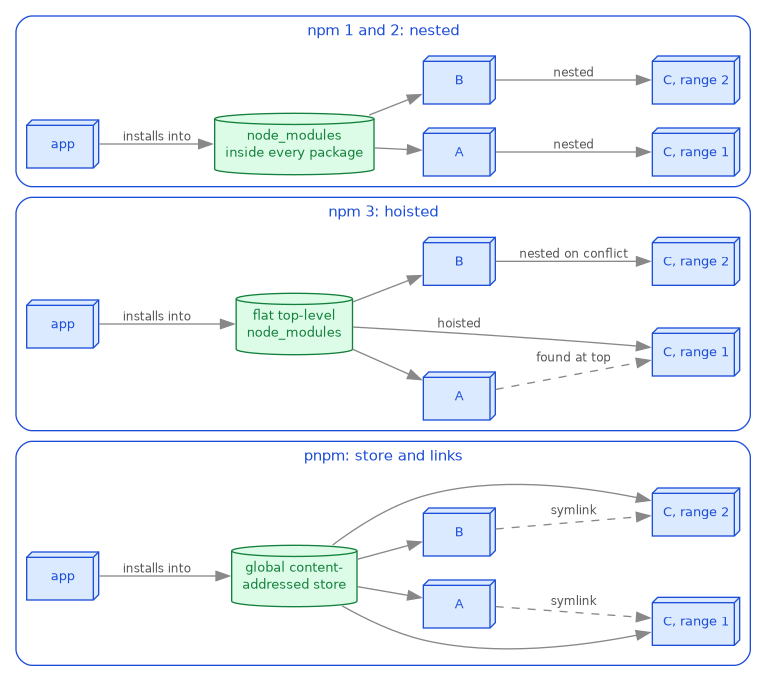
Supply-chain defaults:
- Build scripts. Dependency lifecycle scripts (
postinstall) don't run unless allowed inallowBuilds.strictDepBuilds, on by default, fails the install if a disallowed script is present (“Pnpm, ‘Mitigating Supply Chain Attacks’,” n.d.). pnpm 10.0.0 (2025-01-07) stopped running dependency lifecycle scripts by default;strictDepBuildsbecame default-true in pnpm 11.0.0, whereallowBuildsreplacedonlyBuiltDependencies(“Pnpm Release Notes V10.0.0, V10.16.0, V11.0.0,” n.d.). - Release-age cooldown.
minimumReleaseAgewas added in 10.16.0 (2025-09-12) (“Pnpm 10.16 Release Notes (Minimumreleaseage),” n.d.)(“Pnpm Release Notes V10.0.0, V10.16.0, V11.0.0,” n.d.). It now defaults to 1440 minutes, i.e. a version must be a day old before it is installed (“Pnpm, ‘Mitigating Supply Chain Attacks’,” n.d.). The default was turned on in pnpm 11.0.0 (2026-04-28) (“Pnpm Release Notes V10.0.0, V10.16.0, V11.0.0,” n.d.). - Exotic sources.
blockExoticSubdepsis on by default and forbids git/tarball URLs in transitive dependencies (“Pnpm, ‘Mitigating Supply Chain Attacks’,” n.d.). - Trust downgrades.
trustPolicy: no-downgraderefuses a version whose trust level dropped compared with earlier releases, e.g. one published without provenance where earlier ones had it (“Pnpm, ‘Mitigating Supply Chain Attacks’,” n.d.).
pnpm's defaults follow from one observation: in npm-land, install executes code. Every worm since event-stream has used that.
.NET: NuGet
assembly: removed the unconfirmed "nearest wins" naming; download figure restated as a rolling seven-day count read 2026-11-22; timeline rows merged, three years kept as (unconfirmed); earlier (research-agent, 2026-11-22T20:02:48Z): Versions, quotes and counts checked against Microsoft Learn, NuGet release notes, NuGet/.NET blog posts, nuget.org stats and JFrog's 2023 report; three release years and one naming claim left unconfirmed.
Before NuGet. Microsoft's Windows 2000 application specification defined the problem.
When a shared component is upgraded or downgraded by another install, "the former
application may break. This condition is often referred to as 'DLL Hell'" [nuget-1]. Its
answer was side-by-side components installed into the application directory [nuget-1].
.NET Framework kept a machine-wide Global Assembly Cache, and "assemblies deployed in the
Global Assembly Cache must have a strong name" [nuget-2]. A strong name is identity, not
trust: "Do not rely on strong names for security" [nuget-3]. Version mismatches were
patched at load time with <bindingRedirect> in app.config, publisher policy or
machine.config. From .NET Framework 4.5.1 Visual Studio generates these redirects
automatically [nuget-4]. None of this survives into .NET Core and .NET 5+. There the
runtime "never validates the strong-name signature" or uses it for binding [nuget-3].
Launch. The project shipped as NuPack and "was renamed for CTP 2 by the community" (2010-11-09) [nuget-5]. NuGet 1.0 was released 2011-01-13 and 1.1 on 2011-02-12, as a Visual Studio 2010 extension [nuget-6]. The 1.0 RC work list already included "Verify hash from feed after package download" and "Support Binding Redirects for Strong Named Assemblies" [nuget-6].
Version selection. NuGet picks the lowest version that satisfies a range. A bare
3.6.0 means ">=3.6.0 with preference for the lowest version" [nuget-10]. Until 2.8 the
patch number was the exception: patch "was always resolved to the highest version". That
"created a lack of determinism", because two developers installing the same package a day
apart got different dependencies. NuGet 2.8 (2014-01-29) made patch resolution lowest
too, and added -DependencyVersion to opt back into highest [nuget-7].
PackageReference restore applies four rules: lowest applicable version, floating
versions, direct-dependency-wins and cousin dependencies [nuget-9]. A direct reference overrides anything deeper,
downgrades included. NuGet then warns with NU1605 [nuget-9]. Between subgraphs NuGet takes
"the lowest version that satisfies all version requirements". An exact pin that conflicts
with another range is an error [nuget-9]. Floating versions (6.0.*) take the highest
match. They "can only be specified at the project level". *-* for prereleases arrived
in NuGet 5.6 [nuget-9].
Formats. packages.config wrote the whole flattened closure into one file and resolved
conflicts one install at a time. A conflict could leave the project "in an indeterminate
state" [nuget-9]. NuGet 4.0 shipped with Visual Studio 2017 and added PackageReference
[nuget-8]. The project file lists only top-level dependencies, and restore computes the
transitive graph into obj/project.assets.json, which is not committed [nuget-9][nuget-11].
Visual Studio 2017 15.7 added a migrator. PackageReference does not run install.ps1 or
apply XDT transforms [nuget-11].
Lockfiles. NuGet 4.9 (VS 2017 15.9) added packages.lock.json. It is opt-in
via RestorePackagesWithLockFile, with --locked-mode / RestoreLockedMode for CI
[nuget-10][nuget-12]. The stated drivers were floating versions, a lower matching version
being published later, and removal from feeds that permit deletion [nuget-10]. Guidance is
to commit the lockfile for applications. For a common-code library it "has little say"
over consumers [nuget-10].
Central versions. Central Package Management arrived in NuGet 6.2 / VS 2022 17.2 / .NET
SDK 6.0.300, announced 2022-04-12 [nuget-14]. Directory.Packages.props holds
<PackageVersion> items. Projects reference packages without versions [nuget-13].
CentralPackageTransitivePinningEnabled promotes a transitive dependency to top level.
Downgrades through pinning fail with NU1109, and pinned packages become explicit nuspec
dependencies on pack [nuget-13].
Integrity. Package signing arrived in NuGet 4.6 (VS 2017 15.6). The client "now
verifies package integrity before installing" signed packages [nuget-16]. There are two
kinds: author signatures, and repository signatures that cover "all packages in a
repository" [nuget-15]. nuget.org accepted author-signed uploads from May 2018. From
2018-08-10 "all new package submissions to NuGet.org will be repository signed", with
existing packages to follow [nuget-17]. Author signing stays optional per account. Once
an account registers a certificate, its submissions "must be signed" [nuget-18]. NuGet
4.9 added trustedSigners client policies [nuget-12].
Trust and the registry. An ID prefix reservation rejects matching uploads from anyone else and shows a badge on nuget.org and in VS 2017 15.4+ [nuget-19]. Trusted Publishing via OIDC "was launched in September 2025". After the Nx Console npm compromise, new API keys were capped at 30 days from 2026-08-17, and older keys expire 2026-11-01 [nuget-23]. Staged publishing (2026-11-17) holds validated packages private until a maintainer promotes them [nuget-24].
Vulnerability auditing. dotnet list package --vulnerable came first, in NuGet 5.9
[nuget-21]. NuGetAudit warnings during restore arrived in NuGet 6.8 / .NET 8 SDK for
PackageReference and in 6.10 for packages.config [nuget-21]. The codes are NU1901-NU1904
by severity, and the data comes from the GitHub Advisory Database [nuget-21]. In NuGet 7.0
/ .NET 10 SDK, NuGetAuditMode defaults to all (transitive) for net10.0 targets
[nuget-21].
Removal. "nuget.org does not support permanent deletion of packages" [nuget-20]. Unlisting hides a version from search, but exact-version restore still works, and floating ranges can still resolve to it. The NuGet team deletes for malware, copyright infringement and name squatting [nuget-20].
Incidents.
- Coinbase.Core and friends (2023-03). JFrog reported 13 typosquats, such as
Coinbase.CoreandAsip.Net.Core, "downloaded 150K times over the past month". They usedinit.ps1, which runs "without any warning" in Visual Studio. NuGet had already removed them [nuget-22].
Scale. Read on 2026-11-22, nuget.org's stats page showed 9,200,910,384 package downloads as a rolling seven-day count [nuget-25].
Sources
- [nuget-1] Microsoft, "Chapter 3: Component Sharing", Application Specification for Windows 2000 (archived). https://learn.microsoft.com/en-us/previous-versions/ms995843(v=msdn.10)
- [nuget-2] Microsoft Learn, "Global Assembly Cache". https://learn.microsoft.com/en-us/dotnet/framework/app-domains/gac
- [nuget-3] Microsoft Learn, "Strong-named assemblies", 2025-10-20. https://learn.microsoft.com/en-us/dotnet/standard/assembly/strong-named
- [nuget-4] Microsoft Learn, "Redirecting Assembly Versions", 2026-03-02. https://learn.microsoft.com/en-us/dotnet/framework/configure-apps/redirect-assembly-versions
- [nuget-5] Phil Haack, "NuGet CTP 2 Released", 2010-11-09. https://haacked.com/archive/2010/11/09/nuget-ctp2-released.aspx
- [nuget-6] Microsoft Learn, "NuGet 1.0 and 1.1 Release Notes". https://learn.microsoft.com/en-us/nuget/release-notes/nuget-1.1
- [nuget-7] Microsoft Learn, "NuGet 2.8 Release Notes". https://learn.microsoft.com/en-us/nuget/release-notes/nuget-2.8
- [nuget-8] Microsoft Learn, "NuGet 4.0 RTM Release Notes", 2017-03-03. https://learn.microsoft.com/en-us/nuget/release-notes/nuget-4.0-rtm
- [nuget-9] Microsoft Learn, "NuGet Package Dependency Resolution". https://learn.microsoft.com/en-us/nuget/concepts/dependency-resolution
- [nuget-10] Microsoft Learn, "NuGet PackageReference in project files", 2026-02-12. https://learn.microsoft.com/en-us/nuget/consume-packages/package-references-in-project-files
- [nuget-11] Microsoft Learn, "Migrating from packages.config to PackageReference formats". https://learn.microsoft.com/en-us/nuget/consume-packages/migrate-packages-config-to-package-reference
- [nuget-12] Microsoft Learn, "NuGet 4.9 RTM Release Notes". https://learn.microsoft.com/en-us/nuget/release-notes/nuget-4.9-rtm
- [nuget-13] Microsoft Learn, "Central Package Management". https://learn.microsoft.com/en-us/nuget/consume-packages/central-package-management
- [nuget-14] Jeff Kluge, "Introducing Central Package Management", NuGet Blog, 2022-04-12. https://devblogs.microsoft.com/nuget/introducing-central-package-management/
- [nuget-15] Microsoft Learn, "Signed Packages". https://learn.microsoft.com/en-us/nuget/reference/signed-packages-reference
- [nuget-16] Microsoft Learn, "NuGet 4.6 RTM Release Notes", 2018-03-07. https://learn.microsoft.com/en-us/nuget/release-notes/nuget-4.6-rtm
- [nuget-17] Rido, "NuGet.org starts repo-signing packages", NuGet Blog, 2018-08-10. https://devblogs.microsoft.com/nuget/introducing-repository-signatures/
- [nuget-18] Microsoft Learn, "Signing NuGet Packages". https://learn.microsoft.com/en-us/nuget/create-packages/sign-a-package
- [nuget-19] Microsoft Learn, "ID Prefix Reservation". https://learn.microsoft.com/en-us/nuget/nuget-org/id-prefix-reservation
- [nuget-20] Microsoft Learn, "Deleting NuGet Packages from nuget.org". https://learn.microsoft.com/en-us/nuget/nuget-org/policies/deleting-packages
- [nuget-21] Microsoft Learn, "Auditing package dependencies for security vulnerabilities", 2025-10-01. https://learn.microsoft.com/en-us/nuget/concepts/auditing-packages
- [nuget-22] JFrog, "Attackers are starting to target .NET developers with malicious-code NuGet packages", 2023-03-20 (updated 2023-03-21). https://jfrog.com/blog/attackers-are-starting-to-target-net-developers-with-malicious-code-nuget-packages/
- [nuget-23] .NET Team, "Strengthening NuGet Supply Chain Security: Reducing API Key Lifetime", .NET Blog, 2026-08-03. https://devblogs.microsoft.com/dotnet/strengthening-nuget-supply-chain-security-reducing-api-key-lifetime/
- [nuget-24] Jon Douglas and James Parsons, "Introducing staged publishing on NuGet.org", .NET Blog, 2026-11-17. https://devblogs.microsoft.com/dotnet/nuget-staged-publishing/
- [nuget-25] nuget.org, "Statistics", updated 2026-11-22. https://www.nuget.org/stats
- [nuget-26] NuGet Blog, category index (lists "Announcing .NET 10", 2025-11-11). https://devblogs.microsoft.com/nuget/
Apple platforms: CocoaPods, Carthage, Swift Package Manager
assembly: removed the unconfirmed workaround sentence; timeline rows merged; earlier (research-agent, 2026-11-22T20:05:50Z): Proposal numbers/statuses (SE-0145, 0272, 0292, 0339, 0391), CocoaPods blog dates, SwiftPM changelog and git ancestry checked; PubGrub/Package.resolved v3 releases set by tag ancestry; duplicate-package workarounds left unconfirmed.
Three managers, one after another. CocoaPods (repository created 2011-08-14 [swift-1]) is centralised: a git repo of podspecs, later a CDN. Carthage (0.1 tagged 2014-11-18 [swift-17]) "has been created as a decentralized dependency manager" with "no central list of projects" [swift-15]. SwiftPM was announced with open-source Swift on 2015-12-03, "very early in development" and aimed at "sharing source code, rather than compiled binary libraries" [swift-18].
Version selection. CocoaPods uses RubyGems-style requirements plus the optimistic
~>: "'~> 0.1.2' Version 0.1.2 and the versions up to 0.2" [swift-11]. Carthage reads git
tags, "trying to interpret each tag name as a semantic version" [swift-15]. SwiftPM resolves
one version per package; when Foo needs Baz ~>1.0 and Bar needs ~>2.0, "there is no
one version of Baz that can satisfy both" [swift-29]. PubGrub became the default resolver
in a merge of 2019-09-04 [swift-22], first shipped in Swift 5.2 (by git ancestry of the
release tag).
Lockfiles.
- CocoaPods.
Podfile.lock"tracks the version of each Pod that was installed"; Podfile and lock "should always be kept under version control".pod installhonours the lock,pod updateregenerates it [swift-10]. - Carthage.
Cartfile.resolvedlists every dependency, nested ones included, pinned to a tag or sha. Committing it is "strongly recommended"; editing it is forbidden [swift-16]. - SwiftPM. SE-0145 (implemented Swift 3.1) added
Package.pins, so team members and CI "know they are using the same exact version"; library authors were told not to commit it [swift-19]. It was renamedPackage.resolvedon 2017-05-04 [swift-20]. Format v2 arrived in Swift 5.6 to capture "package identity" more accurately [swift-21]. v3 adds anoriginHashof the manifest inputs so a matching lock skips resolution; merged 2023-08-08 [swift-28], first in Swift 5.10 (by git ancestry). The lock is ignored when the package is itself a dependency [swift-29].
Integrity. CocoaPods' SPEC CHECKSUMS are SHA-1 of the podspec file, not of the fetched
source [swift-14]. Carthage relies on git SHAs and requires that binary specs "must be an
https url"; the binary spec format has no checksum field [swift-16]. SwiftPM got hashes
with binary targets in SE-0272 (Swift 5.3): "the hash of the artifact is required similar to
Homebrew" [swift-24]. Swift 5.6 added trust-on-first-use fingerprints for git and registry
packages [swift-21]. SE-0292 (Swift 5.7) records registry archive checksums in
Package.resolved and SwiftPM "will refuse to download dependencies if there's a mismatch"
[swift-25]. SE-0391 (Swift 5.9) added publishing and signing: "A registry may require
packages to be signed" [swift-27]; TOFU was extended to signing identities [swift-21].
Trust and the registry. The git Specs repo took pull requests until trunk (CocoaPods 0.33,
2014-05-20). Trunk made "the first person to publish a pod" its owner, after "an unauthorised
person pushed a podspec for an non-existing AFNetworking version" [swift-2][swift-12]. Accounts
have no passwords, "only per-computer session tokens" [swift-12]. The Specs repo itself hit
GitHub's CPU limits in 2016 (about 16K entries in one directory, 100K commits); the fix was
full clones, fewer fetches and sharding by hashed name [swift-3]. CocoaPods 1.8 (beta
2019-08-05) made the CDN the default, so users "no longer" clone "the now huge" repo
[swift-4]. SwiftPM's registry namespace is scope.package-name, scopes case-insensitive,
39 characters max [swift-30].
Removal. pod trunk delete exists, with a warning that removal is "generally considered bad
behavior"; a deleted version "can never be pushed again". deprecate is the suggested path
[swift-13]. Carthage and git-based SwiftPM have no registry to remove from; a deleted tag or
repo is listed among resolution failures [swift-29]. A SwiftPM registry marks removed releases
410 Gone in the release list [swift-30].
Conflicts and duplicates. No manager here installs two versions of one package. SwiftPM's docs name namespace collision as a failure class [swift-29]. SE-0339 module aliasing (Swift 5.7) exists because "Swift does not allow multiple modules in a program to share the same name" [swift-26].
Incidents.
- Trunk RCE (2021-04-19). Max Justicz: a crafted podspec
sourcereachedgit ls-remotevia--upload-pack, present since 2015-06-04; fixed the same day. Session keys were exposed in principle [swift-5]. - EVA (2023-10-28). Three bugs: pod takeover via "claim your pod", a tamperable verification email, and shell execution. All sessions were reset [swift-6].
- Maintenance mode (2024-08-13). Stated "more up-front" [swift-7]. On 2024-11-30 the read-only
plan followed, to "drastically simplify the security" of trunk.
prepare_commandwas blocked for new pods in 2025-05; trunk stops accepting podspecs on 2026-12-02 [swift-8]. - Token birthday attack (2026-02-18). Verification tokens grew from 8 to 20 characters and were throttled [swift-9].
Xcode 11 (WWDC 2019) brought SwiftPM into app projects [swift-23]. No primary source here quotes download numbers; the 2024 post says usage metrics have risen but gives no figures [swift-7].
Sources
- [swift-1] CocoaPods, CocoaPods/CocoaPods repository (created 2011-08-14). https://github.com/CocoaPods/CocoaPods
- [swift-2] Eloy Durán, "CocoaPods Trunk", 2014-05-20. https://blog.cocoapods.org/CocoaPods-Trunk/
- [swift-3] Eloy Durán, "Master Spec-repo Rate Limiting Post-Mortem", 2016-05-04. https://blog.cocoapods.org/Master-Spec-Repo-Rate-Limiting-Post-Mortem/
- [swift-4] Dimitris Koutsogiorgas, "CocoaPods 1.8 Beta is Here!", 2019-08-05. https://blog.cocoapods.org/CocoaPods-1.8.0-beta/
- [swift-5] Orta Therox, "CocoaPods Trunk: Remote Code Execution found", 2021-04-19. https://blog.cocoapods.org/CocoaPods-Trunk-RCE/
- [swift-6] Orta Therox, "CocoaPods Trunk: 3 Remote Code Execution found, 2023", 2023-10-28. https://blog.cocoapods.org/CocoaPods-Trunk-RCEs-2023/
- [swift-7] Orta Therox, "CocoaPods Support & Maintenance Plans", 2024-08-13. https://blog.cocoapods.org/CocoaPods-Support-Plans/
- [swift-8] Orta Therox, "CocoaPods Trunk Read-only Plan", 2024-11-30, updated 2025-05. https://blog.cocoapods.org/CocoaPods-Specs-Repo/
- [swift-9] Orta Therox, "CocoaPods Trunk: Minor security updates", 2026-02-18. https://blog.cocoapods.org/CocoaPods-Trunk-Security-Thanks/
- [swift-10] CocoaPods Guides, "Using CocoaPods". https://guides.cocoapods.org/using/using-cocoapods.html
- [swift-11] CocoaPods Guides, "The Podfile". https://guides.cocoapods.org/using/the-podfile.html
- [swift-12] CocoaPods Guides, "Getting setup with Trunk". https://guides.cocoapods.org/making/getting-setup-with-trunk.html
- [swift-13] CocoaPods Guides, "Command-line Reference" (
pod trunk delete,deprecate). https://guides.cocoapods.org/terminal/commands.html - [swift-14] CocoaPods/Core,
lockfile.rbandspecification.rb(SPEC CHECKSUMS,SHA-1). https://github.com/CocoaPods/Core/blob/master/lib/cocoapods-core/lockfile.rb - [swift-15] Carthage, README. https://github.com/Carthage/Carthage
- [swift-16] Carthage, "Artifacts" (Cartfile, Cartfile.resolved, binary project specification). https://github.com/Carthage/Carthage/blob/master/Documentation/Artifacts.md
- [swift-17] Carthage, releases (0.1, 2014-11-18). https://github.com/Carthage/Carthage/releases/tag/0.1
- [swift-18] Swift.org, "Welcome to Swift.org", 2015-12-03. https://www.swift.org/blog/welcome/
- [swift-19] swift-evolution, SE-0145 "Package Manager Version Pinning". https://github.com/swiftlang/swift-evolution/blob/main/proposals/0145-package-manager-version-pinning.md
- [swift-20] swift-package-manager, commit 67d1b83 "Rename Package.pin -> Package.resolved", 2017-05-04. https://github.com/swiftlang/swift-package-manager/commit/67d1b83ee5c2c01293b5b874f1b4d6bfc4463944
- [swift-21] swift-package-manager, CHANGELOG.md. https://github.com/swiftlang/swift-package-manager/blob/main/CHANGELOG.md
- [swift-22] swift-package-manager, PR #2327 "switch-pubgrub", merged 2019-09-04. https://github.com/swiftlang/swift-package-manager/pull/2327
- [swift-23] Apple, "Adopting Swift Packages in Xcode", WWDC19 session 408, 2019. https://developer.apple.com/videos/play/wwdc2019/408/
- [swift-24] swift-evolution, SE-0272 "Package Manager Binary Dependencies". https://github.com/swiftlang/swift-evolution/blob/main/proposals/0272-swiftpm-binary-dependencies.md
- [swift-25] swift-evolution, SE-0292 "Package Registry Service". https://github.com/swiftlang/swift-evolution/blob/main/proposals/0292-package-registry-service.md
- [swift-26] swift-evolution, SE-0339 "Module Aliasing For Disambiguation". https://github.com/swiftlang/swift-evolution/blob/main/proposals/0339-module-aliasing-for-disambiguation.md
- [swift-27] swift-evolution, SE-0391 "Package Registry Publish". https://github.com/swiftlang/swift-evolution/blob/main/proposals/0391-package-registry-publish.md
- [swift-28] swift-package-manager, PR #6698 "prefer versions in package.resolved file …", merged 2023-08-08. https://github.com/swiftlang/swift-package-manager/pull/6698
- [swift-29] swift-package-manager docs, "Resolving and updating dependencies" and "Resolving dependency failures". https://github.com/swiftlang/swift-package-manager/blob/main/Sources/PackageManagerDocs/Documentation.docc/ResolvingPackageVersions.md https://github.com/swiftlang/swift-package-manager/blob/main/Sources/PackageManagerDocs/Documentation.docc/Dependencies/ResolvingDependencyFailures.md
- [swift-30] swift-package-manager, "Swift Package Registry Service Specification". https://github.com/swiftlang/swift-package-manager/blob/main/Documentation/PackageRegistry/Registry.md
Rust: Cargo
assembly: dropped a comparison clause about a cut section; no cited claim changed; earlier (research-editor (citation/claim checkers), 2026-11-22T20:09:00Z): RFC 3537 quote 'would require major work in the resolver' -> verbatim RFC wording; lockfile-blog quotes fixed (their project, likely being); checksum-mismatch and vendor unconfirmed mark resolved [119]; semver trick [120]
Version selection. Cargo assumes semver and "will unify dependency versions if they are
SemVer compatible according to the Caret version requirements". If they cannot be unified,
"Cargo will error" (“Cargo Book, ‘Dependency Resolution’,” n.d.). semver-incompatible requirements (rand 0.6 and rand 0.7)
produce two copies (“Cargo Book, ‘Dependency Resolution’,” n.d.).
The links rule. "The resolver will attempt to find a graph where there is only one
instance of each links name … If it is unable … it will return an error". The example
is libgit2-sys 0.11 and 0.12 both linking git2 (“Cargo Book, ‘Dependency Resolution’,” n.d.). This is cargo's version of a
global-symbol uniqueness rule. It exists because C symbols live in one flat namespace.
Duplicates. Allowed across majors. "The types and items are considered different by the
Rust compiler, even if they have the same name" (“Cargo Book, ‘Dependency Resolution’,” n.d.). rustc's diagnostic for
expected struct X, found struct X now says there are multiple versions of the crate in the
graph and points at cargo tree (“Rustc Ui Test Type-Mismatch-Same-Crate-Name.Stderr,” n.d.). The ecosystem workaround is dtolnay's "semver trick":
the old major re-exports the new major's types (“David Tolnay, ‘the Semver Trick’ (Readme),” n.d.).
Resolver versions.
- v1: the original resolver.
- v2: the default for edition 2021. It changed feature unification (
build-deps,dev-depsand inactive targets no longer unify) (“Cargo Book, ‘Dependency Resolution’,” n.d.). - v3: the default for edition 2024, requires Rust 1.84 (“Cargo Book, ‘Dependency Resolution’,” n.d.)(“Rust Blog, ‘Announcing Rust 1.84.0’, 2025-01-09,” n.d.). It turns on the
MSRV-aware resolver from RFC 3537, started 2023-11-14, tracked in cargo#9930 (“Rfc 3537, ‘Msrv-Resolver’, Start 2023-11-14. ; Rust-Lang/Cargo#9930,” n.d.). Cargo
"will prefer packages with a Rust version that is less than or equal to your own". With
rust-version = "1.62"andclap = "4.0", cargo picks clap 4.0.32 over 4.5.20 (“Cargo Book, ‘Dependency Resolution’,” n.d.). It is a preference, not a hard filter: when nothing compatible exists, it "won't error but will instead pick a version". The RFC deferred hard errors because error reporting "of sufficient quality will require major work in a complex, high risk area of Cargo (the resolver)" (“Rfc 3537, ‘Msrv-Resolver’, Start 2023-11-14. ; Rust-Lang/Cargo#9930,” n.d.).
Lockfiles.
- Before 2023-08: commit
Cargo.lockfor binaries; leave it out for libraries. 2023-08-29: guidance changed to "do what is best for their project", with committing as the starting point.
cargo newstopped ignoring the lockfile for libraries (“Ed Page, ‘Change in Guidance on Committing Lockfiles’, Rust Blog, 2023-08-29,” n.d.). The reasons given:- an ignored lockfile loses bisectability;
- CI broke for contributors when a dependency was yanked or released a bug;
- MSRV validation needs pinned versions;
- people were adding upper bounds instead, "likely being a worse solution";
- Dependabot and Renovate make scheduled updates cheap.
Projects should still regularly test against their latest dependencies (“Ed Page, ‘Change in Guidance on Committing Lockfiles’, Rust Blog, 2023-08-29,” n.d.).
Integrity. Each registry package in Cargo.lock carries a checksum (64 hex, sha256)
next to its source = "registry+..." line (observed in lockfiles (“Example Cargo.Lock with Registry Checksum Lines,” n.d.)). A mismatch
is a hard error ("checksum for … changed between lock files") (“Cargo Source Src/Resolver/Resolve.Rs (Checksum Mismatch Error); Cargo Book, ‘Source Replacement’ (.Cargo-Checksum.Json),” n.d.). cargo vendor writes
.cargo-checksum.json, "to protect against accidental modifications. It is not a security
mechanism" (“Cargo Source Src/Resolver/Resolve.Rs (Checksum Mismatch Error); Cargo Book, ‘Source Replacement’ (.Cargo-Checksum.Json),” n.d.).
System requirements. rust-version has been respected since 1.56. "When your package is
compiled on an unsupported toolchain, Cargo will report that as an error". The override is
--ignore-rust-version (“Cargo Book, ‘the Rust-Version Field’,” n.d.). Enforced.
Yanking. Yanking deletes nothing. The resolver "will ignore all yanked releases unless
they already exist in the Cargo.lock file or are explicitly requested by … --precise" (“Cargo Book, ‘Dependency Resolution’,” n.d.).
Yank only for accidental publishes, semver breaks or unusable crates. For vulnerabilities
RustSec is "less disruptive". Yanking cannot stop leaked credentials from spreading (“Cargo Book, Cargo Yank,” n.d.).
Minimum-version testing. -Z minimal-versions was tracked in cargo#5657, opened
2018-06-26 and still open, labelled needs-design. Commenters weighed and mostly rejected
moving to Go's MVS (“Rust-Lang/Cargo#5657, ‘Dependencies Resolution with –Minimal-Versions’, Opened 2018-06-26,” n.d.). -Z direct-minimal-versions is the more usable variant (“Rust-Lang/Cargo#5657, ‘Dependencies Resolution with –Minimal-Versions’, Opened 2018-06-26,” n.d.).
Incidents.
- rustdecimal (2022-05). A typosquat of
rust_decimalwith a modifiedDecimal::new. It was removed, and the registry was swept for similar code (“Rust Blog, ‘Security Advisory: Malicious Crate Rustdecimal’, 2022-05-10. ; Rustsec-2022-0042,” n.d.). - Trusted publishing (2025-07-11). The response to the account-takeover risk generally: trusted publishing per RFC 3691, extended to GitLab and made enforceable per crate in 2026-01 (“Rust Blog, ‘Crates.Io: Development Update’, 2025-07-11 (Trusted Publishing). ; Rfc 3691. ; 2026-01 Update,” n.d.).
Elixir: mix and Hex
Version selection
assembly: removed references to a cut rules list; no cited claim changed; earlier (research-editor (citation/claim checkers), 2026-11-22T20:09:00Z): Version semantics, Hex 0.16.0/2.0/2.0.1 dates and override quote checked against Version docs, CHANGELOG, Hex blog, mix deps docs
The requirement language. mix uses Elixir's Version:
~> 2.0.0means>= 2.0.0 and < 2.1.0, and~> 2.0means>= 2.0.0 and < 3.0.0(“Elixir Version Docs (=>, Allow_Pre),” n.d.). It is the same idea as PEP 440's~=, and the operand's precision sets the cap.~>"will never include pre-release versions of its upper bound" (“Elixir Version Docs (=>, Allow_Pre),” n.d.).- With
allow_pre: false, which Hex sets, prereleases match only when the operand is itself a prerelease (“Elixir Version Docs (=>, Allow_Pre),” n.d.). This is PEP 440's default and a stricter version of npm's. - Hex 0.16.0 (2017-04-18) started warning or erroring on publishing a package with prerelease dependencies (“Hex Changelog.Md (Entries Cited by Version and Date),” n.d.).
Resolution: Hex resolves, mix checks. Hex resolves registry dependencies.
- Before 2.0. The algorithm had "essentially been the same" since early 2014. It backtracked and sometimes appeared to freeze ("just taking a very long [time] to find a solution") (“Hex Blog, ‘Hex V2.0 Released with New Version Solver’, 2022-10-30,” n.d.).
- Hex 2.0 (2022-10-30). Moved to
hex_solver, based on PubGrub, with step-by-step explanations of why solving failed (“Hex Blog, ‘Hex V2.0 Released with New Version Solver’, 2022-10-30,” n.d.)(“Hex Changelog.Md (Entries Cited by Version and Date),” n.d.). That is the same algorithm as Poetry and uv (Python). - Hex 2.0.1 (2023-01-09). Fixed the solver so it does "not override locked deps" (“Hex Changelog.Md (Entries Cited by Version and Date),” n.d.). The fix was needed because the new solver could move versions already pinned in the lock.
One version per app. An Erlang VM loads one module per name, so a mix build has one
version of each OTP application. When two parents disagree, mix refuses instead of
picking (status checks in Mix.Dep (“Elixir Source, Lib/Mix/Lib/Mix/Dep.Ex (Format_Status: Divergedreq, Diverged, Divergedonly, Lockmismatch, Lockoutdated, Nolock, Vsnlock),” n.d.)):
divergedreq. "the dependency X 1.2 … does not match the requirement specified [by another parent] … Ensure they match or specify one of the above in your deps and setoverride: true".diverged. "different specs were given for the X app" (e.g. a Hex source vs a git source).divergedonly/divergedtargets. The parents disagree about:onlyor:targetsenvironments.
override: true "will override any other definitions of itself by other dependencies"
(“Mix Docs, Mix Deps (Options :Only, :Runtime, :Override, :Optional, :in_Umbrella, :Targets; Lockfile Ignored for Dependencies),” n.d.). It is allowed only in the project that declares the dependency directly, at the top.
It is Maven's "declare it yourself" fix and npm's overrides, but explicit and visible
in mix.exs. The pattern: a refusal with a sanctioned escape, kept at the root,
greppable, and named.
mix.lock
assembly: removed references to cut recommendations; no cited claim changed; earlier (research-editor (citation/claim checkers), 2026-11-22T20:09:00Z): vsnlock 'fails' -> flagged and recompiled by deps.loadpaths; --check-unused quote -> verbatim; --check-locked unconfirmed mark -> Elixir v1.15.0 [104]; CVE-2026-32148 checked on GHSA itself (High, >=0.16.0 <2.4.2, 2026-04-30)
Format. mix.lock is an Elixir map literal, one entry per package (from a real
lockfile (“Example Mix.Lock (Phoenixframework/Tailwind),” n.d.)):
"makeup": {:hex, :makeup, "1.2.1",
           "e90ac1c6…16e3713d1",                 # inner checksum
           [:mix],                                # build tools
           [{:nimble_parsec, "~> 1.4", [hex: :nimble_parsec, repo: "hexpm", optional: false]}],
           "hexpm",                               # repository
           "d36484867…bbe84922bf6ba71c8d17ce"},   # outer checksum
Each entry holds the SCM, the package and version, both checksums, the managers, each
dependency's requirement and repository, and the repository. A git dependency locks a commit
instead (“Mix Docs, Mix Deps (Options :Only, :Runtime, :Override, :Optional, :in_Umbrella, :Targets; Lockfile Ignored for Dependencies),” n.d.). A dependency's mix.lock is "ignored when a project is used as a dependency"
(“Mix Docs, Mix Deps (Options :Only, :Runtime, :Override, :Optional, :in_Umbrella, :Targets; Lockfile Ignored for Dependencies),” n.d.). Only the root's lock counts, as in cargo and npm.
Inner and outer checksums (Hex tarball spec (“Hex Specifications, ‘Package Tarball’ (Inner Vs Outer Checksum),” n.d.)). A Hex tarball holds VERSION,
metadata.config, contents.tar.gz and CHECKSUM.
- The inner checksum is sha256 over the concatenated
VERSION,metadata.configand contents. It is now deprecated. - The outer checksum is sha256 of the whole tarball file, and it is preferred.
History:
- Hex 0.12.0 (2016-05-15). Added checksums to the lock, "ensuring a locked package can not change its content" (“Hex Changelog.Md (Entries Cited by Version and Date),” n.d.).
- Hex 0.20.2 (2020-02-03). Changed the checksum "to include the entire tarball instead of specific files inside it", listed under Security fixes next to a symlink path-traversal fix (“Hex Changelog.Md (Entries Cited by Version and Date),” n.d.).
- Hex 0.20.5 (2020-02-05). A rollout fix: a missing outer checksum stopped counting as a mismatch, which ended spurious "out of date" errors (“Hex Changelog.Md (Entries Cited by Version and Date),” n.d.).
The lesson: hash the artifact you download, byte for byte, not a reconstruction of its parts. A partial hash leaves room for content outside the hashed parts. It is the same point as xz (incidents), one level down.
The checksums went unchecked for nine years (CVE-2026-32148, GHSA-hmv9-4mfr-m92v, 2026-04-30, High) (“Ghsa-Hmv9-4mfr-M92v / Cve-2026-32148, ‘Lockfile Checksums Not Verified in Hex Allows Dependency Integrity Bypass’, 2026-04-30,” n.d.).
- Hex ≥ 0.16.0 and < 2.4.2 wrote checksums to
mix.lockbut did not enforce them when validating the resolved set. The lock held string names, the check compared atoms, the pattern never matched, and the check was skipped. - In the proof of concept, a tampered checksum produced no error. The lock was "silently rewritten with the correct checksum values from the registry".
- Downloads were still checked against the registry, so the effective trust root was the registry alone.
- The fix in 2.4.2 was to "raise on
mix.lockchecksum mismatches instead of silently rewriting them" (“Hex Changelog.Md (Entries Cited by Version and Date),” n.d.).
A lock that is written but never compared is decoration. A test must show that a mismatched lock fails. A mutation test (corrupt one hex digit, expect a refusal) would have caught it on day one.
mix deps.get versus a locked build.
mix deps.getfetches whatever the lock says and resolves only what is missing or changed.mix deps.updateis the command that moves locked versions (“Mix Docs, Mix Deps (Options :Only, :Runtime, :Override, :Optional, :in_Umbrella, :Targets; Lockfile Ignored for Dependencies),” n.d.)(“Mix Docs, Mix Deps.Get (–Check-Locked, –Only),” n.d.).- Builds check the lock on every run. A dependency that differs from the lock fails with
"lock mismatch: the dependency is out of date. To fetch locked version run
mix deps.get", a lock behindmix.exswith "lock outdated", and an unlocked one with "the dependency is not locked" (“Elixir Source, Lib/Mix/Lib/Mix/Dep.Ex (Format_Status: Divergedreq, Diverged, Divergedonly, Lockmismatch, Lockoutdated, Nolock, Vsnlock),” n.d.). - A dependency compiled under another Elixir/OTP is flagged "built with an out-of-date
Erlang/Elixir version" (
vsnlock), anddeps.loadpathsrecompiles it rather than failing (“Elixir Source, Lib/Mix/Lib/Mix/Dep.Ex (Format_Status: Divergedreq, Diverged, Divergedonly, Lockmismatch, Lockoutdated, Nolock, Vsnlock),” n.d.). --check-locked"raises if there are pending changes to the lockfile" (“Mix Docs, Mix Deps.Get (–Check-Locked, –Only),” n.d.). It is the CI form of "the lock is the build", the same thing asnpm ciorcargo --locked. It arrived in Elixir v1.15.0 (“Elixir V1.15 Changelog.Md (Mix Deps.Get –Check-Locked),” n.d.).mix deps.unlock --check-unusedfails if the lock contains entries no longer inmix.exs, "useful in pre-commit hooks and CI scripts if you want to reject contributions with extra dependencies" (“Mix Docs, Mix Deps.Unlock (–Check-Unused, –Unused, –All),” n.d.). It is a lock-hygiene gate that no other ecosystem surveyed here ships as a single command.
Retirement versus yanking, and the revert window
assembly: removed a reference to a cut recommendation; dispute unchanged; earlier (research-editor (citation/claim checkers), 2026-11-22T20:09:00Z): revert-window, reuse and MUST NOT quotes corrected to verbatim; open: hex.retire docs say retired releases stay resolvable, registry package.proto says only if already locked [93][103]
Revert window. Hex treats releases as fixed, with a short window:
- a package version can be changed or unpublished "within 60 minutes of the package version
release or within 24 hours of initial release of the package", with
mix hex.publish --revert VERSION; - republishing the same version after a revert is allowed (“Hex Faq (Revert Window, Retirement, Ownership),” n.d.);
- packages removed by admins are automatically reserved and "can never be reused by users" (“Hex Faq (Revert Window, Retirement, Ownership),” n.d.).
That differs from npm, where a name@version is never reusable (“Npm Docs, ‘Npm Unpublish Policy’,” n.d.). Hex's checksum in the
lock is what makes re-use survivable. Any consumer that locked during the window would see
a mismatch, at least once the mismatch check actually fired (“Ghsa-Hmv9-4mfr-M92v / Cve-2026-32148, ‘Lockfile Checksums Not Verified in Hex Allows Dependency Integrity Bypass’, 2026-04-30,” n.d.).
Retirement (mix hex.retire, since Hex 0.15.0, 2016-12-24 (“Hex Changelog.Md (Entries Cited by Version and Date),” n.d.)). It requires a reason
(renamed, deprecated, security, invalid, other) and a ≤ 140-character message. "A
retired package is still resolvable and usable but it will be flagged as retired" (“Hex Docs, Mix Hex.Retire,” n.d.). The
registry spec says "Clients MUST NOT reject a release solely because it is retired" (“Hex Specifications, ‘Registry V2’ (Signed Resources, Repository Check, Retired Status),” n.d.), while
the registry's package.proto comment says "a retired release should only be resolved if it
has already been locked in a project" (“Hex Specifications, Registry/Package.Proto (Dependency Fields; Retired-Release Comment),” n.d.).
So Hex retirement is weaker than cargo's yank, PEP 592 or Go's retract. Those three
remove the release from new resolutions. Hex's docs keep it selectable and make it loud,
though the protobuf comment above points the other way; which one the client does is unsettled here.
Organizations that want removal now use dependency policies (Hex 2.5.0, 2026-06-28). A
policy blocks releases that carry advisories above a severity threshold, are retired for given
reasons, or are newer than a cooldown, "and versions already in mix.lock are never
filtered" (“Hex Changelog.Md (Entries Cited by Version and Date),” n.d.).
Retraction. An ecosystem has to decide whether retraction hides the release from new resolutions (Go, cargo) or only warns (Hex). Hex's experience argues for keeping a loud warning for locked users too, since retirement is how they find out.
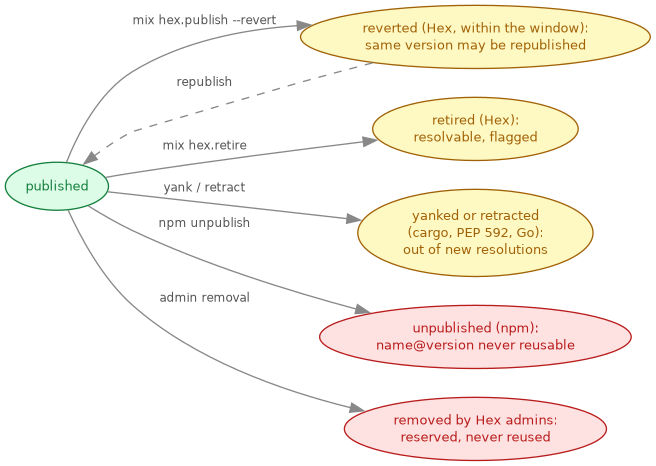
mix hex.audit
0.16.1 2017-06-22, sarif in 2.6.0 confirmed; versions added for ignores (2.5.1) and --check-unused-ignores (2.7.0)
Added in Hex 0.16.1 (2017-06-22) "for checking for retired packages" (“Hex Changelog.Md (Entries Cited by Version and Date),” n.d.). It now also covers security advisories (“Hex Docs, Mix Hex.Audit,” n.d.):
- Exit status. It exits non-zero on retired or advised dependencies, unless acknowledged
in
ignore_advisories/ignore_retirements(Hex 2.5.1, 2026-07-09) (“Hex Docs, Mix Hex.Audit,” n.d.)(“Hex Changelog.Md (Entries Cited by Version and Date),” n.d.). - Stale ignores.
--check-unused-ignores(Hex 2.7.0, 2026-11-06) fails on ignore entries that match nothing (“Hex Docs, Mix Hex.Audit,” n.d.)(“Hex Changelog.Md (Entries Cited by Version and Date),” n.d.). - No silent pass. It refuses to pass when a locked package's registry entry can't be fetched, rather than falling back to a cache that could miss advisories (“Hex Docs, Mix Hex.Audit,” n.d.).
- Formats.
--format sarifwas added in 2.6.0 (“Hex Changelog.Md (Entries Cited by Version and Date),” n.d.).
Two lessons:
- Audit runs against the lock; the manifest is not consulted.
- An audit that cannot fetch must fail. That rule came out of a 2026 fix, after an audit with no cached entry printed "No retired or security advisory packages found" and exited 0 (“Hex Changelog.Md (Entries Cited by Version and Date),” n.d.).
Organizations, private repositories and registry signing
assembly: removed a comparison with a cut project; no cited claim changed; earlier (research-editor (citation/claim checkers), 2026-11-22T20:09:00Z): Signed-message and must-sign quotes were paraphrases -> verbatim spec text; cache-check dated 2.5.2 (2026-10-12)
Multiple repositories (Hex 0.16.0, 2017-04-18). Dependencies of a package came "from the same repository as the parent package unless otherwise stated" (“Hex Changelog.Md (Entries Cited by Version and Date),” n.d.).
Organizations (Hex 0.17.0, 2017-08-28). Hex changed the rule: "packages will always be
pulled from the default hexpm repository and you have to override it with the
:organization or :repo options" (“Hex Changelog.Md (Entries Cited by Version and Date),” n.d.). A private package "can only depend on packages from
its own repository and from the global 'hexpm' repository" (“Hex Docs, ‘Private Packages’ (Organizations),” n.d.). Each locked dependency
records its repo: (“Example Mix.Lock (Phoenixframework/Tailwind),” n.d.).
This is a one-source-per-name rule. Hex adopted it in 2017, four years before Birsan's dependency-confusion write-up (“Alex Birsan, ‘Dependency Confusion: How I Hacked into Apple, Microsoft and Dozens of Other Companies’, 2021-02-09,” n.d.). There is no "search every index" mode to confuse, and the lock records which repository each package came from.
Registry signing. Every registry resource is a Signed message: "The signature is an
(unencoded) RSA signature of the (unencoded) SHA-512 digest of the payload." "Repositories are
required to sign all registry resources" (“Hex Specifications, ‘Registry V2’ (Signed Resources, Repository Check, Retired Status),” n.d.). The client verifies the signature with the repository's public key.
It then checks that the repository field inside the signed payload matches the repository
it asked for (“Hex Specifications, ‘Registry V2’ (Signed Resources, Repository Check, Retired Status),” n.d.). That stops a mirror from replaying one repository's signed data as
another's.
Signature verification arrived in Hex 0.11.2 (2016-03-11) (“Hex Changelog.Md (Entries Cited by Version and Date),” n.d.). With signed registry entries that carry each release's checksum, the hash comes from a signed index, not from a file beside the asset. Since 2.5.2 (2026-10-12), Hex also checks the registry checksum before writing to and before unpacking from its package cache, including offline (“Hex Changelog.Md (Entries Cited by Version and Date),” n.d.).
only:, runtime:, optional:, targets:
assembly: replaced a paragraph about a cut section with a neutral summary of the edge attributes; earlier (research-editor (citation/claim checkers), 2026-11-22T20:09:00Z): option semantics checked against mix deps docs [84]
The options (“Mix Docs, Mix Deps (Options :Only, :Runtime, :Override, :Optional, :in_Umbrella, :Targets; Lockfile Ignored for Dependencies),” n.d.):
only: [:dev, :test]makes a dependency available only in those environments.runtime: falsekeeps a dependency out of the started runtime applications (build tools, linters).optional: truemeans the project always gets the dependency, but projects depending on it are not forced to.targets:restricts a dependency by target, e.g. embedded hardware.
Enforcement. Divergence checks apply here too. A parent that wants a dependency in fewer
environments than a child needs fails with divergedonly (“Elixir Source, Lib/Mix/Lib/Mix/Dep.Ex (Format_Status: Divergedreq, Diverged, Divergedonly, Lockmismatch, Lockoutdated, Nolock, Vsnlock),” n.d.).
In mix these are attributes of an edge, not of a package, and disagreements between edges get their own refusal.
Umbrella apps: the multi-package case
assembly: removed a reference to a cut layout; no cited claim changed; earlier (research-editor (citation/claim checkers), 2026-11-22T20:09:00Z): umbrella sharing checked against Elixir docs; forum source [98] not opened
Each child under apps/ sets build_path: "../../_build", config_path,
deps_path: "../../deps" and lockfile: "../../mix.lock". Umbrella apps "share the same
configuration and the same dependencies" (“Mix Docs, Mix.Project (Umbrella Children’s Build_Path/Config_Path/Deps_Path/Lockfile),” n.d.). In effect there is one lock and one version
per dependency across every app, so no app can quietly differ from its siblings. Siblings
depend on each other with in_umbrella: true, a path dependency sharing the parent's
environment (“Mix Docs, Mix Deps (Options :Only, :Runtime, :Override, :Optional, :in_Umbrella, :Targets; Lockfile Ignored for Dependencies),” n.d.).
The known cost is that the shared lock invalidates CI caches for every app on any change (“Elixir Forum, ‘Elixir Mono-Repo Best Practices’ (Shared Lock and Ci Caching),” n.d.).
This is one version per package at monorepo scale: one lock at the root, children point at
it, and siblings are path dependencies. It matches cargo's workspace model
(one Cargo.lock per workspace).
System requirements
assembly: removed a reference to a cut section; no cited claim changed; earlier (research-editor (citation/claim checkers), 2026-11-22T20:09:00Z): unconfirmed mark resolved: dependency :elixir only warns at deps.compile [102]; registry Dependency has no Elixir/OTP field [103]
The root project. A project's elixir: "~> 1.15" is checked at load, in
deps.loadpaths. A mismatch raises "You're trying to run :app on Elixir v… but it has
declared in its mix.exs file it supports only Elixir ~> 1.15". The override is
--no-elixir-version-check (“Elixir Source, Lib/Mix/Lib/Mix/Tasks/Deps.Loadpaths.Ex (Check_Elixir_Version, –No-Elixir-Version-Check) and Lib/Mix/Lib/Mix/Exceptions.Ex (Mix.Elixirversionerror),” n.d.). Enforced, like cargo's rust-version.
Dependencies. A dependency's :elixir requirement is only a warning when it is compiled:
"the dependency … requires Elixir … but you are running on v…" (“Elixir Source, Lib/Mix/Lib/Mix/Tasks/Deps.Compile.Ex (Dependency :Elixir Mismatch Is a Warning) and Lib/Mix/Lib/Mix/Dep/Converger.Ex (Cycle Error),” n.d.). The registry's
Dependency record holds only package, requirement, optional, app and repository, with no
Elixir/OTP field (“Hex Specifications, Registry/Package.Proto (Dependency Fields; Retired-Release Comment),” n.d.), so Hex cannot use Elixir/OTP versions during selection (as cargo v3
does). mix checks the Elixir version but does not select by it.
Incidents and the rule changes they produced
audit period 2026-02->04 not in blog and CVE-2026-32148 not an audit finding -> row reworded; 2020-02-03 causation softened; 2026-10-12 batch missed GHSA-rw8q-hg7m-cxgr (added)
| Date | Event | Rule change |
|---|---|---|
| 2016-03-11 | (preventive) | Registry signatures verified client-side (“Hex Changelog.Md (Entries Cited by Version and Date),” n.d.) |
| 2016-05-15 | (preventive) | Checksums written into mix.lock (“Hex Changelog.Md (Entries Cited by Version and Date),” n.d.) |
| 2017-04 → 08 | Multi-repo support, then organizations | Default repo is always hexpm; other repos must be named per dependency (“Hex Changelog.Md (Entries Cited by Version and Date),” n.d.) |
| 2020-02-03 | Security release that also fixed symlink path traversal in tarballs (same release, not stated as the cause) | Checksum widened to the whole tarball (outer) (“Hex Changelog.Md (Entries Cited by Version and Date),” n.d.) |
| 2022-10-30 | Solver freezes and opaque conflicts | PubGrub solver (Hex 2.0) (“Hex Blog, ‘Hex V2.0 Released with New Version Solver’, 2022-10-30,” n.d.) |
| 2026-02-27 → 04-30 | Third-party audit (Paraxial.io, zentrust; OpenSSF Alpha-Omega via EEF Ægis), published 2026-04-08 (“Hex Blog, ‘Security Audit’, 2026-04-08,” n.d.); the lock-checksum report (CVE-2026-32148) is not among the audit's listed findings (“Ghsa-Hmv9-4mfr-M92v / Cve-2026-32148, ‘Lockfile Checksums Not Verified in Hex Allows Dependency Integrity Bypass’, 2026-04-30,” n.d.) | Unsafe term deserialization fixed (CVE-2026-21619, Hex 2.3.2); lock checksums enforced (CVE-2026-32148, Hex 2.4.2) (“Hex Changelog.Md (Entries Cited by Version and Date),” n.d.)(“Ghsa-Hmv9-4mfr-M92v / Cve-2026-32148, ‘Lockfile Checksums Not Verified in Hex Allows Dependency Integrity Bypass’, 2026-04-30,” n.d.) |
| 2026-06-28 | (preventive, after npm/PyPI worm waves) | Release-age cooldown and organization dependency policies (Hex 2.5.0) (“Hex Changelog.Md (Entries Cited by Version and Date),” n.d.) |
| 2026-10-12 | Advisory batch: cooldown bypass by retiring the locked release; unverified tarball to stdout; mirror resource exhaustion; path traversal via app names; terminal-escape injection; bundled CA certificates trusted when cacerts_path is set (GHSA-rw8q-hg7m-cxgr) (“Hex Security Advisories List,” n.d.) |
Cooldown kept for retired locks; tarballs verified before output; 16 MiB cap before verification; names validated; output escaped (“Hex Changelog.Md (Entries Cited by Version and Date),” n.d.) |
| 2026-10-23 | (preventive) | Reproducible package builds, so "a package can be rebuilt from its source and its checksum compared" (Hex 2.6.0), which answers xz's tarball-vs-source gap (“Hex Changelog.Md (Entries Cited by Version and Date),” n.d.) |
I found no report of a malicious package published to hex.pm. The record is of the client and registry hardening themselves (“Hex Blog, ‘Security Audit’, 2026-04-08,” n.d.).
Go modules
golang/go#24301 accepted 2018-07-17 -> accepted 2018-05-21, closed 2018-07-17; Go 1.13 2019-09-03 [121]
MVS (Russ Cox, 2018-02-21). "MVS … traverses the graph, tracking the highest required version of each module. … the highest required versions comprise the build list: they are the minimum versions that satisfy all requirements" (“Go Modules Reference (Mvs, Go.Sum, Checksum Db, Go/Toolchain, Retract, Major Suffixes),” n.d.). Requirements are lower bounds only. Cox's arguments (“Russ Cox, ‘Minimal Version Selection’, 2018-02-21,” n.d.):
- builds are high-fidelity: they deviate from the author's build "only to satisfy a requirement elsewhere";
- builds are reproducible from
go.modwithout a version lockfile; - a new upstream release changes nothing until someone asks for it;
- the algorithm is a graph walk, not an NP-complete solve.
The proposal, golang/go#24301, opened 2018-03-07, was accepted 2018-05-21, and was closed 2018-07-17 once the module code was committed (“Golang/Go#24301, ‘Cmd/Go: Add Package Version Support to Go Toolchain’, 2018-03-07, Accepted,” n.d.).
Duplicates. One version per module path. v2+ must change the path (/v2), so
"modules with distinct suffixes are treated as separate modules" and can coexist (“Go Modules Reference (Mvs, Go.Sum, Checksum Db, Go/Toolchain, Retract, Major Suffixes),” n.d.). This is
cargo's two-majors outcome, made explicit in the source text.
Integrity: go.sum plus checksum DB. A go.sum mismatch makes go "report a security error
and delete the downloaded file". Missing hashes are fetched from sum.golang.org, a
transparency log (Merkle tree) of go.sum lines. GOPRIVATE=/=GONOSUMDB opt out (“Go Modules Reference (Mvs, Go.Sum, Checksum Db, Go/Toolchain, Retract, Major Suffixes),” n.d.). The
proxy and sumdb became defaults in Go 1.13. They were announced 2019-08-29 (“Go Blog, ‘Module Mirror and Checksum Database Launched’, 2019-08-29,” n.d.), and Go 1.13
shipped 2019-09-03 (“Go Release History (Go1.13, 2019-09-03),” n.d.). MVS did not remove the need for a hash lock: go.sum
exists anyway.
System requirements. Since Go 1.21 the go line is mandatory: "Go toolchains refuse to
use modules declaring newer Go versions", and a module's go line must be ≥ every
dependency's. Before 1.21 it was advisory (“Go Modules Reference (Mvs, Go.Sum, Checksum Db, Go/Toolchain, Retract, Major Suffixes),” n.d.). toolchain suggests (and can fetch) a newer
toolchain (“Go Modules Reference (Mvs, Go.Sum, Checksum Db, Go/Toolchain, Retract, Major Suffixes),” n.d.). Go moved from warn to enforce, as cargo did with rust-version.
Retraction (Go 1.16). A later version's go.mod can say
retract v1.0.0 // Published accidentally. Retracted versions are excluded from @latest
and upgrades, but "builds that depend on retracted versions should continue to work" (“Go Modules Reference (Mvs, Go.Sum, Checksum Db, Go/Toolchain, Retract, Major Suffixes),” n.d.).
This is yanking with no registry server: the metadata travels in the package itself.
Clojure: tools.deps (deps.edn)
assembly: removed the unconfirmed no-official-lockfile-discussion sentence; remaining claims cited; earlier (research-editor (citation/claim checkers), 2026-11-22T20:09:00Z): :checksum :warn default confirmed; no official lockfile discussion found on ask.clojure.org, TDEPS JIRA unreachable (410); unconfirmed mark kept
Version selection. "Top dep versions always win." For transitive conflicts the newest version wins, and a newer selection deselects the older one's children. This is explicitly unlike Maven, which "keeps only the first found version regardless of new/old" (“Clojure, ‘Dependency Expansion’,” n.d.). No range solving and no refusal.
git deps. :git/sha is required, so a git dep is pinned by content. If two paths want
shas where one descends from the other, the descendant wins. If neither is an ancestor of the
other, "this is an error and classpath construction will fail" (“Clojure, ‘Deps.Edn Reference’ (Git Coords, :Checksum Policy),” n.d.). This is the one place
tools.deps refuses, and the refusal rests on git history alone.
Lockfiles. None built in. The reproducibility story is pinned top-level versions plus git
shas. Third-party tools fill the gap, e.g. clj-nix's deps-lock.json (“Clj-Nix, ‘Lock File’,” n.d.).
Integrity. Maven repository checksums with policy :warn by default (:fail=/:ignore=
optional) (“Clojure, ‘Deps.Edn Reference’ (Git Coords, :Checksum Policy),” n.d.).
C and C++: no default, then Conan and vcpkg
assembly: removed four unconfirmed sentences (ExternalProject origin, CMake 3.11 date, package-revision locking, registry removal); timeline rows merged, undated rows marked undated; earlier (research-agent, 2026-11-22T20:01:59Z): Checked CMake, Conan, vcpkg, Meson, pkg-config, ODR and xz/CVE-2024-3094 claims against primary pages; CMake 3.11 release date, ExternalProject's first version and registry removal policy are unconfirmed.
The default. For most of the period there was no language package manager. Libraries
came from the OS distribution, were vendored, or were pulled in as git submodules. What
ran on a machine was whatever the distro had built. Discovery was pkg-config: "The
first implementation was written in shell, by James Henstridge", later rewritten in C by
Havoc Pennington [cpp-1]. Its current release, 0.29.2, dates from 2017-03 [cpp-1]. It
reports flags for what is installed. It does not choose versions.
Why no single registry. The binary is the problem. Conan's package_id is the SHA-1 of
a conaninfo.txt recording settings (os, arch, compiler, build_type), options
and dependencies. A dependency change yields a new binary because of "the C and C++
compilation model": inline functions and templates in headers [cpp-2]. One source
version therefore fans out into many incompatible binaries. The build side is split
too. WG21's P2656R0 (2022-10-13) says "the C++ ecosystem is fractured in ways that hinder
its successful advancement" and proposes an Ecosystem International Standard for
build/package interop formats [cpp-3]. That proposal is no registry.
Build-system fetching. CMake's ExternalProject_Add downloads and builds "as part of
CMake build phase" [cpp-4]. CMake 3.11 added FetchContent,
"populating content at configure time" so add_subdirectory() works on it [cpp-5][cpp-6].
FetchContent_MakeAvailable came in 3.14. In 3.24 FIND_PACKAGE_ARGS let it try
find_package() first, so a system copy wins over a download [cpp-6].
Conan. 1.0 shipped 2018-01-10, framed as "mainly a commitment to stability and
robustness" [cpp-7]. Conan 2.0 shipped 2023-02-22 with a rebuilt graph model for
"transitive usage requirements" [cpp-8]. Recipes for ConanCenter arrive by pull request
to conan-center-index, built by CI [cpp-9]. The Conan 2 remote changed in 2024-11, and
the legacy remote stopped receiving updates on 2024-11-04 [cpp-9].
Revisions. A recipe revision is a hash of conanfile.py plus exported sources. Edit
either and the revision changes while the version stays the same [cpp-10]. A package
revision is a hash of the built binary. More than one per package_id usually means
an unneeded rebuild, since C and C++ builds are often not reproducible [cpp-10].
Revisions were opt-in in 1.x and "enabled by default in Conan 2.0" [cpp-8].
Lockfiles. In Conan 2 they are "modeled as list of sorted references" [cpp-8], each
pinned to a recipe revision, e.g. matrix/1.0#905c...%1675278126.05 [cpp-11].
conan lock create writes one. install and create pick up conan.lock implicitly
and treat it strictly unless --lockfile-partial is given [cpp-11].
vcpkg. Announced 2016-09-19 as a Windows tool. The survey cited: "80% of your C++
projects depend on two or more libraries" [cpp-12]. Manifests (vcpkg.json) and binary
caching were announced 2020-09-14. Manifests were behind a manifests feature flag.
Binary caching was on by default [cpp-13]. Versioning followed on 2021-02-18 as
"experimental": builtin-baseline (a registry commit sha), version>=, overrides
[cpp-14]. All of it went GA on 2021-05-19 with no flags, at "over 1600 libraries" [cpp-15].
Version selection. vcpkg uses minimal selection "inspired by the one used by Go". It
picks the "oldest" versions satisfying all constraints and avoids a SAT solver [cpp-16].
The baseline supplies floors for unconstrained dependencies. Old versions stay reachable
through versions/<x>-/<port>.json, which maps each version to a git tree [cpp-16].
Integrity. vcpkg_from_github requires SHA512 whenever REF is given, and REF
"should not be a branch" [cpp-17]. Meson's wrap source_hash is a "sha256 checksum of
the downloaded source archive" [cpp-18]. FetchContent recommends a commit hash over a
tag, since it "helps to confirm" the content [cpp-6]. vcpkg binary caching stores build output
locally by default, under $XDG_CACHE_HOME/vcpkg/archives on non-Windows [cpp-19].
Meson wraps. Wraps automate bundling subprojects. WrapDB is the shared index. The
[provide] section, mapping a wrap to the dependency names it satisfies, arrived in
0.55.0 [cpp-18]. Cargo-method wraps arrived in 1.3.0 and Cargo.lock support in 1.5.0 [cpp-18].
Conflicts and duplicates. C has one flat symbol namespace, so the duplicate-dependency problem becomes the One Definition Rule. Two definitions of a non-inline function or variable across a program: "The compiler is not required to diagnose this violation", and behaviour is undefined [cpp-20]. Two copies of a library at different versions in one link are an ODR hazard and an unsupported state. vcpkg keeps one version per port: a higher constraint replaces the earlier pick, and incomparable versions are reported as conflicts [cpp-16].
Incidents.
- xz-utils (2024-03-29). Andres Freund reported a "backdoor in upstream xz/liblzma
leading to ssh server compromise" [cpp-21]. The release tarballs 5.6.0 and 5.6.1
carried an obfuscated line in
m4/build-to-host.m4that was not in git. The payload sat in committed "test" files [cpp-21]. The path tosshdwent through distro patches: OpenSSH linked to libsystemd, which links liblzma. It was seen first on Debiansid[cpp-21]. CVE-2024-3094 (assigner Red Hat, CVSS 3.1 10.0): "Malicious code was discovered in the upstream tarballs of xz" [cpp-22]. A source hash taken from the published tarball would have matched the malicious tarball. Hashing only proves the artifact is the one that was pinned.
Sources
- [cpp-1] freedesktop.org, "pkg-config" wiki page. https://wiki.freedesktop.org/Software/pkg-config/
- [cpp-2] Conan, "The
package_id", Conan 2 reference. https://docs.conan.io/2/reference/binary_model/package_id.html - [cpp-3] R. F. Rivera Morell, B. Craig et al., "P2656R0: C++ Ecosystem International Standard", WG21, 2022-10-13. https://www.open-std.org/jtc1/sc22/wg21/docs/papers/2022/p2656r0.html
- [cpp-4] Kitware, "ExternalProject", CMake documentation. https://cmake.org/cmake/help/latest/module/ExternalProject.html
- [cpp-5] Kitware, "CMake 3.11 Release Notes". https://cmake.org/cmake/help/latest/release/3.11.html
- [cpp-6] Kitware, "FetchContent", CMake documentation. https://cmake.org/cmake/help/latest/module/FetchContent.html
- [cpp-7] Conan team, "Conan C/C++ Package Manager Hits 1.0", 2018-01-10. https://blog.conan.io/2018/01/10/Conan-C-C++-Package-Manager-Hits-1.0.html
- [cpp-8] Conan team, "Conan 2.0", 2023-02-22. https://blog.conan.io/2023/02/22/Conan-2.0.html
- [cpp-9] conan-io, "conan-center-index" repository README. https://github.com/conan-io/conan-center-index
- [cpp-10] Conan, "Revisions", Conan 2 tutorial. https://docs.conan.io/2/tutorial/versioning/revisions.html
- [cpp-11] Conan, "Lockfiles", Conan 2 tutorial. https://docs.conan.io/2/tutorial/versioning/lockfiles.html
- [cpp-12] E. Mittelette, "vcpkg: a tool to acquire and build C++ open source libraries on Windows", Microsoft C++ Team Blog, 2016-09-19. https://devblogs.microsoft.com/cppblog/vcpkg-a-tool-to-acquire-and-build-c-open-source-libraries-on-windows/
- [cpp-13] Microsoft C++ Team Blog, "vcpkg: Accelerate your team development environment with binary caching and manifests", 2020-09-14. https://devblogs.microsoft.com/cppblog/vcpkg-accelerate-your-team-development-environment-with-binary-caching-and-manifests/
- [cpp-14] A. Popa, "Take control of your vcpkg dependencies with versioning support", Microsoft C++ Team Blog, 2021-02-18. https://devblogs.microsoft.com/cppblog/take-control-of-your-vcpkg-dependencies-with-versioning-support/
- [cpp-15] Microsoft C++ Team Blog, "All vcpkg enterprise features now generally available: versioning, binary caching, manifests and registries", 2021-05-19. https://devblogs.microsoft.com/cppblog/all-vcpkg-enterprise-features-now-generally-available-versioning-binary-caching-manifests-and-registries/
- [cpp-16] Microsoft, "Versioning concepts", vcpkg documentation. https://learn.microsoft.com/en-us/vcpkg/users/versioning.concepts
- [cpp-17] Microsoft, "
vcpkg_from_github", vcpkg documentation. https://learn.microsoft.com/en-us/vcpkg/maintainers/functions/vcpkg_from_github - [cpp-18] Meson project, "Wrap dependency system manual". https://mesonbuild.com/Wrap-dependency-system-manual.html
- [cpp-19] Microsoft, "Binary Caching", vcpkg documentation. https://learn.microsoft.com/en-us/vcpkg/users/binarycaching
- [cpp-20] cppreference.com, "Definitions and ODR". https://en.cppreference.com/w/cpp/language/definition
- [cpp-21] A. Freund, "backdoor in upstream xz/liblzma leading to ssh server compromise", oss-security, 2024-03-29. https://www.openwall.com/lists/oss-security/2024/03/29/4
- [cpp-22] CVE Program, "CVE-2024-3094" record (CNA: Red Hat), published 2024-03-29. https://cveawg.mitre.org/api/cve/CVE-2024-3094
Lean 4: Lake and Reservoir
Workspace layout (=lean-toolchain=, =lakefile.toml= or =lakefile.lean=, =lake-manifest.json=, =.lake/=), the =[[require]]= fields (=path=, =git=, =rev=, =source=) and Reservoir's presence as a =[[cache_service]]= kind with an =apiEndpoint= were read from the Lean Language Reference's Lake section [133] on 2026-11-23; reservoir.lean-lang.org [134] answered 200 the same day. Dates of introduction for Lake, the manifest and Reservoir are NOT sourced here and are deliberately not asserted.
Lean 4's build tool is Lake, and it is the youngest system in this survey. It is worth a short section because it arrives after every lesson in this page was already learned elsewhere, and adopts most of them at once rather than in sequence.
The workspace is four declared files
A Lake workspace carries lean-toolchain, lakefile.toml or lakefile.lean,
lake-manifest.json, and .lake/ for intermediate state (“Lean Language Reference, ‘Lake’ (Workspace Layout; [[Require]] Fields; [[Cache_Service]]),” n.d.). Three of those
are the pattern this page has been tracing: a manifest the human writes, a
manifest the tool writes, and a cache the tool owns.
The fourth is the one worth noting. lean-toolchain pins the compiler in the
tree, beside the dependency list rather than outside it — the same move Rust
made with rust-toolchain and Go made by putting go and toolchain lines in
go.mod. Lean had the benefit of starting after that argument was settled, and
so has never shipped a version that treated the compiler as ambient.
Dependencies are git revisions first, a registry second
A [[require]] entry takes path, git, rev and source (“Lean Language Reference, ‘Lake’ (Workspace Layout; [[Require]] Fields; [[Cache_Service]]),” n.d.). The
primary identity of a dependency is a repository and a revision, which is Go's
pre-module and Nix's position rather than npm's or Hex's: there is no version
range to solve, so there is no resolver to disagree with, and
lake-manifest.json records what was chosen.
That buys the property this page keeps finding valuable — an exact, reproducible selection — by giving up the one that makes ranges worth having: a transitive bump cannot reach you without someone editing a revision. The cost and the benefit are the same mechanism, as with vendoring.
Reservoir is the index layered on afterwards, and the reference lists it as a
[[cache_service]] kind alongside an S3 shape, with an apiEndpoint (“Lean Language Reference, ‘Lake’ (Workspace Layout; [[Require]] Fields; [[Cache_Service]]),” n.d.)(“Reservoir, the Lean Package Index,” n.d.).
Registry-after-git is the Go order, not the npm order.
What it says about the argument
Lean is the clearest case in this survey of a young ecosystem picking the settled answers rather than rediscovering them: an in-tree toolchain pin, a written lockfile, content addressed by revision, and a registry added as an index over git rather than as the system of record. The page's four patterns — refuse rather than pick, record exact versions, record where it came from, slow new releases — are satisfied by the first three; the fourth has no analogue here, and with revision-pinned dependencies it has less to do.
Part III: across ecosystems
Name and symbol clashes across ecosystems
assembly: removed the row and paragraph for a cut ecosystem; added a C/C++ ODR pointer to the C and C++ section; earlier (research-editor (citation/claim checkers), 2026-11-22T20:09:00Z): JPMS rule sourced from java.lang.module, not JEP 261 [122]; Python overwrite = open pip#4625 [130]; 2 unconfirmed mark removed
| Ecosystem | What two providers of one name do | Detected? |
|---|---|---|
| JVM classpath | First jar on the classpath wins, silently (shadowing) | No, unless Maven Enforcer banDuplicateClasses (“Mojohaus Extra-Enforcer-Rules, Banduplicateclasses,” n.d.) or Gradle capabilities (“Gradle User Guide, ‘Handling Mutually Exclusive Dependencies’ (Capabilities),” n.d.) |
| JPMS (Java 9+) | Two modules exporting the same package to one reader is a resolution error; resolution fails when "Two or more modules export a package with the same name to a module that 'reads' both" (“Java Se 21 Api, Java.Lang.Module Package Summary (Resolution Failures). ; Jep 261,” n.d.); JEP 261 gives the motive, not the rule | Yes, at startup/compile |
| npm | Two copies of react; hooks fail with "Invalid hook call" because the react import in the app and in react-dom "resolve to two different exports objects" (“React Docs, ‘Rules of Hooks / Invalid Hook Call Warning: Duplicate React’,” n.d.) |
Only at runtime, and only for packages that check |
| cargo | Two majors give two distinct types (expected X, found X) (“Cargo Book, ‘Dependency Resolution’,” n.d.)(“Rustc Ui Test Type-Mismatch-Same-Crate-Name.Stderr,” n.d.); two crates with one links name are refused (“Cargo Book, ‘Dependency Resolution’,” n.d.) |
Types at compile time; links at resolve time |
| Go | Distinct major paths give distinct packages, by design (“Go Modules Reference (Mvs, Go.Sum, Checksum Db, Go/Toolchain, Retract, Major Suffixes),” n.d.) | N/A, no clash possible |
| Python | One site-packages: two distributions that ship the same top-level module overwrite each other's files; pypa/pip#4625, open since 2017-07-20 (“Pypa/Pip#4625, ‘Pip Overwrites Existing Files Unconditionally during Installation’, Opened 2017-07-20,” n.d.) |
No |
The JVM classpath is the flat-namespace case: the first loaded wins and nothing stops it
by default. In C and C++ the same clash is an ODR violation the compiler need not diagnose
(C and C++). The ecosystems
that fixed this made the clash an error at resolution time (cargo links, Gradle
capabilities, JPMS). Checks that fire later (Maven's banDuplicateClasses, which is opt-in;
npm's runtime hook error) catch it late or not at all.
Incidents and the rules they produced
assembly: removed the unconfirmed distro-rebuild clause from the xz row; earlier (research-editor (citation/claim checkers), 2026-11-22T20:09:00Z): xz 'backdoor in release tarballs only' -> only the build-to-host.m4 trigger was tarball-only; scopes/upstream rule sourced [117][118]; distro-rebuild unconfirmed mark kept, no primary source
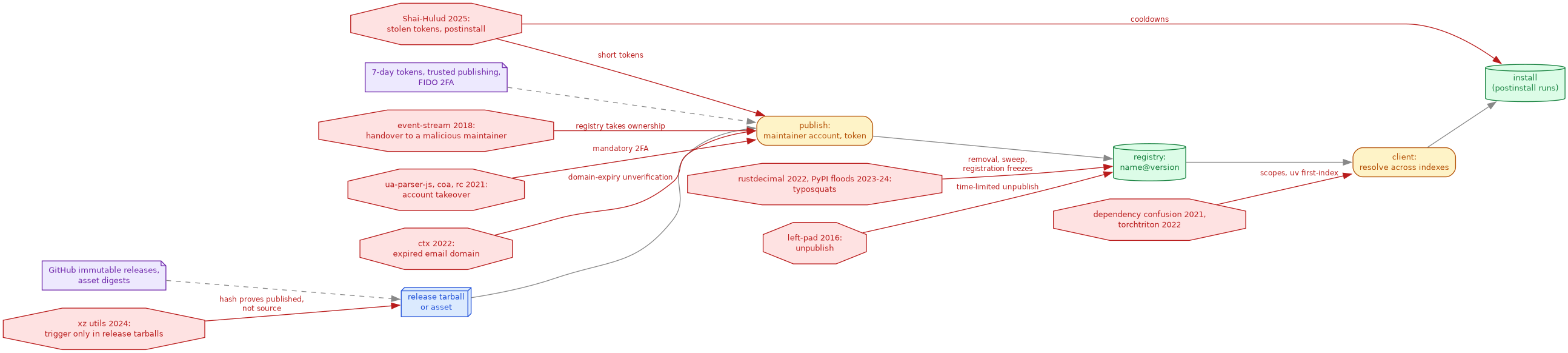
Long-running issues and RFCs where the rules were argued
#24301 accepted 2018-07-17 -> 2018-05-21; MNG-5728 2014 unconfirmed mark -> 2014-11-27, fixed for 4.0.0, still RC; RFC 0025 2020 -> PR opened 2019-08-07; poetry#3747 2021-03-03; PEP 751 created 2024-07-24
| Issue / RFC | Opened | Outcome |
|---|---|---|
| pypa/pip#988 "pip needs a dependency resolver" (“Pypa/Pip#988, ‘Pip Needs a Dependency Resolver’, 2013-06-11 to 2020-11-30,” n.d.) | 2013-06-11 | Closed 2020-11-30 by pip 20.3 |
| pypa/pip#8606 index priority / dependency confusion (“Pypa/Pip#8606, ‘Index-Url Extra-Index-Url Install Priority Order’,” n.d.) | 2020-07-21 | Open; PEP 708 rejected (“Pep 708, ‘Extending the Repository Api to Mitigate Dependency Confusion Attacks’ (Rejected),” n.d.) |
| pypa/pip#9187 "New resolver takes a very long time" (“Pypa/Pip#9187, ‘New Resolver Takes a Very Long Time to Complete’,” n.d.) | 2020-11-30 | Closed 2021-10-11 after resolvelib heuristics |
discuss.python.org #12663 "Requires-Python upper limits" (“Discuss.Python.Org, ‘Requires-Python Upper Limits’,” n.d.) |
2021-12 | No spec change; tools (uv) ignore upper bounds (“Uv, ‘Resolution’,” n.d.) |
python-poetry#3747 caret/upper bounds by default (“Python-Poetry#3747. ; #8291. ; #10136. ; Poetry-Relax,” n.d.) |
2021-03-03 | Maintainers declined; partial move to >= for Python later (#9558) |
| npm RFC 0025 install peer deps (“Npm Rfc 0025, ‘Install Peer Dependencies’,” n.d.) | 2019-08-07 (PR #43) | Implemented in npm 7 (ERESOLVE, --legacy-peer-deps) |
| golang/go#24301 vgo / modules proposal (“Golang/Go#24301, ‘Cmd/Go: Add Package Version Support to Go Toolchain’, 2018-03-07, Accepted,” n.d.) | 2018-03-07 | Accepted 2018-05-21; closed 2018-07-17 |
rust-lang/cargo#5657 --minimal-versions (“Rust-Lang/Cargo#5657, ‘Dependencies Resolution with –Minimal-Versions’, Opened 2018-06-26,” n.d.) |
2018-06-26 | Open (needs-design); direct-minimal-versions emerging |
| RFC 3537 MSRV-aware resolver / cargo#9930 (“Rfc 3537, ‘Msrv-Resolver’, Start 2023-11-14. ; Rust-Lang/Cargo#9930,” n.d.) | 2023-11-14 | Stabilized Rust 1.84 (2025-01-09); default in edition 2024; cargo#9930 still open (“Rust Blog, ‘Announcing Rust 1.84.0’, 2025-01-09,” n.d.) |
| Cargo.lock for libraries (“Ed Page, ‘Change in Guidance on Committing Lockfiles’, Rust Blog, 2023-08-29,” n.d.) | 2023-08-29 (decision) | Commit by default |
| Maven MNG-5728 checksum policy warn to fail (“Mng-5728, Default Checksum Policy,” n.d.) | 2014-11-27 | Fixed for 4.0.0 (2020-12-02); Maven 4 still RC (“Maven, ‘Release History’ (4.0.0-Rc-7),” n.d.) |
| PEP 751 standard lockfile (“Pep 751, ‘a File Format to Record Python Dependencies for Installation Reproducibility’, Accepted 2025-03-31,” n.d.) | 2024-07-24 | Accepted 2025-03-31 |
Comparison table
assembly: removed two rows for a cut ecosystem; yarn berry system-requirement cell set to "-"; added 17 rows filled only from the linked sections, "-" where a section is silent; earlier (research-editor (citation/claim checkers), 2026-11-22T20:09:00Z): yarn classic engines 'Like npm' (npm warns) -> checked by default [114]; 8 unconfirmed mark resolved; yarn berry system-requirement unconfirmed mark kept
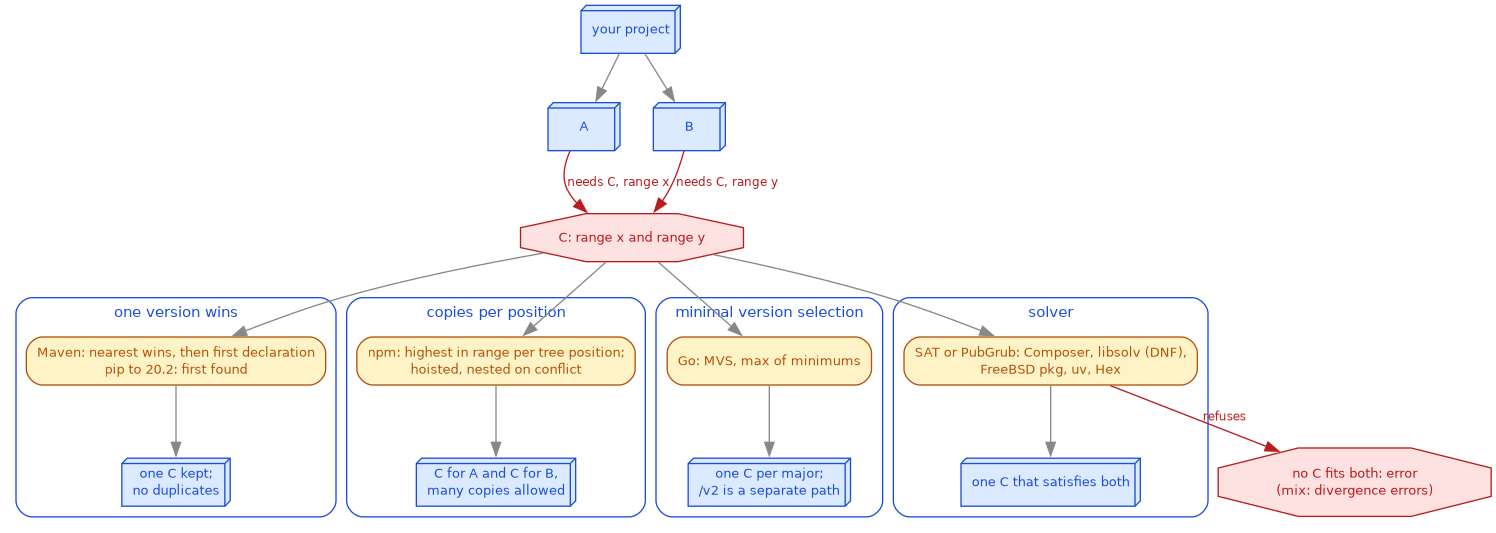

| Ecosystem | Selection | Duplicates in one build | Lockfile | Integrity | System-requirement enforcement | Clash detection | What an incident taught |
|---|---|---|---|---|---|---|---|
| npm | Highest in range per tree position; hoisted, nested on conflict | Yes, many | package-lock.json v1 to v3 |
SRI sha512 per entry | engines warn unless engine-strict |
None (runtime singleton errors) | left-pad: freeze name@version; ua-parser: 2FA; Shai-Hulud: short tokens, cooldown |
| yarn classic | Like npm, plus resolutions override |
Yes | yarn.lock (2016) |
sha1 in resolved URL; integrity (sha512) since 1.10.0 (“Yarn V1.10.0 Release Notes (Integrity Field in Yarn.Lock),” n.d.) |
engines checked by default (--ignore-engines) (“Yarn Classic, Yarn Install (–Ignore-Engines),” n.d.) |
None | Lockfile first, a year before npm |
| yarn berry (PnP) | Like npm; peers per ancestor set | Yes (per peer set) | yarn.lock with checksum (“Yarnpkg/Berry Yarn.Lock (per-Package Checksum),” n.d.) |
Checksum per package (“Yarnpkg/Berry Yarn.Lock (per-Package Checksum),” n.d.) | - | Undeclared imports are errors | Strictness up front beats later breakage |
| pnpm | Highest in range | Yes | pnpm-lock.yaml |
SRI integrity per package (“Pnpm’s Own Pnpm-Lock.Yaml (Resolution: (Integrity: .)),” n.d.) |
engines warns unless engineStrict (“Pnpm, ‘Settings’ (Enginestrict),” n.d.) |
Strict node_modules (no phantoms) |
Install-time code is the attack; scripts off, 1-day cooldown |
| cargo | Highest semver-compatible; error if unifiable ranges conflict; MSRV-preferring (v3) | Across majors only | Cargo.lock, committed for libraries since 2023 |
sha256 per registry pkg | rust-version error (override flag) |
links: one native lib, resolve error |
Yank ≠ delete; lockfiles beat upper bounds |
| Go | MVS: max of minimums | Across majors (/v2 paths) |
No version lock needed; go.sum hashes |
go.sum + sum.golang.org transparency log | go line refused since 1.21 |
Impossible by construction | Hash lock is needed even with MVS; retract in-package |
| tools.deps | Top-level wins; else newest wins; git: descendant wins | No | None | Maven checksums, warn default | None (no JVM-version key in deps.edn) (“Clojure, ‘Deps.Edn Reference’ (Git Coords, :Checksum Policy),” n.d.) |
None; git non-ancestor shas are an error | Pin by content (sha) when there is no lock |
| Maven | Nearest wins, then first declaration | No (per GAV) | None standard | Central requires md5/sha1 + PGP; client warn (M3) | Enforcer requireJavaVersion (opt-in, fails) |
Opt-in banDuplicateClasses |
Log4Shell: transitive fixes need explicit overrides |
| Gradle | Highest wins; strictly=/=reject |
No | Optional locking (acts as strictly) |
verification-metadata.xml (6.2), fails |
org.gradle.jvm.version fails resolution |
Capabilities conflict fails by default | Make "provides the same thing" a resolve error |
| pip | First-found (to 20.2); backtracking (20.3+) | No (one site-packages) | None native (pip-tools; PEP 751 now) | --require-hashes, all-or-nothing |
Requires-Python filter + refuse (9.x) | None (file overwrite) | torchtriton: index precedence still unfixed |
| poetry | PubGrub over the whole Python range | No | poetry.lock |
Hashes in lock | Project Python range must fit all deps (errors) | None | Caret by default propagates caps; users can't undo them |
| uv | PubGrub; highest by default; lowest=/=lowest-direct; --exclude-newer |
Per marker fork only | uv.lock universal; exports pylock.toml (uv 0.6.15) (“Uv 0.6.X Changelog (0.6.15: Uv Export –Format Pylock.Toml),” n.d.) |
Hashes in lock | requires-python lower bound only; upper ignored |
None | first-index default fixes dependency confusion |
| mix / Hex | PubGrub (Hex 2.0, 2022); highest within ~>; refuse on divergence; root-only override: true |
No (one OTP app per name) | mix.lock: version, inner+outer sha256, repo per dep; --check-locked, deps.unlock --check-unused |
Outer sha256 of whole tarball; RSA/SHA-512 signed registry; lock check a no-op until 2.4.2 (CVE-2026-32148) |
Root elixir: raises at load; deps' only warn; not selection-aware |
Divergence errors (divergedreq, diverged, divergedonly) |
Lock written ≠ lock checked; default repo hexpm, others named per dep |
| dpkg/APT | Heuristic resolver; backtracking solver default in apt 3.1.10 (2025) | - | None; the installed set is the record (unconfirmed) | Signed Release lists Packages checksums, Packages lists .deb checksums (Secure APT) | - | Conflicts refuses unpack; Breaks blocks configure |
OpenSSL 2008: a distribution patch is part of the dependency |
| RPM | libsolv SAT solver (via DNF, default from Fedora 22) | - | None; rpmdb is the record (unconfirmed) | Package signatures, checked by default from RPM 6.0.0 (2025) | - | - | - |
| BSD ports | None; one version per port directory | Refused | The tree checkout; quarterly branches | distinfo sha256 (FreeBSD); BLAKE2s and SHA512 (pkgsrc) |
- | CONFLICTS*, @conflict |
2012 build compromise: source had an audit anchor, binaries did not |
| FreeBSD pkg | SAT solver since pkg 1.3.0 (2014) | - | None; the (Poudriere) repository is the lock | Repository signed, trusted by fingerprint; separate pkgbase keys | ABI string selects the repository | Solver conflict handling | - |
| Nix | None; one version-set per nixpkgs revision | Yes, one store path per input hash | flake.lock (Nix 2.4, experimental) |
Input-addressed paths; signed substitutes required since 2.0; narHash in lock |
- | None needed: distinct paths | CVE-2024-27297: fixed-output derivations are a trust boundary |
| Guix | None; the channel commit fixes the package set | Yes, as Nix | guix describe -f channels plus guix time-machine |
Signed substitutes; commits signed by keys in .guix-authorizations |
- | None needed: distinct paths | Daemon code shared with Nix shared the CVE |
| Homebrew | None; rolling, one current version; foo@x formulae |
No two versions of one formula in a tree | None (Brewfile.lock.json 2019 to 2024, removed) |
sha256 per download and bottle; JWS-signed API; attestations opt-in | - | Two versions of one formula refused | 2018 token leak: branch protection; 2021 cask bot: maintainer review |
| Windows/macOS installers | None; each installer decides | Yes: per-app copies, side-by-side assemblies | None | Authenticode; MSIX block hashes; winget InstallerSha256; notarization |
- | MSI component rules, not enforced | DLL hell: the OS stopped sharing its directory |
| Docker/OCI | None; an image freezes one build | - | Digest pin (image@sha256:...) |
SHA-256 content addressing; cosign and Notation signatures; DCT retired |
- | - | 2020 pull limits: the registry is a dependency |
| CPAN | Index maps a package to its latest indexed file; minimum versions | No; a second version needs a second tree | cpanfile.snapshot (Carton), no hashes |
PGP-signed CHECKSUMS with sha256; verification opt-in |
- | conflicts relationship, discouraged |
2021 CHECKSUMS bypass: record each file's location |
| RubyGems/Bundler | Molinillo, then PubGrub (Bundler 2.4) | - | Gemfile.lock; CHECKSUMS on by default in 4.0 |
SHA1 in packaged gems; lock checksums refused on mismatch | Locked BUNDLED WITH honoured since 2.3 |
- | rest-client 2019: account takeover; MFA for popular gems |
| Composer | SAT solver (port of libzypp's) | - | composer.lock with content-hash; unsatisfying lock fails since 2.5 |
Mostly none: GitHub archives are not byte-stable; signing planned | php and ext-* platform packages; runtime check since 2.0 |
- | 2026 tag rewrites: stable versions pinned to commits |
| NuGet | Lowest applicable; direct dependency wins | - | packages.lock.json opt-in (4.9); locked mode |
Author and repository signatures; all new nuget.org uploads repository-signed | - | Exact-pin conflicts are errors; NU1605 on downgrade | Nx compromise: 30-day API keys |
| CocoaPods | RubyGems-style requirements plus ~> |
No | Podfile.lock, committed |
SHA-1 of the podspec, not of the source | - | - | Trunk RCEs (2021, 2023): trunk going read-only |
| SwiftPM | PubGrub (Swift 5.2); one version per package | No | Package.resolved v1 to v3; ignored when a dependency |
Binary-target checksums; registry checksums refused on mismatch; TOFU | - | Module-name collision fails; SE-0339 aliasing | - |
| Conan | - | - | conan.lock of references pinned to recipe revisions |
Recipe and package revisions are hashes | Settings in the package_id |
- | - |
| vcpkg | Minimal selection after Go; baseline supplies floors | No; one version per port | builtin-baseline registry commit |
SHA512 required when REF is given |
- | Incomparable versions reported as conflicts | xz: a pinned tarball hash matches a malicious tarball |
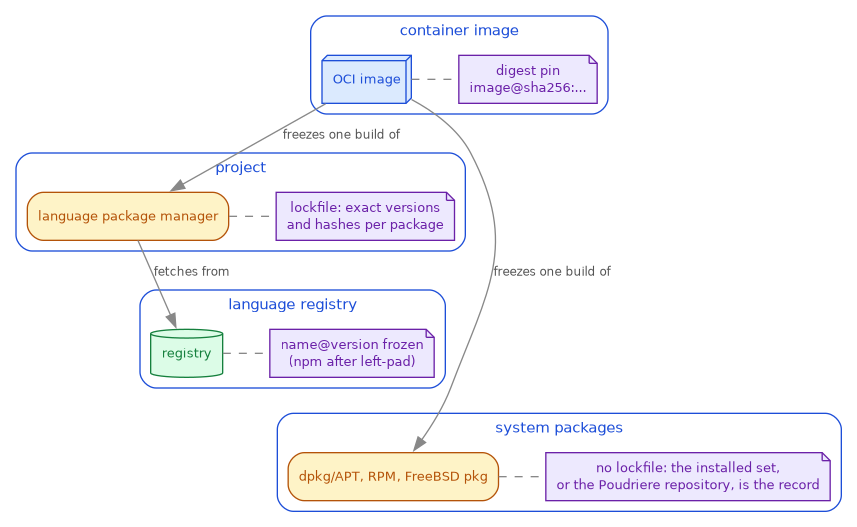
Sources
assembly: removed entries 75-79, 79a and 105, cited only by cut sections; kept numbers stable with list cookies; earlier (research-editor (citation/claim checkers), 2026-11-22T20:09:00Z): items 9-80 were numbered one below their in-text citations -> renumbered 10-81 ([@10] cookie); sources 102-132 added