TOC rail + highlighter — data flow, boundaries, and the implicit org to html contract
Table of Contents
1. What this note settles
Ran =node experiments/toc-nav-simulator/simulate.mjs fixtures/geometry.json= live — 17 headings over a real captured-geometry fixture, properties P2 (monotone), P3 (reachable, 17/17), P4 (inert) all pass. Confirms the simulator grades the reducer against a real fixture, as claimed.
The right-rail TOC ships (site/static/css/style.css, gated by
body:has(#table-of-contents) at ≥1024px). The next feature is the
highlighter — as the reader scrolls, mark the current section in
the rail. The reducer contract for it landed independently in
docs/toc-rail-reducer-contract.org (internal to the repo) and a JS
mirror at experiments/toc-nav-simulator/reducer.mjs; the head-less simulator
already grades that reducer against real org-publish HTML fixtures.
What is not settled and this note settles:
- Data flow between browser events, geometry reads, the pure reducer, and DOM mutations.
- Boundary responsibilities — what the reducer owns, what the browser adapter owns, what the CSS owns, what the publisher owns.
- The implicit contract the org to html exporter provides — the guarantees the highlighter relies on, and the guarantees the highlighter must not rely on.
- Bundle strategy — extend the existing tracker.js so the
highlighter ships with the ambient page load, without a new
<script>include touched into every template.
The reducer itself is done. This is the wiring diagram + boundary spec + bundle decision.
2. Data flow
Six events, one pure reducer, one DOM effect. The reducer is a
function (state, event) → state; the adapter is what turns
browser noise into events and what turns state changes into class
toggles.

The reducer inputs are five numbers and one array: scrollY,
headerH, viewportH, documentH, headings[]=. Output is one
string (activeId) or null. Nothing else crosses the boundary in
either direction.
3. User flow — from click to highlight
Two entry points: passive scroll, and explicit navigation. Both go through the same reducer.
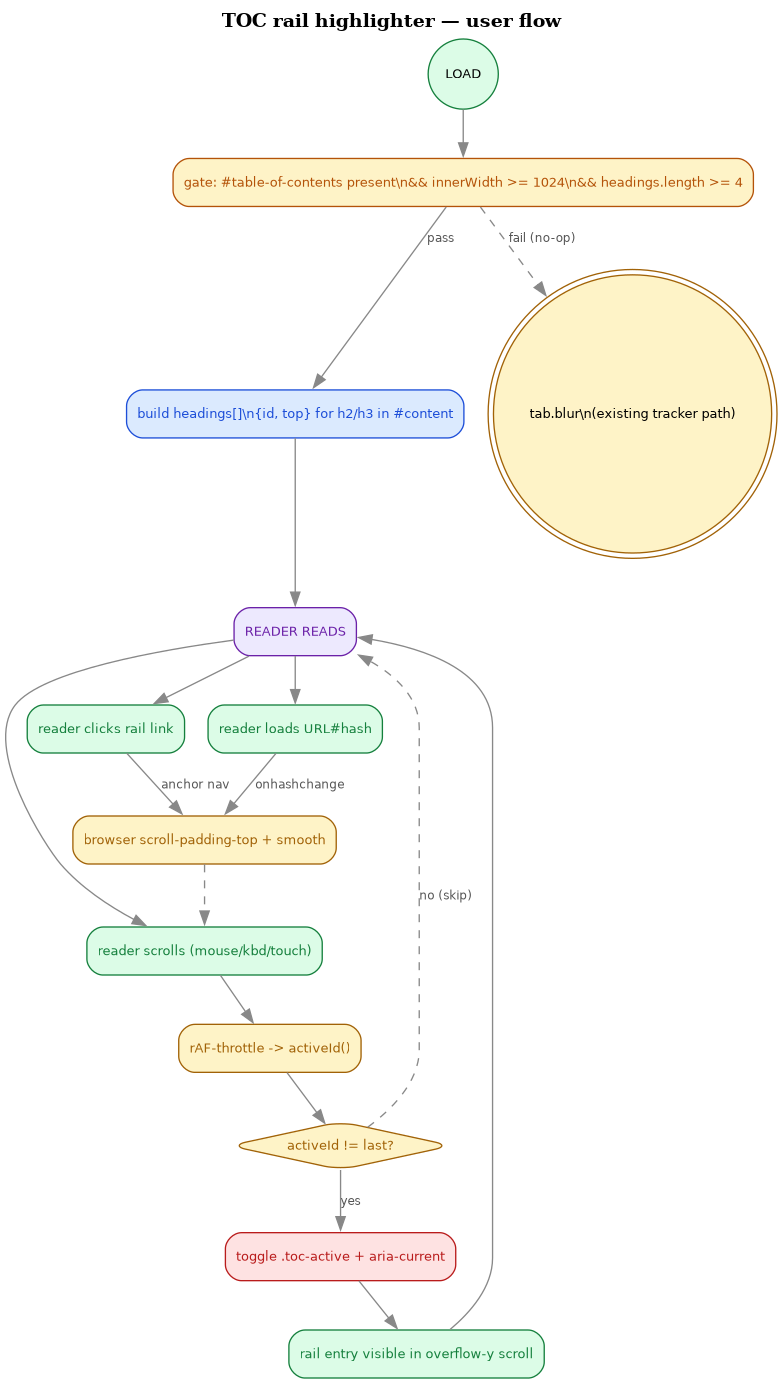
The "activeId != last" diamond matters. Without diff-caching, every rAF tick writes to the DOM, which is a 60Hz style recalc for zero visual change. With the cache the write happens exactly at section boundaries.
4. Boundaries — who owns what
Five actors. Each owns a strictly non-overlapping surface.
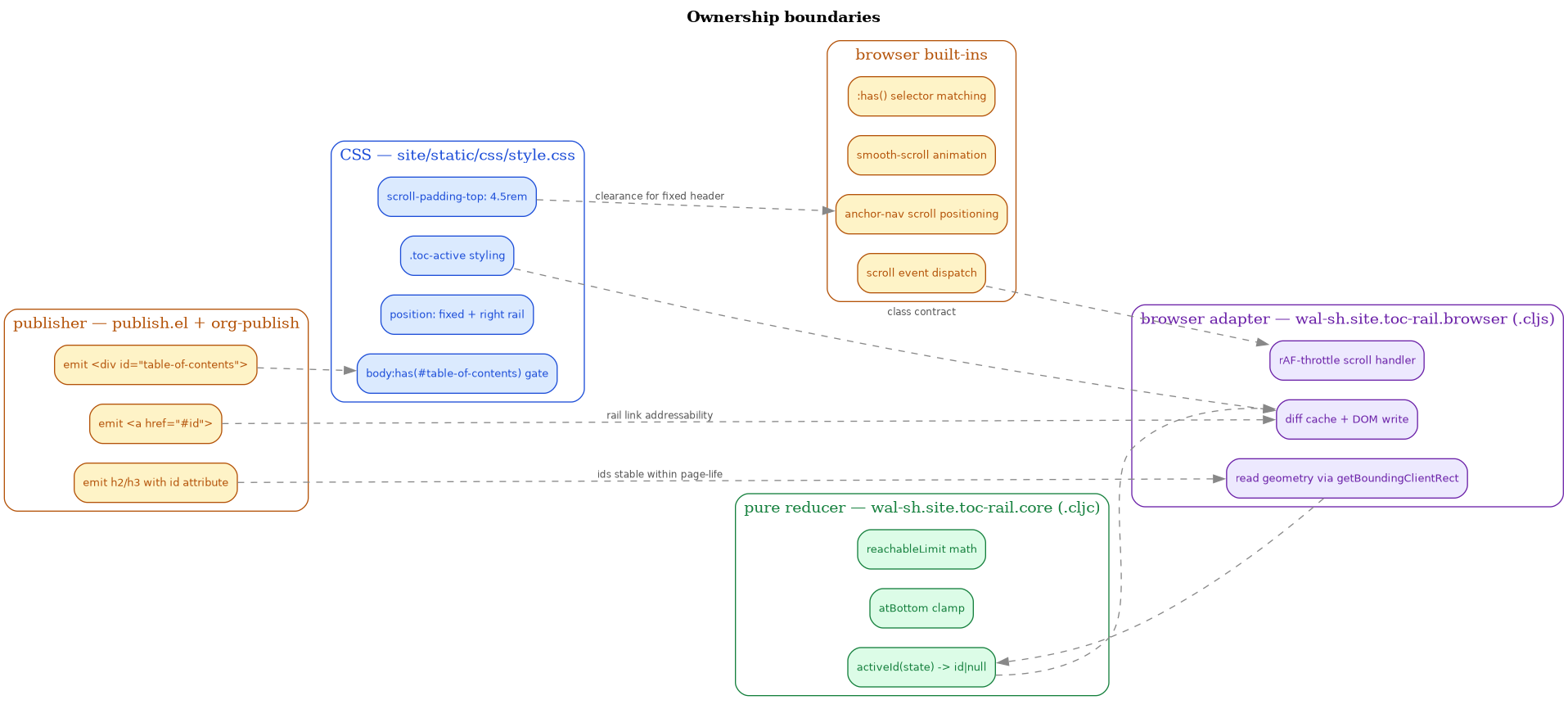
Every cross-boundary edge is a single-direction contract, and each is small enough to state in one sentence. If a future change forces an arrow to reverse, it's a spec-bump signal.
4.1. Reducer ownership — what it must NOT touch
| Forbidden | Why |
|---|---|
document, window, Math.random |
Purity requirement — the reducer is graded against a JSON oracle on the JVM |
setTimeout, requestAnimationFrame |
Timing is the adapter's problem |
IntersectionObserver |
Alternative algorithm; the reducer decides from geometry, not from intersection events |
Any mutable state outside the state arg |
Idempotency — same input, same output, always |
4.2. Adapter ownership — what it must NOT do
| Forbidden | Why |
|---|---|
| Decide which heading is active | That is the reducer's one job |
| Modify heading content or ids | Publisher-owned; adapter only READS |
Style the .toc-active class |
CSS-owned; adapter only toggles the class name |
| Fire tracker events | Separate concern — the tracker.js observer can pick up the class change via its own IntersectionObserver if wanted |
Scroll the document, or write location.hash |
The adapter scrolls one element, the rail itself, and only to keep the active entry in frame. Page position belongs to the browser anchor navigation and the reader |
4.3. Rail scroll: the one thing the adapter does move
The rail is overflow-y: auto at calc(100vh - 14rem). On a long note the
highlighted entry leaves the frame and the class toggle is invisible. The
reducer gains a second pure decision, rail-scroll-top, and the adapter
applies it after the class toggle. The when and how are Emacs's own scrolling
rules with the rail as the window and the active entry as point:
scroll-margin (two lines, 40 px), scroll-conservatively (scroll-driven
activation moves the rail just enough), recenter on a discontinuous jump
(anchor click, hashchange, load with a fragment), and
next-screen-context-lines (a minimal move of a near-full frame recenters
instead). Reduced motion selects instant over smooth at the adapter; the
reducer never knows.
The mapping table, the quoted Emacs docstrings, the signature, and the five
properties live in docs/toc-rail-reducer-contract.org under "Rail scroll
(keeping the active entry in frame)". The user-flow diagram above still shows
"rail entry visible in overflow-y scroll" as a browser built-in; it is now an
adapter write, and the diagram is due a regeneration.
5. The implicit org to html contract
Six guarantees the highlighter relies on, and two the highlighter
must NOT rely on. These aren't in the org manual as a "contract"
per se — they're what org-export-html observably does, and the
gap between "observable" and "guaranteed" is where the risk lives.
5.1. Relied-on guarantees
| # | The exporter guarantees | Highlighter use |
|---|---|---|
| G1 | #+OPTIONS: toc:t emits <div id"table-of-contents"><div id="text-table-of-contents"><ul>= |
Gate: presence check |
| G2 | Every heading gets an id attribute |
headings array construction |
| G3 | The <ul> inside #text-table-of-contents has <a href"#<id>">= entries matching heading ids |
Class-toggle target |
| G4 | Heading order in the ToC matches DOM order | activeId scan invariant |
| G5 | :CUSTOM_ID: on a heading overrides the random id |
Stable-id path (see G7) |
| G6 | The publisher's canonical-URL filter rewrites .html paths but does NOT touch #hash fragments |
Rail anchors survive canonicalization |
5.2. Must-not-rely-on guarantees
G7's "three exports, three disjoint id sets" is recorded primary evidence, not a derived claim — =experiments/toc-nav-simulator/fixtures/id-runs.txt= logs 17 headings across three exports of the unmodified =note-random-ids.org= fixture, all 17 ids differing each run, matching the claim exactly.
| # | The exporter DOES NOT guarantee | Consequence |
|---|---|---|
| G7 | Ids are stable across rebuilds — org-export-format-reference generates random 7-hex-digit ids per export (three exports of the same file produce three disjoint id sets, verified in experiments/toc-nav-simulator/) |
Highlighter reads DOM at load time; never caches ids across page-loads. Shared #hash URLs break on republish unless the source uses :CUSTOM_ID: on every heading. |
| G8 | Heading top coordinates are stable across viewport widths or font-loading |
Adapter recomputes on resize AND on load (after web-fonts settle) rather than trusting a single DOMContentLoaded read |
The G7 finding is why the reducer takes headings as an argument
rather than computing them from a URL or a manifest — the DOM is
the only source of truth for what ids exist right now.
6. Bundle strategy
The site loads six sitewide JS bundles today: tracker.js ·
page-tags.js · web-vitals-init.js · bot-signal.js ·
global-pollution.js · event-pixel.js. Options:
6.1. Extend tracker.js (recommended)
This option landed the same day as this note (commit e965596c, 2026-09-08). The commit message gives the actual measured cost: tracker.js grew +6.3 KB advanced-compiled (128,888 -> 136,491 bytes), about 3x the ~2 KB estimated below. Body text corrected to the measured figure.
- Add
wal-sh.site.toc-rail.core(.cljc, pure reducer, 77-line port ofexperiments/toc-nav-simulator/reducer.mjs) andwal-sh.site.toc-rail.browser(.cljs, ~50 lines) to the:site-trackershadow-cljs build. - The adapter reuses
wal-sh.site.tracker.browser' existingrAF-throttleutil (already handles scroll forscroll.depth). - Guard: gate the
toc-rail.browser/init!call on(and (.querySelector js/document "#table-of-contents") (>(.-innerWidth js/window) 1024))=, so pages without a TOC pay no cost. - Bundle-size cost: the landed commit measured +6.3 KB
advanced-compiled (128,888 -> 136,491 bytes), about 3x the ~2 KB
estimate. No new
<script>tag anywhere.
6.2. New toc-rail.js bundle (rejected)
- Requires editing every template's postamble to add a new
<script src"/static/js/cljs/toc-rail.js">= include, OR touchingpublish.elto inject it into the exported HTML head. - Adds an HTTP round-trip on every page load.
- The only reason to prefer it: hard isolation from the tracker's
event vocabulary. But the two are ergonomically related — the
next feature after "highlight current section" is "fire a
section.dwellevent when a section is on the reading line ≥30s," which is already the tracker's shape.
6.3. Piggyback on page-tags.js (rejected)
page-tags.jsrenders the keyword-chip footer; unrelated concern.- Would couple two independent UI behaviors in one bundle without a shared abstraction.
7. Implementation sketch (follow-on, not this note)
This heading frames the work as not-yet-landed, but commit e965596c landed it 10 seconds before this note's own commit (git log: note committed 2026-09-08T11:10:16-04:00; implementation committed 11:10:06). Landed sizes and test method differ from the estimate below; body corrected. Live run of the actual suite (=clojure -M:test -e ...= against =wal-sh.site.toc-rail.core-test=) on 2026-10-08: 36 tests, 84 assertions, 0 failures, 0 errors.
Three files land, all in the :site-tracker shadow build:
src/wal_sh/site/toc_rail/core.cljc      ; landed at 111 lines, now 199 after the rail-scroll follow-on (c3eb6497)
src/wal_sh/site/toc_rail/browser.cljs   ; landed at 168 lines, now 335
test/wal_sh/site/toc_rail/core_test.cljc ; property tests against docs/toc-rail-reducer-contract.org fixtures
core.cljc exposes (active-id state) and (reachable-limit state)
as pure functions. The landed test harness does not byte-match
against a JS oracle; it runs clojure.test.check properties
(membership, monotonicity, at-bottom, progress-in-range, plus rail-scroll
properties added later) against numeric fixtures from
docs/toc-rail-reducer-contract.org.
browser.cljs wires:
init!— gate + buildheadingsarray + attach listeners.on-scroll— rAF-throttle to(active-id ...)to diff-cache to DOM write.on-resize— recomputeheadings[].topanddocumentH.on-load— one delayed recompute after web-fonts settle, to catch G8.
Ledger block on land, with the reducer contract's own version as the pinned dependency.
8. Refutation
The claim is that this reducer + adapter, added to tracker.js with
zero template touches, produces a working highlighter with no
regression on any current page. It fails if:
- The reducer disagrees with
reducer.mjson any fixture scenario (grading harness catches this in CI). - Rail links stop scrolling to the right position — implicates
scroll-padding-topinteracting with the class-toggle timing; test by clicking every link on a long note. - Pages without a TOC take a measurable perf hit — the gate at
init!should return in <1ms; measure withperformance.now()in dev. - The tracker's existing
scroll.depthevent count changes — the two handlers share the rAF-throttle util; a bug here shows up as event-count drift in the daily snapshot. - On a page with
:CUSTOM_ID:on every heading, the highlighter still misses one anchor — implicates G4 (heading order in ToC vs. DOM order). This is the one that would be a real spec bug.
9. Cross-references
docs/toc-rail-reducer-contract.org(repo-internal) — the ClojureScript reducer contract this note wrapsexperiments/toc-nav-simulator/README.org(repo-internal) — the JS mirror + real org-publish fixtures + the G7 anchor-instability findingdocs/views-projection.org(repo-internal) — bundle-per-page map that §Extend tracker.js references- tracker-rebuild-spec — the tracker whose rAF-throttle util the adapter reuses
site/static/css/style.css— the rail CSS (:has() gate + fixed positioning + scroll-padding-top)