Table of Contents
British Airways 48, Boeing 777-300ER, KSEA → EGLL. Daily transatlantic service.
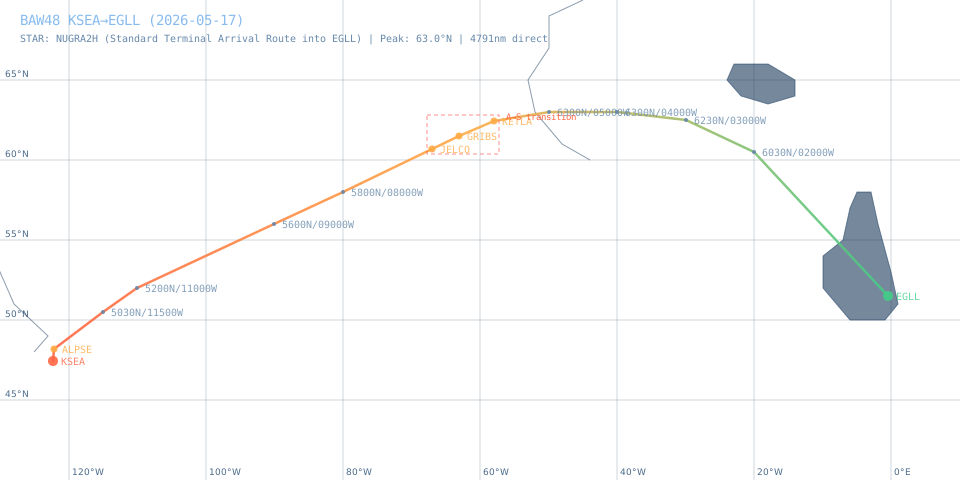
1. Route Analysis
Filed route: KSEA ALPSE YDC → oceanic fixes → JELCO GRIBS KETLA → Greenland crossing → NUGRA2H STAR → EGLL
| Metric | Value |
|---|---|
| Direct distance | 4,791 nm |
| Filed distance | 4,948 nm |
| Dogleg | 157 nm |
| Peak latitude | 63°N (Greenland) |
| Filed speed | 459 kt |
| Block time | ~9h 15m |
| Aircraft | B77W (777-300ER) |
| STAR | NUGRA2H into Heathrow |
2. ADS-B Coverage Transition
The route passes through Davis Strait (~60-63°N) where terrestrial
ADS-B coverage transitions to space-based surveillance (Aireon). The
update_type field in AeroAPI track positions encodes this:
| Code | Source | Coverage |
|---|---|---|
| A | ADS-B terrestrial | Ground station range |
| S | Space-based (Aireon) | Global/polar |
| Z | ATC radar | Controlled airspace |
| P | Projected | Everywhere (estimated) |
A naive tracker reports "gap" when surveillance source changes. A correct tracker reports "handoff."
3. Finding: No A→S Transition Observed
Analysis of 658 track positions from the 2026-05-17 departure showed
all positions as type A (ADS-B) or Z (radar) — no S (space-based).
This suggests either continuous terrestrial ADS-B coverage on this
routing or that AeroAPI's Personal tier does not surface the S
distinction. An open question for further investigation.