Scheme LLM Toolkit: Functional LLM Integration with Contracts
Table of Contents
- 1. Scheme LLM Toolkit
1. Scheme LLM Toolkit
A composable, functional interface for LLM integration in Guile Scheme, emphasizing type safety through contracts and formal specification.
1.1. Repository
1.2. Philosophy
The toolkit follows several key principles:
- Composability - Functions compose naturally using standard Scheme idioms
- Provider Abstraction - Unified interface across LLM providers (Ollama, OpenAI, Anthropic)
- Contracts as Documentation - Runtime contracts serve as executable specifications
- Formal Methods Integration - Contracts bridge to TLA+, Lean4, and OpenAPI specifications
1.3. Architecture
src/llm/
├── core/
│   ├── provider.scm     # Provider abstraction layer
│   ├── contracts.scm    # Racket-inspired contract system
│   └── tools.scm        # Function calling / tool use
├── providers/
│   ├── ollama.scm       # Local Ollama API
│   ├── openai.scm       # OpenAI API
│   └── anthropic.scm    # Anthropic Claude API
└── utils/
    ├── http.scm         # HTTP client (curl-based)
    └── json.scm         # JSON parsing/generation
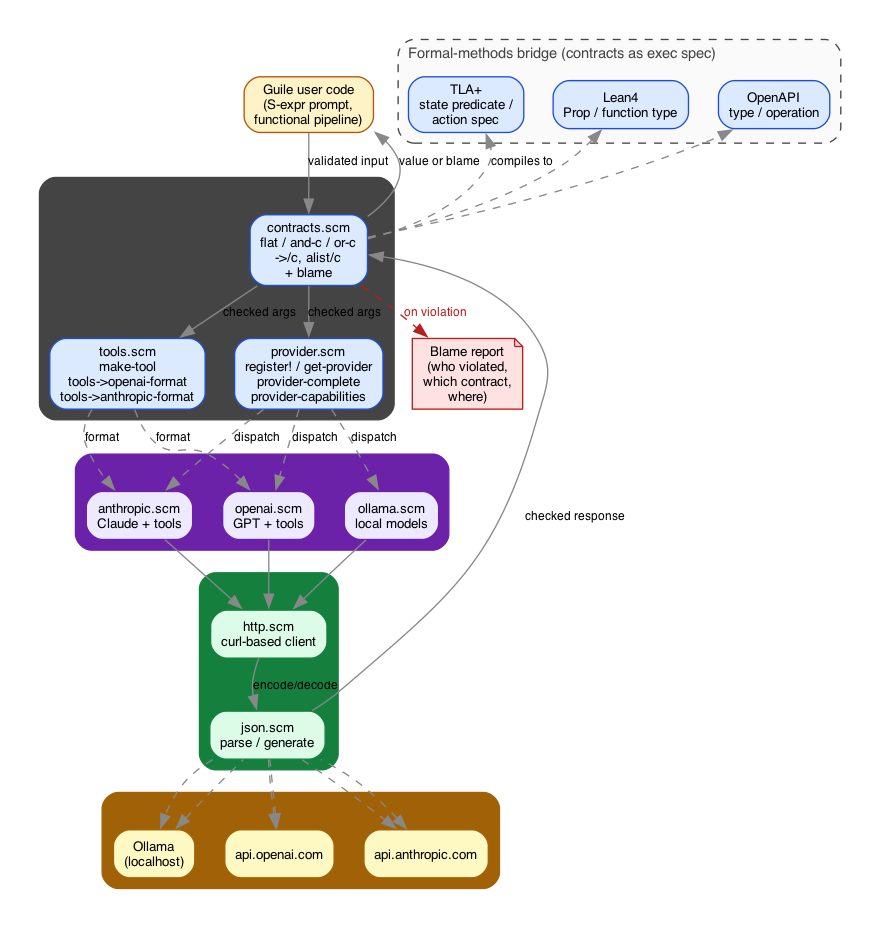
Figure 1: Scheme LLM Toolkit pipeline — user code flows through the contract spine into a provider abstraction that dispatches to Ollama, OpenAI, or Anthropic, with contracts also bridging to TLA+, Lean4, and OpenAPI artefacts.
1.4. Contract System
The contract system is inspired by Racket's approach to design-by-contract:
1.4.1. Core Concepts
- Flat Contracts - Simple predicates (
string?,number?) - Combinators - Compose contracts (
and/c,or/c,not/c) - Function Contracts - Specify domain/range (
->/c) - Structural Contracts - Validate data shapes (
alist/c,listof/c) - Blame Assignment - Identify who violated the contract
1.4.2. Example Usage
(use-modules (llm core contracts))

;; Define a flat contract
(define positive?
  (flat-contract (lambda (x) (> x 0))
                 #:name "positive?"))

;; Contract combinators
(define non-empty-string?
  (and/c (flat-contract string?)
         (flat-contract (lambda (s) (> (string-length s) 0)))))

;; Function contract
(define string->number/c
  (->/c (flat-contract string?)
        (flat-contract number?)))

;; Structural contract for LLM messages
(define message/c
  (alist/c
   #:required `((role . ,role/c)
                (content . ,string/c))
   #:optional `((name . ,string/c))))
1.4.3. Formal Methods Mapping
| Racket Concept | TLA+ Equivalent | Lean4 Equivalent | OpenAPI |
|---|---|---|---|
| Flat contract | State predicate | Prop | type |
| Function contract | Action spec | Function type | operation |
| Blame | Error trace | Error monad | 4xx/5xx |
1.5. Provider Abstraction
All providers implement a common interface:
(use-modules (llm core provider)
             (llm providers openai-provider))

;; Register a provider
(register-openai-provider!
 #:api-key (getenv "OPENAI_API_KEY")
 #:model "gpt-4o")

;; Use through abstraction
(let ((provider (get-provider 'openai)))
  (provider-complete provider "Explain recursion briefly."))

;; Provider capabilities are declared
(provider-capabilities provider)
;; => (streaming chat embeddings function-calling ...)
1.6. Function Calling / Tool Use
(use-modules (llm core tools))

;; Define a tool
(define weather-tool
  (make-tool
   #:name "get_weather"
   #:description "Get current weather for a location"
   #:parameters '((type . "object")
                  (properties . ((city . ((type . "string"))))))
   #:handler (lambda (city)
               (format #f "Weather in ~a: sunny" city))))

;; Convert to provider format
(tools->openai-format (list weather-tool))
(tools->anthropic-format (list weather-tool))
1.7. FreeBSD Compatibility
The toolkit includes first-class FreeBSD support:
# FreeBSD setup
pkg install guile3 curl bash

# guile-json must be built from source
gmake install-guile-json

# Run tests
gmake test
Key adaptations:
- Auto-detects OS and sets
GUILE=guile3on FreeBSD - Uses
/usr/local/bin/bashinstead of/bin/bash - Provides
bin/guile-llmwrapper for portable execution - Build script for guile-json (not in FreeBSD packages)
1.8. Formal Specification
The project includes formal specifications mapping contracts to:
1.8.1. TLA+ Style
---------------------------- MODULE Provider ----------------------------
VARIABLES providerState, requestQueue

TypeInvariant ==
    /\ providerState \in [Providers -> {"ready", "busy", "error"}]

CanAcceptRequest(p) ==
    providerState[p] = "ready"

Safety ==
    \A p \in Providers:
        providerState[p] = "error" =>
            ~(\E r \in Responses: Complete(p, _, r))
=========================================================================
1.8.2. Lean4 Style
structure Provider where
  name : String
  complete : String → IO (Except Error Response)

  -- Proof obligations
  complete_deterministic : ∀ p, complete p = complete p
1.8.3. JSON Schema / OpenAPI
;; Convert JSON Schema to contract
(define user/c
  (json-schema/c
   '((type . "object")
     (required . ("name" "email"))
     (properties
      . ((name . ((type . "string")))
         (email . ((type . "string"))))))))

(contract-check user/c '((name . "Alice") (email . "a@b.com")))
;; => #t
1.9. Project Status
| Component | Status | Notes |
|---|---|---|
| Ollama Provider | Complete | Local LLM support |
| OpenAI Provider | Complete | Including function calling |
| Anthropic Provider | Complete | Claude API support |
| Contract System | Complete | Racket-inspired |
| Function Calling | Complete | Cross-provider |
| CLI Tool | Planned | Interactive chat |
| RAG Utilities | Planned | Embeddings + search |
1.10. References
- Racket Contracts: https://docs.racket-lang.org/reference/contracts.html
- TLA+ Specification Language: https://lamport.azurewebsites.net/tla/tla.html
- Lean4 Theorem Prover: https://lean-lang.org/
- OpenAPI Specification: https://spec.openapis.org/oas/latest.html
1.11. Installation
# Clone
git clone https://github.com/aygp-dr/scheme-llm-toolkit
cd scheme-llm-toolkit

# Check system
gmake check-system  # FreeBSD
make check-system   # Linux/macOS

# Install dependencies
gmake install-guile-deps

# Test
gmake test

# Use
bin/guile-llm -c "(use-modules (llm core provider)) (display 'ok)"
1.12. Why Scheme for LLMs?
- Homoiconicity - Code as data enables powerful prompt templating
- Macros - DSLs for prompt engineering compile to efficient code
- REPL-driven - Interactive development with live LLM connections
- Functional Composition - Pipeline LLM calls naturally
- Formal Methods Heritage - Natural fit for specification and verification
;; S-expression prompts compose naturally
(define code-review-prompt
  `(system "You are a code reviewer")
    (user ,(format #f "Review: ~a" code)))

;; Functional pipelines
(define analyze-and-fix
  (compose
   (curry provider-complete provider)
   (curry format-prompt 'fix-bugs)
   extract-issues
   (curry provider-complete provider)
   (curry format-prompt 'analyze)))
1.13. Conclusion
The Scheme LLM Toolkit demonstrates that functional programming principles—composition, immutability, and formal contracts—provide a robust foundation for LLM integration. By treating contracts as executable specifications that bridge to formal methods, we gain both runtime safety and documentation that can inform verification efforts.