Boston Security Meetup: Zero Trust for Agentic AI; Ransomware Defense
Table of Contents
Event
| Field | Value |
|---|---|
| Event | Boston Security September Meetup |
| Group | Boston Security Meetup (Meetup rating 4.8, 755 reviews) |
| Listing | meetup.com/…/events/316364149 |
| Organizers | Nivi and four co-hosts; Ori Zigindere (super organizer since 2018, and founder of MinuteCon) |
| Date | Thursday, 17 September 2026 |
| Doors | 18:30 |
| Venue | FHL Bank Boston, 800 Boylston St., 6th Floor, Boston, MA |
| Format | Two talks, two sponsor pitches, sticker swap table |
| Sponsors | Realm Security, DomainTools |
Registration and entry requirements
The group publishes the following entry rules on the event listing:
- Meetup QR-code check-in, in use since May 2026, restricts entry to registered users.
- Registrants must give a first and last name that matches a photo ID. Organizers send the name list to building door security before the event.
- Door security checks the name and photo ID at entry. Organizers or building security may refuse entry on a mismatch.
- Entry requires a confirmed RSVP. A wait-list position does not grant entry; it moves a person to the registered list only when a registrant cancels more than 48 hours before the event.
- The group tracks no-shows. Three no-shows remove a member from the group. Repeated cancellations with less than 48 hours' notice can count as no-shows.
- Pets and telepresence robots are not admitted.
At this event, attendees passed two security checkpoints in the building, and staff checked names against the registration list at both.
Running order
From the welcome slide:
| Time | Item |
|---|---|
| 18:30-19:00 | Arrival, introductions |
| 19:00-19:15 | Opening slides |
| 19:15-19:20 | Sponsor spotlight |
| 19:30-19:40 | Break |
| 19:40-20:30 | Talks |
| 20:30 | Bar: AT O'Keefes |
Announcements
Upcoming conferences
| Date | Event | Location | Note |
|---|---|---|---|
| 2026-09-26 | BSides Connecticut | Fairfield, CT | |
| 2026-10-08 | Cybersecurity Summit Boston | Boston | own page; code CSS26-MASSCC by Oct 8, free admission |
| 2026-10-25 | BSides CambridgeMA | Somerville | own page; Cambridge is the org's name, the venue has always been Somerville |
| 2027-04-30 | MinuteCon | Cambridge | own page; announced as Boston, venue is the Boston Marriott Cambridge |
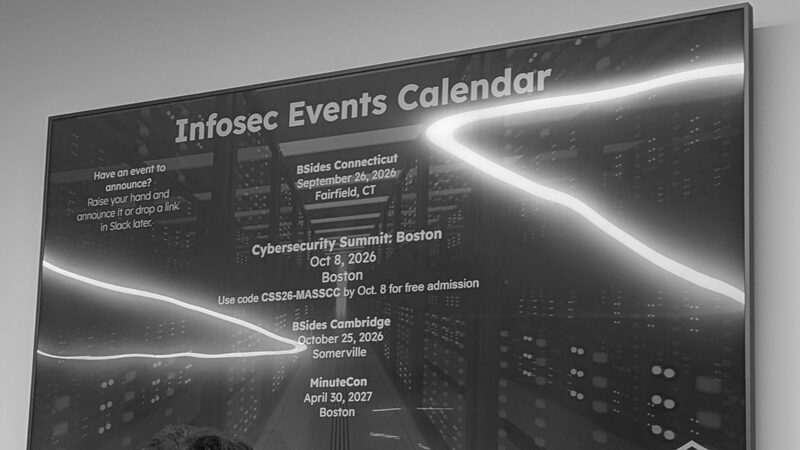
Figure 1: Slide: the organizers' Infosec Events Calendar, the source for the table above
Transcribed from the slide above, so the dates and locations are what was announced on the night. None has been checked against the events' own published listings except MinuteCon, which has been: it is a two-day conference, 30 April to 1 May 2027, at the Boston Marriott Cambridge, run by NEISA, the same organization that runs this meetup. See MinuteCon 2027.
Awards
The organizers announced a "Secure in Shadow" award.
Hiring
Few attendees or sponsors announced open positions. DomainTools announced openings for a software engineer and a product manager.
Sponsor pitches
Realm Security
- Product area: security data pipeline covering data in transit, ingest, and redaction. The sponsor slide's own line is "the SOC-aware security data pipeline."
- Market position: competes with Splunk on ingest and redaction.
Recovered on 2026-09-17 from a photograph of the sponsor title slide; the name was not written down on the night.
DomainTools
- Speaker: company executive.
- Product area: domain intelligence, including detection of newly registered and reactive domains.
- Hiring: software engineer, product manager.
Talk 2: A Zero Trust Architecture for Agentic AI: Practical Guidance
Figure 2: Slide: talk title card, Boston Security Meetup, 2026-09-17
- Speaker
- Jason Garbis, Numberline Security; author and Zero Trust practitioner; background in C++ development.
Abstract
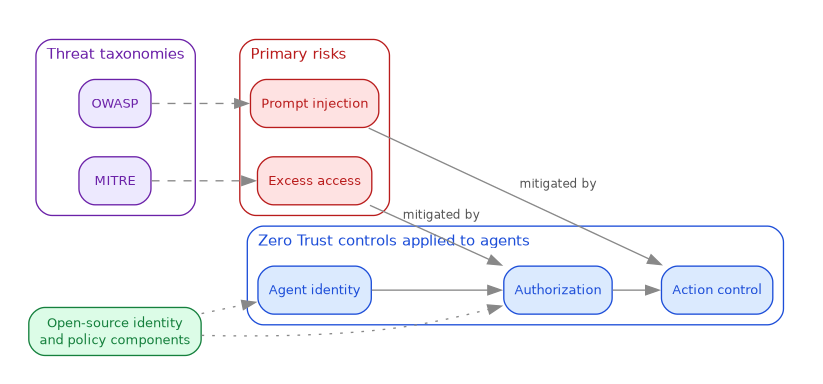
End users and developers deploy AI agents faster than security teams adopt controls for them. Agents have leaked sensitive data, executed destructive actions, and caused financial losses. Garbis applies the Zero Trust principles used for users and workloads to agents through three mechanisms: agent identity, authorization, and action control. The talk introduces an agentic AI maturity model and a reference architecture built on open-source identity and policy components. The reference architecture uses the Ory project components (Kratos, Hydra, Talos, Keto, Oathkeeper).
Zero Trust principles
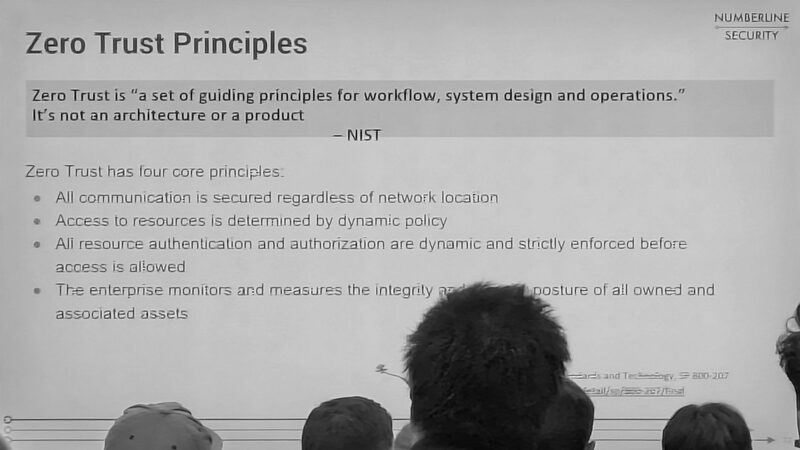
Figure 3: Slide: Zero Trust Principles (Numberline Security)
Garbis cites NIST SP 800-207, which defines Zero Trust as "a set of guiding principles for workflow, system design and operations." The slide states that Zero Trust is neither an architecture nor a product, and lists four core principles:
- All communication is secured regardless of network location.
- Access to resources is determined by dynamic policy.
- All resource authentication and authorization are dynamic and strictly enforced before access is allowed.
- The enterprise monitors and measures the integrity and security posture of all owned and associated assets.
The four principles correspond to tenets 2, 4, 6, and 5 of the seven tenets in NIST SP 800-207 section 2.1.
Need for a taxonomy
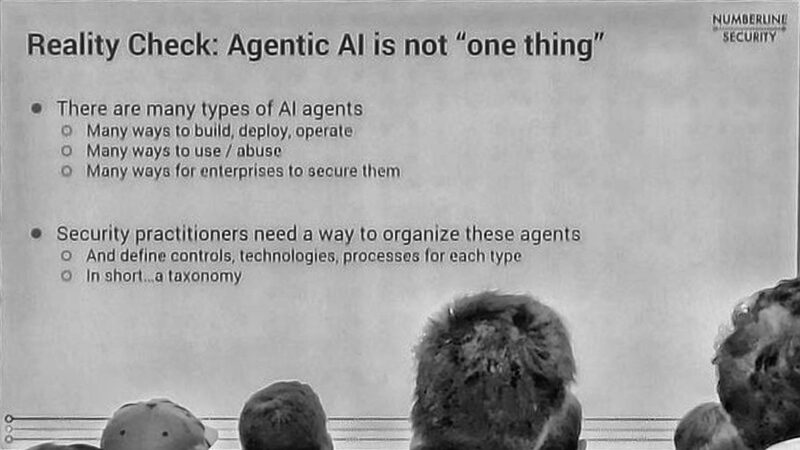
Figure 4: Slide: Reality Check: Agentic AI is not "one thing" (Numberline Security)
- AI agents differ in how they are built, deployed, and operated, in how they are used and abused, and in how an enterprise secures them.
- Security practitioners need a taxonomy that assigns controls, technologies, and processes to each agent type.
Framing
- An audience poll on security-team readiness for agentic AI returned scores at or below zero (responses included -3 and 0).
- Garbis described consumer and desktop agent products (Claude chat, Claude Cowork) as expanding the set of systems and data a single user session can reach.
- Agent workloads can move between cloud, desktop, and mobile runtimes.
- Garbis maps threats using OWASP and MITRE taxonomies.
- The two primary risk classes are prompt injection and excess access.
- The talk's goal is a method for defining enterprise controls per agent.
Governance questions per agent
Garbis poses the same set of questions for every agent deployment:
| Attribute | Question |
|---|---|
| Provenance | Did a vendor or the enterprise build the agent? |
| Data access | Which data sources can the agent read or write? |
| Identity | Which identity does the agent act as? |
| Authority | Which actions is the agent authorized to take? |
| Duration | Does the agent run once or as a long-running process? |
| Management | Which team owns and operates the agent? |
| Lifecycle | How is the agent provisioned, changed, and retired? |
Runtime and classification
Agents run on three locations: mobile, desktop, and cloud. Garbis classifies agent deployments into five forms:
- Chat interfaces.
- Harnesses (for example, Claude Code).
- Multi-agent swarms calling cloud model APIs.
- Sandboxed agents.
- Agents embedded in workspace tools (Slack, Microsoft Teams).
Taxonomy of usage
Each usage category determines whether the agent has its own account, what access it holds, and how its provenance is established.
| Category | Builder | Access pattern | Examples |
|---|---|---|---|
| SaaS / vendor solution | Vendor | Integrations with full access to data wired into the org | Datadog, Jira, AWS integrations |
| Local access | Vendor | Host filesystem, shell, input devices | Claude Code, computer use |
| Low-code / shared automation | End user | Spreadsheet and workflow-tool automations shared in teams | Shared sheet automations |
| Engineering-built | Enterprise | Local and enterprise data; build and deploy guardrails | Internal agents and services |
SaaS / vendor solution
The vendor agent inherits every integration the organization has connected. The agent's reach equals the union of those integrations' scopes.
Local access
Reference architecture: local access (code / terminal) agent
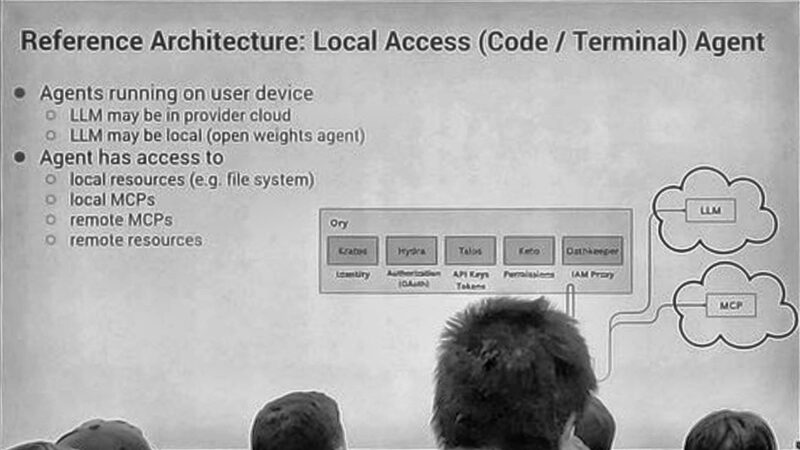
Figure 5: Slide: Reference Architecture: Local Access (Code / Terminal) Agent
- The agent runs on the user device.
- The LLM runs either in a provider cloud or locally (open-weights model).
- The agent can reach local resources (for example, the filesystem), local MCP servers, remote MCP servers, and remote resources.
- An Ory component layer sits between the agent and the LLM and MCP endpoints:
| Ory component | Function on slide |
|---|---|
| Kratos | Identity |
| Hydra | Authorization (OAuth) |
| Talos | API keys, tokens |
| Keto | Permissions |
| Oathkeeper | IAM proxy |
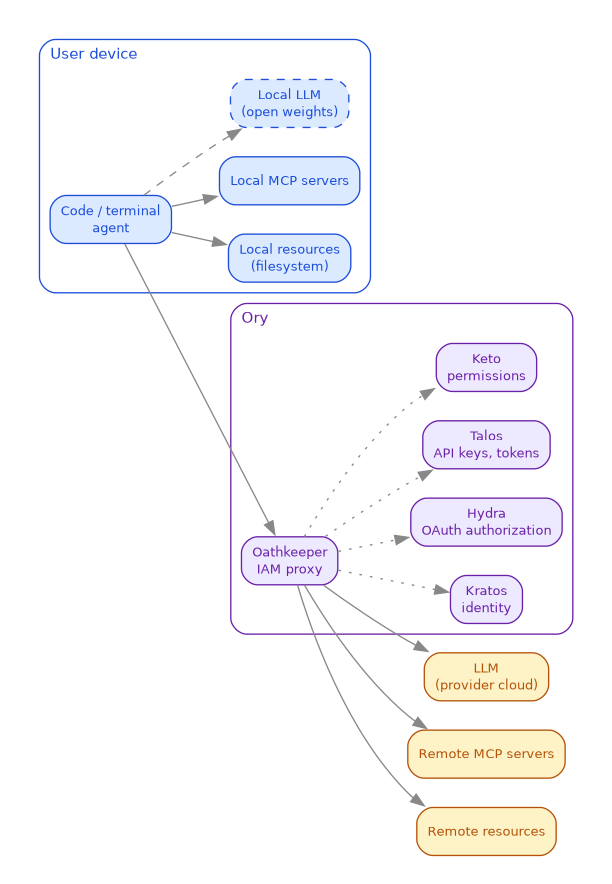
The slide shows the Ory block connected to the LLM and MCP endpoints. The routing of remote-resource traffic through Oathkeeper and the dotted Oathkeeper-to-component edges are inferred from Oathkeeper's role as an identity and access proxy; the slide does not draw them.
Controls on local-access agents
- Claude Code enforces a configured list of allowed tools and commands.
- Computer use drives the host mouse and keyboard directly. The original computer-use reference implementation ran inside an isolated Docker container; current desktop deployments do not require that container.
Low-code and shared automations
End users build these automations without an engineering review path.
Engineering-built and supported
- Built on standard and internal components.
- Reads local and enterprise data.
- Usually passes through existing build and deployment guardrails.
- The engineering team decides access on behalf of the organization.
- Garbis recommends defining roles early and mocking controls and identities before production deployment.
Taxonomy diagram
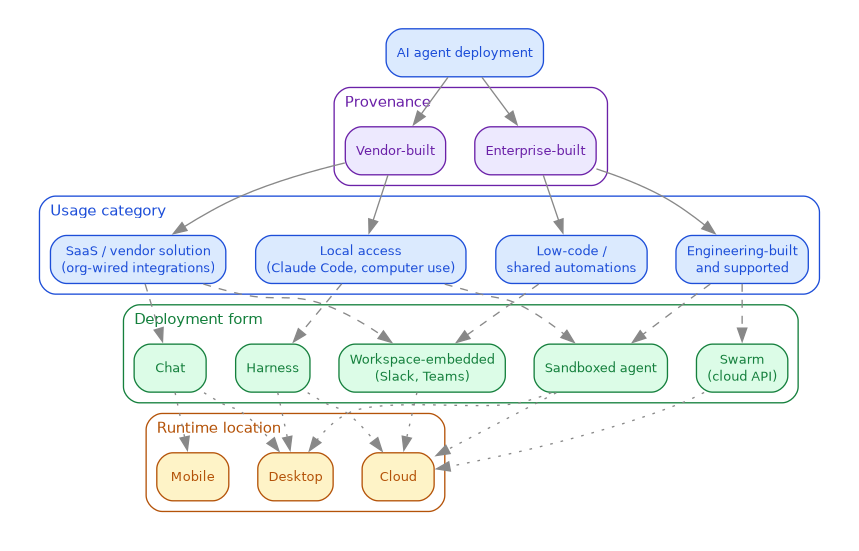
Solid edges show the classification stated in the talk. Dashed and dotted edges show typical mappings inferred from the examples given; the talk did not present a complete mapping.
Visibility and compliance
- Garbis stated that Claude Cowork activity does not appear in the Anthropic Compliance API. Security teams therefore need to track two things: agent events, and application changes that alter what telemetry exists at all.
- For Claude Code, the combination of dispatch, a sandbox, hard egress restrictions, and filesystem controls may not meet enterprise requirements on its own.
- A complementary control layer is an egress proxy that rewrites requests to inject credentials and emits telemetry for each call.
- An open question from the talk: how much line-of-business staff and security teams each know about the agents running in their environment.
Scenarios
Scenario 1: Harness hook with classification
An internal tool with local access runs inside a harness. A harness hook intercepts each agent action, logs it, and emits a record of the agent identity and the action. The record passes through a network channel to an authorization service, which resolves identity, attaches context, and classifies the action.

This scenario requires dedicated infrastructure. The classification step requires labeled data on expected actions and an evaluation set; without them, the classifier has no baseline.
Scenario 2: Harness with SDK
An SDK embedded in the agent runtime performs the identity and policy calls in place of an external hook. The talk did not specify the SDK interface.
Talk 1: Ransomware Defense and Recovery
- Speaker
- Joseph Davis, Chief Security Advisor, Microsoft (30+ years in cybersecurity and risk leadership)
Abstract
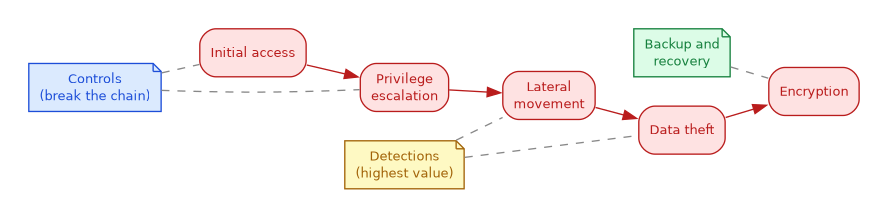
The talk covers how human-operated ransomware campaigns proceed from initial access to encryption. Davis walks through a real intrusion and converts it into a defender playbook with three parts: controls that stop each stage, detections with the highest value, and backup and recovery practices that let an organization recover without paying. Attendees receive a prioritized checklist.
Relevance
This talk does not overlap the current research areas listed below. The entry records the abstract and structure only.
Relation to current research
The agentic AI talk overlaps three existing threads:
- IAM policy design for agents, including delegated identity. See Trust Boundaries as a Typed Category for the boundary treatment this talk's identity and authorization split maps onto.
- Deployment gating and guardrails.
- Egress proxies that transform requests for credential injection and emit telemetry.
Follow-up work
- Build ACLs and roles for a mock customer service representative (CSR) workflow, including issued JWTs and the related access grants.
- Build a demo that separates human and agent roles and emits both as distinct OpenTelemetry spans.