Grounded AI Agents with Neo4j and AWS: AICamp Boston Workshop
Table of Contents
1. Event
| Field | Value |
|---|---|
| Event | AI Workshop with Neo4j and AWS, Boston |
| Series | AICamp Boston |
| Date | Thursday, 27 August 2026, 12:00–17:00 |
| Venue | AWS office BOS21, 55 Pier 4 Blvd, Boston MA |
| Format | Half-day hands-on workshop |
| Listing | meetup.com/aittg-boston/events/316112010 |
| Materials | neo4j-partners.github.io/neo4j-aws-graphrag-workshop |
The materials are public and still up, which makes this one of the few workshops worth revisiting after the fact rather than only attending.
2. Shape of the workshop
Six modules building one worked example, a hotel booking assistant, from a document corpus to a deployed agent:
| # | Module | What it adds |
|---|---|---|
| 1 | Build the graph | documents to a knowledge graph |
| 2 | Graph-enriched retrieval | GraphRAG rather than vector-only |
| 3 | Grounded booking agent | the agent over that retrieval |
| 4 | Production agent | hardening |
| 5 | AgentCore deployment | MCP and the AgentCore gateway/runtime |
| 6 | Neo4j graph memory | memory as a graph |
Framing sections either side: how Neo4j and AWS fit together, AWS GenAI services, the graph intelligence platform, foundations and setup at the start; summary, production path and wrap-up at the end.
The through-line is grounding: every module is an answer to "what stops this agent inventing a hotel." That is the same question the retrieval and attribution work here keeps arriving at from the other direction.
3. Three layers of agent memory
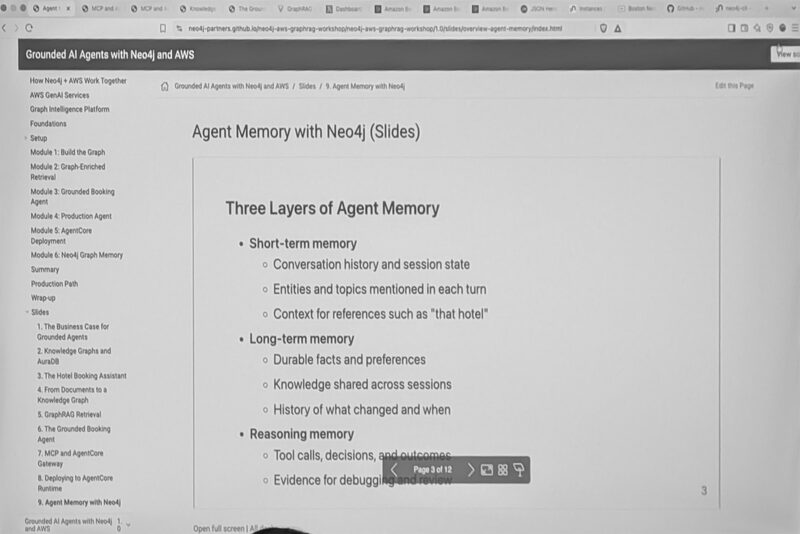
Figure 1: Slide: "Three Layers of Agent Memory", module 6, from the projected workshop materials
The model the workshop uses, transcribed:
- Short-term: conversation history and session state; entities and topics mentioned in each turn; context for references such as "that hotel".
- Long-term: durable facts and preferences; knowledge shared across sessions; history of what changed and when.
- Reasoning: tool calls, decisions and outcomes; evidence for debugging and review.
The first two are the conventional split and unremarkable. Reasoning memory as a layer of its own is the interesting claim: it says the record of what the agent did, and why, is a distinct store with its own lifetime, rather than a log to be discarded or a subset of long-term memory.
That bears directly on two open threads here. It is the same object the provenance work treats as an audit trail, arrived at as a memory tier rather than as a compliance artifact. And it cuts against the decay framing in forgetting and attribution: if the reasoning trace is memory, then what decays and what must not are different questions for each layer, and a uniform decay policy over "memory" is the wrong shape. See also agent memory and institutional knowledge.
Worth noting the workshop asserts the three layers rather than arguing for them, and offers no eviction or retention policy per layer. The claim is architectural, not empirical.
4. Follow-up
- Read the published modules 5 and 6 (AgentCore deployment, Neo4j graph memory) against the local egress-proxy and boundary notes: an agent whose memory is a managed graph service has a data boundary the jail work does not currently model.
- Decide whether "reasoning memory" is a third thing or long-term memory with a different index. The workshop does not settle it.